

In the 1990s, Mitsubishi Motors built sensible, durable cars as well as tuner favorites. While Mitsubishi wasn’t big enough to challenge the likes of Honda and Toyota in the US, the automaker could hold its own against smaller Japanese brands, such as Mazda and Subaru. Like Mitsubishi, Mazda strived to take on the bigger companies. The difference is that Mitsubishi failed. Hard.
The Early 2000s
Mitsubishi Motors
Mitsubishi went into decline in the 2000s, and 2004 was a key year in the automaker’s history. Mitsubishi was forced to admit it systematically covered up defects in its vehicles, acknowledging 30 major issues, including brake failures and fuel leaks, dating back to 1993. The admission was brand suicide in Japan.
The United States could have been a way out, but Mitsubishi Motors US plant, which was left over from its joint venture with Chrysler, was operating well below capacity. To compound its problems, Mitsubishi’s early 2000s “0–0–0” finance offer (0% down, 0% interest, and $0 monthly payments for 12 months) boosted sales. However, many customers defaulted on their loans, which caused even more financial trouble for the beleaguered brand.
In 2008, Mitsubishi’s dream was over as it closed dealerships in Japan, and US sales dried up. From there, the previously popular Galant and Lancer models aged out as traditional cars lost popularity to SUVs.
Related
Mazda vs. Subaru: Which Automaker Should Get Your Money
Mazda and Subaru are two reputable and well-liked Japanese car brands – but which one deserves your hard-earned money?
Mazda
Mazda entered into a partnership with Ford toward the end of the 1970s due to financial problems, peaking with Ford owning a 33.4% stake in Mazda in 1995. Under new CEO Alan Mulally, Ford began divesting stock in 2008. Meanwhile, Mazda had already set a new direction for the brand that made the company profitable by the start of the 2000s, setting it up for a big turnaround. Unlike Mitsubishi, Mazda was holding its own and had a solid brand identity as being driver-centric, helped in large part by the runaway success of the MX-5 Miata. But, Mazda still had a way to go, and, like Mitsubishi, needed to push forward into the 2010s.
The 2010s
Mitsubishi
In 1999, the Renault–Nissan Alliance was formed, and Nissan took a controlling interest in Mitsubishi in 2016. In 2017, the conglomerate became the Renault-Nissan-Mitsubishi Alliance and sold over 10 million vehicles worldwide. It seemed like exactly the shot in the arm Mitsubishi needed.
In 2014, Mitsubishi stalwart and product development specialist Tetsuro Aikawa took charge of the company. When he arrived, the all-electric i-MiEV had already launched in 2009, way ahead of its time. Sales were up in 2015 and heading towards the same levels as in 2005, pointing towards a recovery for the brand.
However, Aikawa resigned in 2016 following another Mitsubishi scandal – this time because Nissan had found differences between the claims made and the actual fuel consumption of kei cars Mitsubishi manufactured for Nissan in Japan. Mitsubishi had messed up.
As a result of the scandal, Nissan went all-in and acquired a 34% controlling ownership of Mitsubishi in 2016. It had already shut down major plants in the US, Australia, and Western Europe and lacked dealerships. Since 2016, there have been promises that Mitsubishi would invest in its dealership network, but the public has largely forgotten that it still makes some vehicles. Mostly, it seems, Mitsubishi has become a powertrain engineering and production company for Nissan and the alliance.
Related
The Mitsubishi Engine That Powered Cars You Wouldn’t Expect
And one American truck.
Mazda
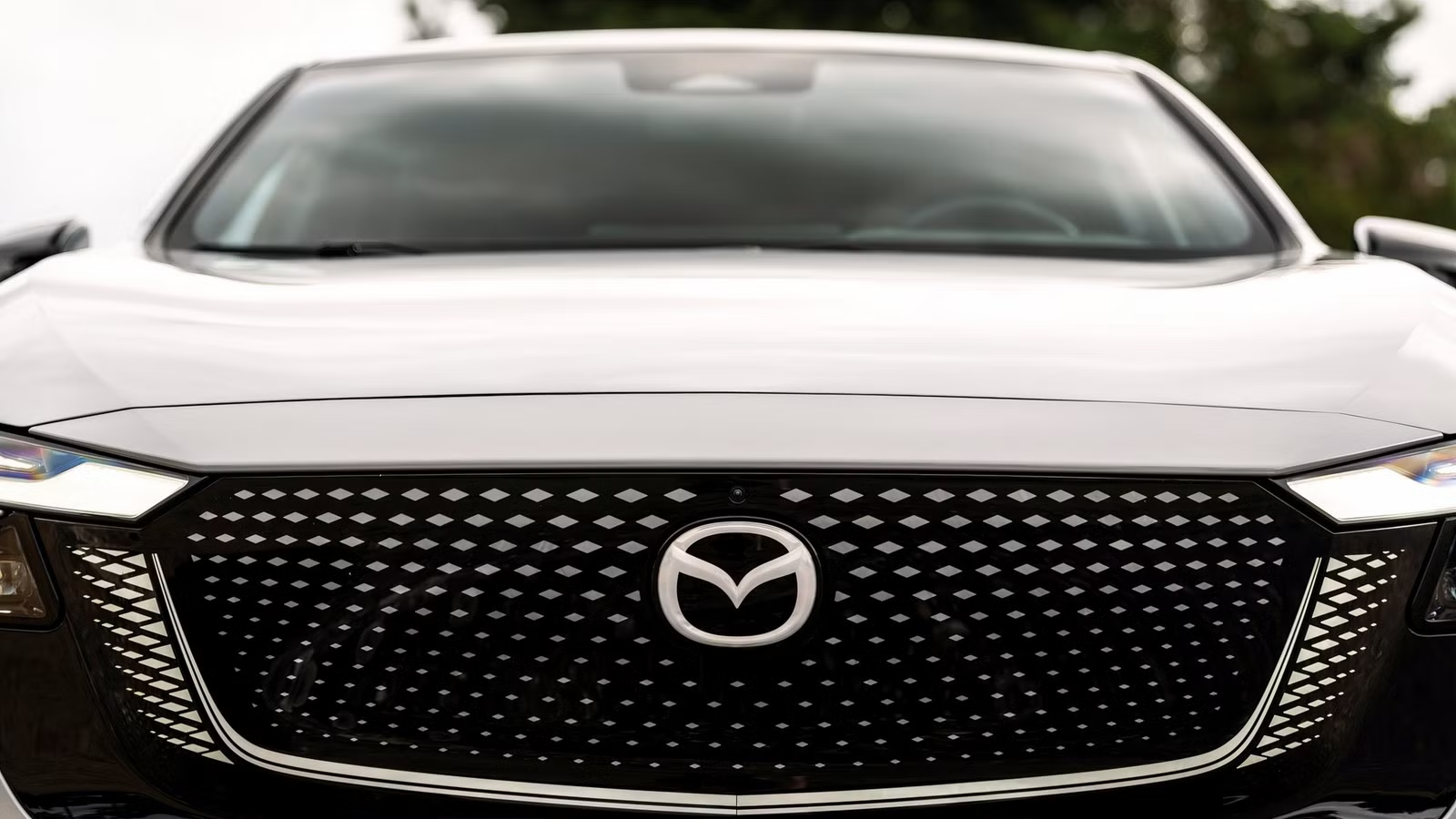
As the 2010s started for Mazda without Ford, it replenished its capital with a record-breaking $1.9 billion share sale in 2011. One of the first orders of business was to use the money to build a production plant in Mexico and announce its Skyactiv-branded technology for improved automatic and manual transmissions and engines. Mazda also showed its new Kodo design language with its latest model, the CX-5 for the 2012 model year, and dropped the last rotary-powered vehicle from its lineup: the RX-8.
It was a seismic shift for Mazda to go from being under Ford’s wing to an independent automaker with a new identity to shape. Dropping the rotary engine to focus on the power and efficiency of its gas engines was a sign that Mazda was getting serious, and the Kodo design language emphasized the brand’s newfound sophistication. The unifying design language took inspiration from the movement and grace of natural forms, ranging from the stance of an animal poised to strike or the fluidity of water flowing over rocks.
The CX-5 was a hit and became Mazda’s biggest-selling vehicle. The company’s powertrains balanced power with efficiency, and the Kodo design language separated the brand from its immediate competition of Subaru, Honda, and Toyota by looking stylish. At the same time, Mazda was making sure its cars were still fun to drive, whether it was the MX-5, Mazda3, or the CX-5.
Enter The 2020s
In 2026, Mitsubishi can barely be found on the automotive dealership map. The Outlander, Outlander Sport, and Eclipse Cross struggle to compete in their respective segments. The Eclipse Sportback EV is coming soon, and likely a rebadged Nissan Leaf. Mitsubishi still talks about how important the Lancer is, but won’t build one.
Mazda kicked off the 2020s with its range of consistently good-looking, fun-to-drive, efficient cars with interiors that punch above their price points. Mazda set new standards for affordable interiors. For a while, it also decided to hold back from the touchscreen craze and stick with a smaller screen set in the dashboard, controlled by a dial on the center console.
Mazda Leaves Mitsubishi In The Dust
With premium-level interiors in top trim, a gorgeous exterior design language, well-performing four-cylinder engines, and excellent, consistent driving dynamics, some of us wondered whether Mazda was looking to step upmarket. Perhaps looking at BMW and thinking it might compete there. Mazda had most of the ingredients, but its cars were all front-wheel-drive and powered by four-cylinder engines.
In November 2020, Mazda announced a series of inline-six engines that would enter the market in 48-volt mild-hybrid, plug-in-hybrid, petrol, and diesel variants. Furthermore, the engines would be used on its new longitudinal rear-wheel-drive platform. That meant Mazda would be launching rear-wheel-drive, straight-six engine-powered vehicles. That started with the CX-60, followed by the CX-70 and CX-90 SUVs.
Related
Mazda’s $40K Inline-Six Crossover Embarrasses Its Downsized BMW And Mercedes Rivals
While rivals downsize to four-cylinders, Mazda’s CX-70 fights back with an inline-six — and delivers more car for the money.
The US didn’t get the CX-60, but we do get the two-row CX-70 and three-row CX-90. While not a direct play to grab BMW customers, the automaker might be raising some eyebrows in Bavaria and giving Lexus some pause for thought. Meanwhile, Mazda took a big swipe, deliberate or not, in 2022, at Subaru with the CX-50. It’s Mazda’s best-handling vehicle that isn’t an MX-5, but it’s also effectively an off-road version of the CX-5, aimed at the same lifestyle demographic Subaru is so good at catering to.
Moving Toward 2030
If Mitsubishi has a plan to rebuild, it’s not telling. However, the Montero SUV is coming back, likely sharing a platform with the next-gen Nissan Xterra.
Mazda, however, is in a production partnership with Toyota, and its lineup ranges from the still-brilliant little MX-5 sports car to the three-row CX-90. The CX-5 is still its biggest seller, and this year it showed up with a new, more consumer-friendly Google-based infotainment system instead of the rotary-dial system.
Mazda could be said to be missing a mid-size sedan in the US since the Mazda6 left us when production ceased at the Flat Rock Assembly Plant in Michigan, cutting the final tie to Ford. It’s hard to say how Mazda will evolve, and whether it will push further into the near-premium market or continue to flesh itself out, bridging the gap between affordable and premium from every angle.
That’s where Mazda has excelled, while also pushing itself, safety-wise, to earn the highest safety awards. Meanwhile, as much as anyone who remembers Mitsubishi in its heyday might wish, it seems destined to maintain a limited presence and lineup for the foreseeable future. The bottom line is that Mitsubishi made some terrible mistakes and lost sight of itself at some point, while Mazda evolved its brand identity and focused on every element of its cars.
Source: Mazda, Mitsubishi
