

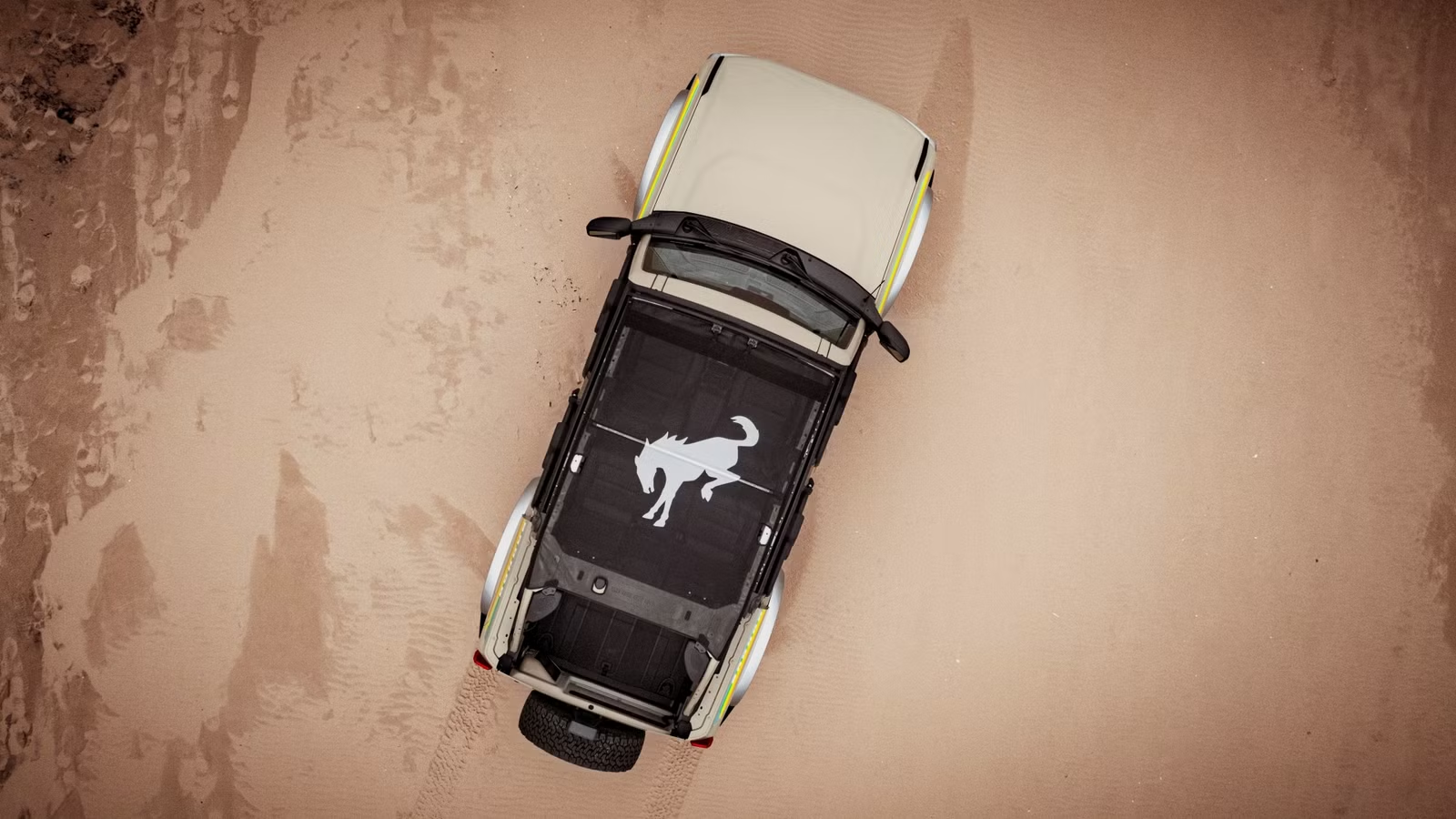
This is a topic we’ve been waiting to sink our teeth into, because possibly the most prevalent misconception echoing across Ford showroom floors today involves a simple, legendary badge. Buyers walk in, see two ruggedly styled vehicles bearing the identical bucking horse emblem, and incorrectly assume they are merely different sizes of the exact same machine. But they’re not. If you are currently weighing a Bronco vs Bronco Sport, you must understand that underneath their similarly squared-off sheet metal and aggressive grilles, these SUVs belong to entirely different automotive species. And that’s what we’re dissecting in the next few minutes.
The information in this on-paper comparison was correct at the time of writing. The base MSRP (manufacturer’s suggested retail price), where mentioned, excludes destination fees and other costs. Brands reserve the right to change pricing without notice.
Bronco vs. Bronco Sport: Architecture Matters
To understand the primary difference between the Ford Bronco and Bronco Sport, we must look at the architectures they’re built on. And for these two SUVs, their structural DNA dictates everything else: how they ride, how they handle corners, how much fuel they burn, and how they protect occupants during a highway collision.
The full-size Ford Bronco is built utilizing a traditional body-on-frame truck chassis. This means the steel body is bolted onto a separate, high-strength steel ladder frame – the exact same architecture that underpins the Ford Ranger midsize pickup truck. This structure provides the immense torsional strength required to withstand the punishing articulation of extreme off-roading, and it allows the SUV to feature removable doors and roof panels without the entire chassis buckling under stress.
The Ford Bronco Sport utilizes a unibody platform. Riding on the Ford C2 architecture, it shares its genetic makeup with the Ford Escape crossover and the Maverick compact truck. In a unibody design, the frame and body are welded into a single, unified structure. Sure, this structural setup prohibits the extreme suspension travel necessary for scaling vertical rock walls, but it creates a lighter, stiffer, and vastly more aerodynamic vehicle for public roads. So while the Bronco is an uncompromising truck parading as an SUV, the Bronco Sport is a car-based crossover.
Power, Towing & Fuel Efficiency Differences Between Bronco And Bronco Sport
All-in With The Ford Bronco
2026 Ford Bronco Badlands Wildtrak rear 3/4 angle in yellowFord Motor Company
2026 Ford Bronco Powertrains
Engine
2.3L Turbo
2.7L V6 Turbo
3.0L V6 Turbo
Horsepower | Torque
300 hp | 325 lb-ft
330 hp | 415 lb-ft
418 hp | 440 lb-ft
Transmission
7-speed Manual
10-speed Auto
10-speed Auto
10-speed Auto
Drivetrain
4×4
4×4
4×4
MPG (city/hwy/comb.)
20 / 21 / 20
19 / 21 / 20
15 / 16 / 15
Towing Capacity
3,500 lbs
3,500 lbs
4,500 lbs
When evaluating the Ford Bronco vs Ford Bronco Sport specs, the numbers reflect their distinct mechanical priorities: raw power and capability versus daily commuter efficiency.
The full-size Bronco relies on longitudinal engine layouts designed to generate immense low-end mechanical leverage. The base 2.3-liter four-cylinder produces excellent torque, but the twin-turbo 2.7L V6 is the real deal for turning heavy 35-inch tires through deep mud. The transmission choices cater to off-road purists, featuring an available seven-speed manual with a dedicated “crawler” gear ratio for predictable throttle modulation. However, pushing a heavy, aerodynamically blunt brick like the Bronco down the highway at 75 mph requires a staggering amount of fuel.
A Bronco Sport For Everyday
2026 Ford Bronco Sport Bronze Appearance Package rear 3/4 angle in whiteFord
2026 Ford Bronco Sport Powertrains
Engine
1.5L Turbo
2.0L Turbo
Horsepower | Torque
180 hp | 200 lb-ft
250 hp | 280 lb-ft
Transmission
8-speed Auto
8-speed Auto
Drivetrain
4×4
4×4
MPG (city/hwy/comb.)
25 / 30 / 27
21 / 27 / 23
Towing Capacity
2,200 lbs
2,700 lbs
The smaller Bronco Sport utilizes transverse-mounted engines that have been optimized for urban driving and high fuel efficiency. The entry-level 1.5L three-cylinder engine is more than adequate for typical commuting duties, returning an impressive 30 miles per gallon on the highway. For drivers wanting passing power, the 2.0L turbo four-cylinder unlocks 250 horsepower. Because of its lighter C2 platform footprint, towing is capped at 2,700 lbs, which is perfect for small jet skis but insufficient for heavier utility trailers.
“While other automakers are adapting crossovers to meet the demand for lifestyle vehicles that can get you to the campsite, hiking trail, lake, and so on, Ford has used its platform to create a crossover capable of going off-road for off-road sake, as well as meeting the lifestyle criteria.”
– Ian Wright, Senior Road Tester, CarBuzz
Off-Roading Capability Is Different Too: Bronco vs Bronco Sport
Off-road Comparison
Ford Bronco
Ford Bronco Sport
Ground Clearance
8.3–11.6 in
7.8–8.1 in
Approach Angle
35.7–47.2 degrees
30.4–31.2 degrees
Departure Angle
29.8–26.3 degrees
Up to 33.1 degrees
When it comes to Bronco Sport vs Bronco off-road capability, many often miss the central point. The full-size Bronco is engineered to withstand heavy impacts that would destroy a standard consumer vehicle. It utilizes a solid Dana 44 rear axle, a highly sophisticated independent front suspension equipped with electronic sway-bar disconnects, and factory-available mud-terrain tires on beadlock-capable wheels. It also features a genuine two-speed transfer case that provides heavy low-range gearing for rock crawling. The G.O.A.T (Goes Over Any Type of Terrain) modes adjust the software mapping to get the most out of the heavy-duty mechanical hardware, underlining why this SUV was specifically designed to conquer places like the Rubicon Trail and the Baja deserts.
“If you have access to all the forms of off-roading and like to take friends and family out for a spin, then the Bronco Raptor is the surefire winner.”
– Ian Wright, Senior Road Tester, CarBuzz
Disclaimer: The smaller Bronco Sport is not built for Moab, but it is an incredibly proficient soft-roader built to outperform standard compact crossovers. Rather than heavy low-range transfer cases, it relies on standard all-wheel drive across all trim levels. Stepping up to the Badlands trim, or the newly introduced Sasquatch package, unlocks an advanced twin-clutch rear-drive unit capable of intelligently vectoring torque to the rear wheel with the most traction. With up to 8.8 inches of ground clearance, standard steel bash plates, and Bilstein position-sensitive dampers, it can navigate forest roads, snowy conditions, and loose sand.
Related
Google Street View Just Got A Major Off-Road Upgrade, With Help From Ford
Now you can virtually drive the entire 5,900-mile TransAmerica Trail.
Interior Comfort & Usability In The Bronco And Bronco Sport
For many buyers, the final purchasing decision also hinges on cabin refinement, overall layout, and daily livability. When executing a Bronco Sport vs Bronco size comparison, the sheer physical footprint of the full-size Bronco immediately grabs attention. The massive four-door SUV provides expansive headroom, wide shoulder room, and immense rear cargo capacity totaling up to 83 cubic feet when the second row is folded flat. However, that interior volume is paired with significant acoustic compromises. Because the roof panels and doors can be removed, the cabin lacks conventional sound-deadening insulation, so you can imagine the prominent wind noise and loud tire roar at highway speeds.
The Bronco Sport delivers a more serene, highly conventional daily driving experience. The interior is properly insulated against road noise, tracks straight at 80 mph, and maneuvers more effortlessly in tight parking spaces. While total cargo volume peaks at a slightly smaller 65.2 cubic feet, Ford engineered the rear hatch with clever, utilitarian touches like built-in bottle openers, adjustable rear floodlights mounted in the liftgate, and washable rubberized flooring. The 2026 lineup standardizes a massive 13.2-inch SYNC 4 infotainment screen across all trims.
Bronco vs Bronco Sport: Pricing Differences & Market Rivals
2026 Bronco Costs
2026 ford bronco raptor drift off-roadFord
When cross-shopping the Ford Bronco vs Bronco Sport, it quickly becomes obvious that they do not compete against one another, but rather wage war against entirely separate factions.
The Ford Bronco demands a significant financial commitment. While stripped-down base configurations start near the $40,000 mark, dealer lots are heavily populated with highly desirable trims – such as the Badlands or the retro-styled Heritage and Stroppe Edition packages – that push asking prices between $50,000 and $70,000. The apex, wide-body Raptor variant has no issue touching on $80,000. The Bronco goes up against some serious rivals in the form of the Jeep Wrangler and Toyota 4Runner. All three SUVs are putting up an aggressive fight for the wallets of dedicated, well-funded off-road enthusiasts.
2026 Ford Bronco Lineup:
- Bronco Base: $40,795
- Bronco Big Bend: $41,295
- Bronco Outer Banks: $48,190
- Bronco Badlands: $48,890
- Bronco Heritage Edition: $51,625
- Bronco Stroppe Edition: $69,995
- Bronco Raptor: $79,995
2026 Bronco Sport Costs
2026 Ford Bronco Sport front 3/4 angle in blue while driving on a dusty trailFord
The Bronco Sport remains highly accessible to the average consumer. The entry-level Big Bend trim starts at around $30,000, while fully loaded Badlands models or units equipped with the aggressive Sasquatch package peak closer to $42,000. This SUV operates within the cutthroat compact crossover segment, and actively aims to steal market share from the Subaru Crosstrek Wilderness, the Toyota RAV4 Woodland, and the Jeep Compass Trailhawk.
2026 Ford Bronco Sport Lineup:
- Bronco Sport Big Bend: $31,845
- Bronco Sport Heritage: $32,284
- Bronco Sport Outer Banks: $34,145
- Bronco Sport Badlands: $37,265
Who Wants The Bronco, And Who Wants The Bronco Sport
Close-up of the 2027 Ford Bronco Filson wheelFord
Deciding between these two exceptional vehicles comes down to one simple cliché: your needs. The Bronco is a spectacular, uncompromised lifestyle vehicle. If your weekends consist of scaling fields of boulders, driving through deep river crossings, or cruising the coastline with the roof and doors completely removed, then you’re pretty sorted going down this route. However, if you want the Bronco-look coupled with good fuel efficiency on a long commute, the smaller Bronco Sport is the right choice.
Source: Ford
