

UPDATE: 2026/06/17 04:00 EST BY BELINDA ANDERSON
The Trickle-Down Reality: Will The V8 Make It To Mainstream Cars?
We take a look at whether this new engine will make it’s way to more mainstream cars and which other automakers are reviving the V8 in this way.
It may not be what everyone wants, but the automotive industry is embracing downsizing and full battery-electric architectures to meet stringent global emission requirements. Yet, out of Aichi, Japan, comes a mechanical battle cry that defies the current regulatory stranglehold.
The forthcoming Toyota V8 in the all-new GR GT is not a nostalgic tribute to the past, but a meticulously engineered weapon designed to dominate the future of performance. While competitors quiet their tailpipes (even Toyota is “guilty” of doing it), the Japanese brand opted to invest heavily in a high-displacement, forced-induction masterpiece. This engine represents a calculated gamble aimed at proving that internal combustion still possesses untapped potential on the global stage.
The technical specifications and performance metrics mentioned in this article remain subject to official confirmation by Toyota ahead of the GR GT’s official launch.
Combustion Defiance For Toyota
Toyota GR GTToyota
Toyota’s refusal to abandon the internal combustion engine (ICE) is well-documented, but the development of the new Toyota V8 engine elevates this philosophy from theoretical stubbornness to tangible hardware. In the past, Toyota has always had a conservative ethos in how it approaches engine design – vehemently prioritizing reliability over absolute peak horsepower. However, this fresh eight-cylinder breaks that mold and operates as a statement of intent against the premature death of gasoline powertrains. By investing millions in a clean-sheet architecture, Toyota is calling the bluff of global emissions mandates, betting that advanced engineering can keep combustion viable and legally compliant across North America, Europe, and globally.
The focus here is on achieving thermal efficiency while delivering the visceral and auditory engagement that electric vehicles (EVs) lack. This defiant stance ensures that driving purists will still have something to exploit, and it is supported by a brand that understands the intrinsic value of explosive horsepower in a sanitized era. But as this new engine move proves, Toyota envisions a future of diverse propulsion methods rather than forced battery adoption.
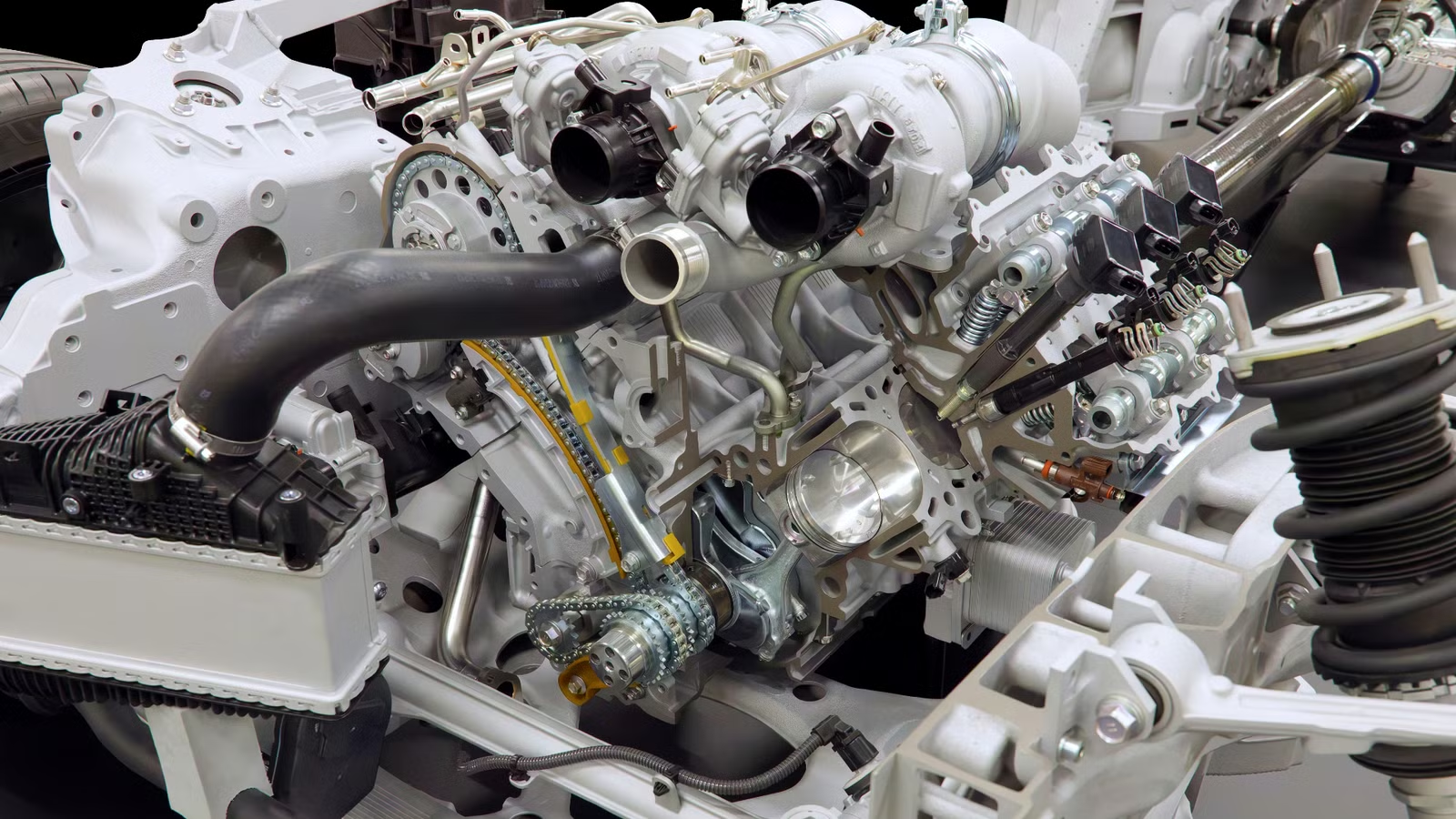
“The GR GT’s 4.0L V8 twin-turbo engine, which is Toyota’s first to be fitted in a production vehicle, was developed on a thoroughly compact and light design concept to help achieve the GR GT’s packaging of low overall height and a low center of gravity.”
Toyota 4.0L V8 Package
Front-mid Engine Power Outputs
Fast Facts: New Toyota V8
Engine
4.0L Twin-turbocharged V8
Hybrid System
Transaxle-integrated Single Motor
Total System Power
~641 hp
Total System Torque
~627 lb-ft
Transmission
8-speed Automatic
Drivetrain
Rear-wheel Drive (RWD)
0–60 mph
~2.9 seconds (Estimated)
Top Speed
~199 mph
To understand the packaging of this new unit, we must look at how it sits within the chassis. Pushed deep against the firewall, the front-mid-engine layout drastically alters the vehicle’s yaw moment of inertia. This placement is a departure from the nose-heavy characteristics that plagued older Toyota V8 engines. And in theory, this should transform the car’s dynamic response from ponderous to razor-sharp. By centralizing the mass, Toyota unlocked a platform capable of instantaneous directional changes, which is absolutely important for high-speed stability and track dominance.
The power outputs of this 4.0-liter twin-turbocharged V8 mill are nothing short of violent. Industry estimates place the baseline figure north of 640 horsepower, with torque figures pegged at 627 lb-ft of torque (Toyota will confirm the figures closer to the launch date). These outputs demand strong internal components, including forged rods, reinforced main caps, and highly efficient water jackets. The engine is a precision instrument that’s been engineered to obliterate lap times, while translating that immense mechanical force into forward momentum without overwhelming the rear tires unnecessarily.
The Numbers: 45:55 & 3860 lbs
2027 Toyota GR GTToyota
The chassis dynamics rely on the complex interaction between the overall weight and how said weight is distributed. Achieving a 45:55 front-to-rear weight bias in a front-engine vehicle is a clinic in modern packaging. It ensures that, under heavy acceleration, weight transfers to the rear axle in an efficient manner, maximizing traction when those 640 horses are unleashed onto the tarmac. This rearward bias also mitigates understeer and allows the car’s nose to tuck into apexes with precision.
Tipping the scales at an estimated 3,860 lbs, the Toyota GR GT is remarkably svelte for its footprint. When you look back at the heavy iron-block Toyota 4.7 V8 that powered the bulky SUVs of the early 2000s, the evolution in materials science becomes obvious. The extensive use of forged aluminum, carbon-fiber reinforced polymers, and high-tensile steel keeps the curb weight in check without sacrificing crucial torsional rigidity. This proves that outright power is meaningless without the right obsession with mass reduction and dynamic balance.
Toyota’s Most-Powerful Engine Dethroned
2025 Lexus LC 500 Convertible 5.0L NA 2UR-GSE V8 EngineLexus
The automaker’s new engine is set to be its most powerful V8 to date — this is what it’s leaving behind. Toyota/Lexus aren’t new to making high-powered cars, like the Lexus LFA with its V10 that makes 552 hp, but its most powerful V8 (before the new 4.0-liter engine debuts) is the 2UR-GSE. It’s a 5.0-liter naturally aspirated V8 that can be found in the Lexus RC F, LC 500, IS 500 F Sport, GS F, and the original IS F.
The engine went out of production after 2025, where outputs ranged from 471 to 472 horsepower and 395 to 398 lb-ft of torque depending on which model the engine was equipped in. In the early days, its application in the first IS F sedan (sold for the 2008 through 2014 model years) saw 416 hp and 372 lb-ft of torque.
Not only was this V8 successfully integrated with production vehicles that are bound to become future collectibles and classics, but it proved itself in some of the most grueling environments in racing. Toyota entered the Dakar rally by fitting the 2UR-GSE into its Hilux race trucks, where it won in 2019, 2022, and 2023. The engine is as durable as it is powerful, and we hope to see the new 4.0L twin-turbo V8 reach a similar status.
The Hot-Vee Motor Architecture
Toyota GR GTToyota
The mechanical trait of this new powerplant is its hot-vee configuration. By placing the twin turbochargers inside the valley of the cylinder banks, Toyota altered the engine’s thermal and volumetric efficiency. This compact design minimizes the physical distance exhaust gases must travel to spool the turbines, which results in near-instantaneous boost response and a massive reduction in turbo lag. It is a far cry from the lazy, naturally aspirated methodology seen in the revered Toyota 5.7 V8, which relied on sheer displacement to generate its torque curve.
The hot-vee setup also makes the engine block remarkably compact, allowing it to sit lower for a superior center of gravity. However, confining the hottest components within the core requires aerospace-grade heat shielding and advanced, high-flow liquid cooling circuits. That’s why Toyota’s engineers inserted a thermal extraction system that ensures that ambient under-hood temperatures do not degrade the dense intake charge required for the peak horsepower output.
Five main benefits of a hot-vee engine architecture:
- Instant throttle response
- More compact engine size
- Lower center of gravity
- Better exhaust energy efficiency
- More room for suspension components
Related
Flat-Plane V8 vs. Cross-Plane V8: Not All V8s Are Created Equal
There are two paths to building a V8 engine. We unearth the thinking behind the flat-plane and cross-plane V8.
Toyota’s V8 Electrification Strategies
Toyota GR GTToyota
While this motor is a sure-fire celebration of combustion, it does not exist in a technological vacuum. The current automotive landscape demands hybrid integration, and this platform is engineered to accommodate immediate electrical assistance. We are not looking at a heavy, efficiency-focused bolt-on system, but rather a sophisticated, performance-oriented mild-hybrid or plug-in hybrid electric vehicle (PHEV) configuration.
An integrated electric motor sandwiched between the engine block and the transmission fills the microscopic gaps in the torque curve before the turbos fully spool up. This marriage of technologies transforms the Toyota V8 engine into a multifaceted powertrain that’s capable of setting the track alight, while returning acceptable daily fuel efficiency in the city. Toyota designed the powertrain in such a way that the electrical architecture deploys energy rapidly, while the aggressive regenerative braking capabilities keep the battery topped off during hard driving.
GT3 Racing Base
Toyota GR GTToyota
Motorsport is the ultimate crucible for high-performance automotive engineering, and this specific powertrain is intrinsically linked to the track. The development of the new Toyota V8 engine was heavily dictated by the stringent homologation rules of global GT3 racing. And to successfully compete at the absolute highest echelons of endurance racing against European stalwarts, Toyota needed a base engine that was over-engineered straight from the factory floor.
GT3 regulations strictly demand that the race car’s engine shares its basic architecture with a legal road-going counterpart. Therefore, the block design, tight cylinder spacing, and massive structural integrity of this road engine are explicitly built to withstand the punishing environment of 24-hour endurance events. The sophisticated dry-sump lubrication system, essential for preventing engine-destroying oil starvation during high-G cornering, must transition to the street car. The valuable telemetry gathered from grueling test sessions on circuits like Fuji has directly shaped the production unit, creating a true race engine for the streets.
Final Act Or A New Dawn: The Toyota V8 Of The Future
Toyota GR GT And GR GT3Toyota
With the arrival of Toyota’s new V8 engine, there are certainly going to be questions about its purpose and whether this twin-turbocharged leviathan represents the glorious swan song of Toyota’s combustion development. Or, are we lucky to witness the beginning of a highly specialized new era?
Given the immense financial capital and engineering hours required to develop a clean-sheet engine from scratch today, it is highly improbable that Toyota intends for a limited/short production run. This advanced powerplant is designed to be modular, adaptable, and forward-facing, which implies that the ICE will remain a key indicator of performance within the brand’s global portfolio for at least another decade.
Trickle-Down Reality: Mainstream Application
For Toyota, it is likely that engines of this exceptional caliber will inevitably transition from mainstream availability to exclusive, halo-tier applications within its own ranks and that of Lexus. Whether we, as everyday aficionados, want to admit it or not, this move signifies a massive paradigm shift where the internal combustion engine is no longer the default commuter choice, but rather a luxury mechanical instrument.
But as the technology around this engine becomes cheaper and more readily available, we might just see this engine trickle down to other products, or perhaps even more affordable, all-new sports cars. The engine’s ‘modular’ architecture implies that there is some adaptability here – could we see it in future Tundra or Tacoma models? What about Lexus models?
Looking at the last Lexus models with V8 engines, there is room for this engine to be used in select applications – we’ll have to wait and see what the world wants, though. Downsizing for efficiency is all the rage at the moment, although some automakers have stepped back from full electrification to revive the V8, including:
- Ram
- Jeep
- Chevrolet
- Mercedes-Benz
- Porsche
- Ford
We’d love to see a few more names added to the list. Where would you like to see it used?
Source: Toyota
FAQ
Q: Does Toyota offer any V8?
Currently, Toyota only offers V8 powertrains in select premium Lexus models. The standard Toyota lineup has replaced eight-cylinder applications with advanced, highly capable turbocharged V6 and hybrid-electric engine configurations.
Q: What was the last Toyota V8?
The last naturally aspirated V8 offered in a mainstream Toyota vehicle was the legendary 5.7L engine, which powered the robust Tundra pickup truck and Land Cruiser SUV before its discontinuation.
Q: Is the 3UZ a V8 engine?
Yes, the 3UZ is a highly respected 4.3L V8 engine produced by Toyota.
