

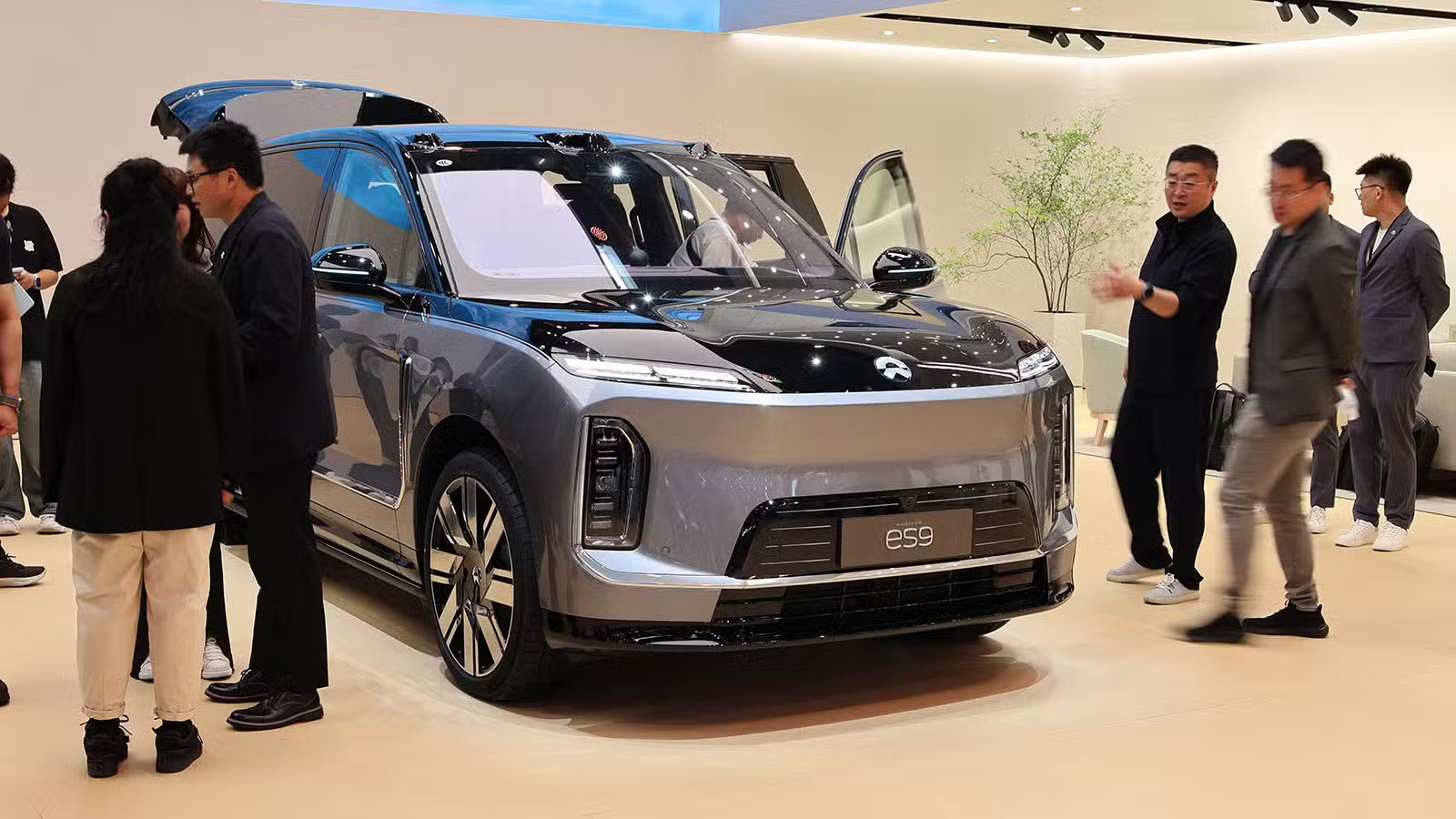
A Nio ES9 on display at the Beijing Auto Show in April 2026. Credit: CnEVPost
- Li Auto founder said extended-range and battery electric models serve different needs, urging respect for user preferences.
- The president of Nio’s sub-brand Onvo said battery electric vehicles have become the dominant force, while the share of extended-range EVs has slipped to 7%.
Two of China’s major electric vehicle (EV) makers have engaged in a public debate over whether extended-range vehicles are on the decline, underscoring an intensifying battle over technology paths.
The founder, chairman and CEO of Li Auto (NASDAQ: LI) spoke out via Weibo on June 17, saying that some people have recently argued that extended-range EVs are losing share and have begun to talk down the entire market.
He stressed that battery electric vehicles (BEVs) and extended-range electric vehicles (EREVs) serve different user needs, calling for an end to “putting one down to lift another up” and to the idea of an energy hierarchy.
He also noted that even today, more than 40% of buyers still opt for gasoline cars. In the flagship five-seat SUV segment, plenty of customers continue to choose combustion models such as the BMW X5 and Mercedes-Benz GLE.
The remarks quickly drew an indirect response from Shen Fei, the president of Nio Inc (NYSE: NIO) sub-brand Onvo. In a Weibo post on June 18, he said he would continue to focus on selling BEVs well in the second half of the year.
The Onvo president cited the latest data to point out that China’s new energy vehicle (NEV) penetration rate reached a record high of 62.9% in May. Within that, EREVs’ share of the NEV market fell further to 7%, while the share of BEVs rose to 67%.
He described BEV models as having become the dominant force, unstoppable in momentum. He also noted that in the large SUV segment, the sales champion has been a battery electric model for six consecutive months.
Shen launched a Weibo poll, asking his followers to vote on whether buyers of large five-seat SUVs should choose battery electric or extended-range.
Behind the debate lie the two companies’ starkly different technology bets. Nio is one of the very few automakers in the Chinese market that produces only battery electric models, while Li Auto is the pioneer of EREVs.
Data from the China Passenger Car Association (CPCA) provides support for BEV advocates.
China’s EREV retail sales were 85,000 units in May, down 28.0% year-on-year while up 11.2% from the previous month. BEV retail sales over the same period were 637,000 units, up 3.9% year-on-year.
China Passenger BEV Retail Sales 2024-2026
Month
2024
2025
2026
January
379,000
419,000
348,000
February
219,963
427,000
278,000
March
428,000
646,000
568,000
April
405,198
559,000
579,000
May
495,825
607,000
637,000
June
492,945
661,000
July
487,000
607,000
August
580,718
686,000
September
643,000
826,000
October
673,000
812,000
November
758,000
827,000
December
762,000
782,000
China passenger BEV retail sales
2024
2025
2026
China EREV Monthly Sales 2024-2026
Month
2024
2025
2026
January
85,000
75,000
76,000
February
53,000
60,000
52,000
March
74,000
77,000
76,000
April
65,000
86,000
79,000
May
77,000
116,000
85,000
June
107,000
116,000
July
115,000
102,000
August
106,000
100,000
September
118,000
109,000
October
117,000
109,000
November
121,000
116,000
December
122,000
145,000
China EREV monthly sales
2024
2025
2026
Overall, NEV retail sales in May were 950,000 units, down 7.5% year-on-year, marking the fifth straight month of annual decline.
The debate also echoes previous remarks by William Li, founder, chairman and CEO of Nio. Earlier this year, he declared that the golden era of three-row extended-range SUVs had passed, and that the golden era of battery electric models had arrived.
Nio has recently gained strong momentum with its battery electric large SUVs. Its ES8, starting at 406,800 yuan ($60,194), delivered 11,475 units in May, exceeding 10,000 for the seventh consecutive month.
The newly launched full-size SUV ES9 carries a higher starting price of 498,000 yuan. The wait time for deliveries of the high-end versions currently runs as long as 16 to 17 weeks.
By contrast, Li Auto is facing pressure on both sales and profitability. The company delivered a total of 33,350 vehicles in May, down 18.37% year-on-year.
Demand for the company’s extended-range models has come under marked pressure, with all four — the Li L6, Li L7, Li L8 and Li L9 — posting sustained sharp year-on-year declines over the past year.
To reverse the slide, Li Auto is overhauling its entire L-series extended-range lineup. The company rolled out the updated Li L9 on May 15 and will release the all-new Li L8 — switched from six seats to five — on June 23. An updated Li L6 will also go on sale in July.
Notably, Li Auto is also betting on battery electric models, having launched the Li Mega MPV (multi-purpose vehicle), the Li i6 and the Li i8, with the Li i6 serving as its sales mainstay this year.
A Nio executive publicly questioned an ES9 chassis test video posted on Li Auto’s official platform, signaling intensifying competition in China’s large SUV market.
($1 = 6.7582 yuan)
