

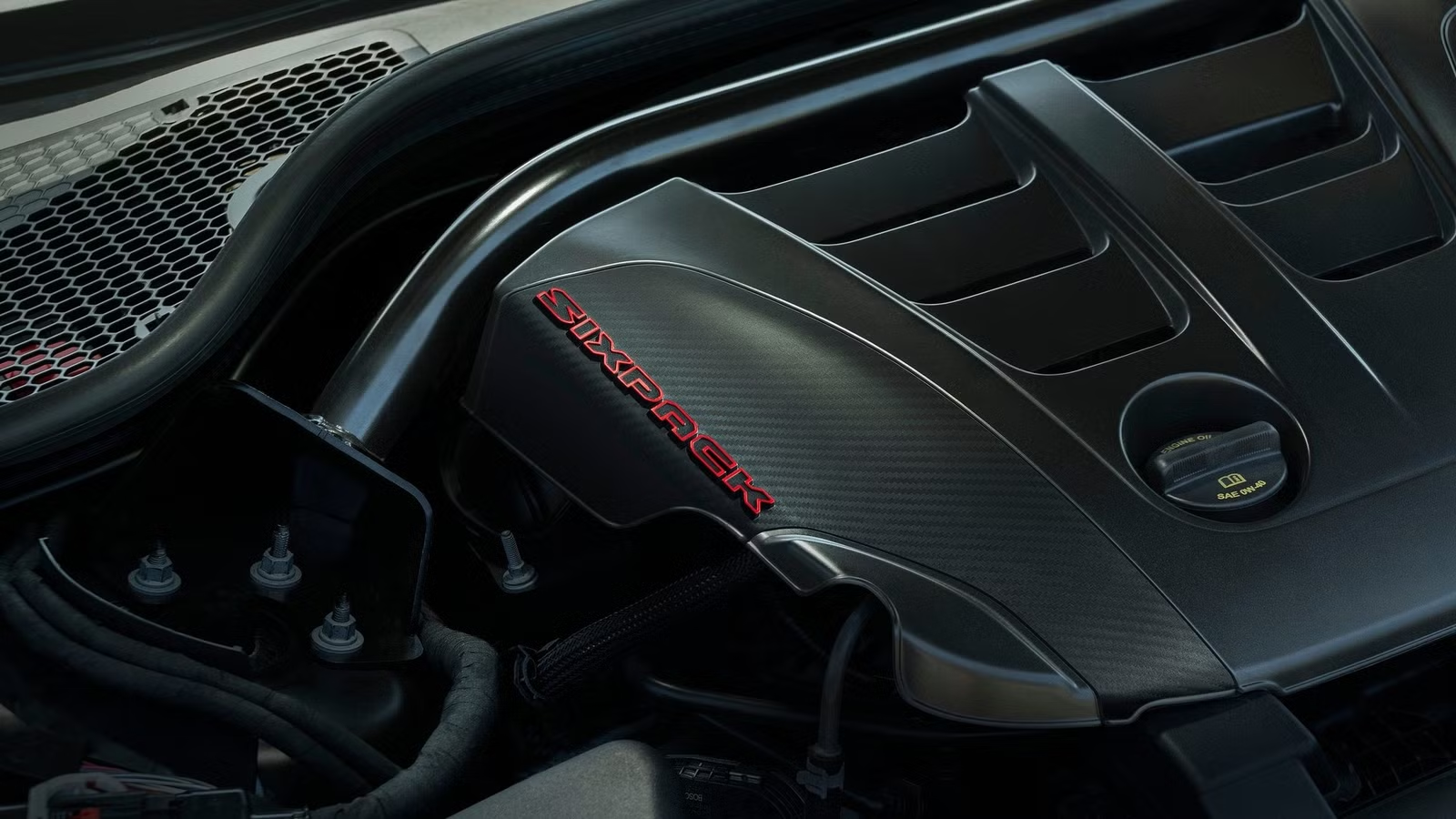
The V8 engine is ingrained in American culture. At one point in our not-so-distant past, eight-cylinder powertrains were available in essentially every full-size pickup truck, such as the Ram 1500, large SUVs like the Toyota Sequoia, and even some midsize SUVs, like the Nissan Pathfinder. So what happened to them? People can blame everything from emissions regulations, which are partly to blame, to buyers’ personal preferences, but there’s no single answer to the slow disappearance of V8s.
Another reason we consider a likely scenario is that turbocharging technology is to the point where smaller engines with forced induction are simply as powerful – if not more powerful– than the V8s they are replacing. The Stellantis Hurricane powertrain is a prime example of this phenomenon. Some buyers are still holding onto the V8 as if their lives depend on it, so Ram coddles those customers with the 1500’s optional Hemi V8. This story goes deeper than speed and performance, though. Sure, smaller turbocharged engines are more efficient, but buyers care about more aspects than numbers on a page.
There are some V8 characteristics that a turbo engine can’t replicate. Here’s why truck buyers and muscle-car traditionalists are content with switching to smaller powertrains, and where V8 engines still hold old-school appeal.
All specs are sourced directly from the manufacturer. Where 0–60 mph sprint times were not officially available, independent testing was used. CarBuzz performs 0-60 testing using a RaceBox data recorder on closed roads representative of regular driving conditions.
The V8 Reign and Its Challengers
2026 Ram 1500 Rebel detail shot of the 5.7-liter V8Ram
Truck culture is a topic on its own that could span multiple novel-length articles. V8 engines have dominated truck culture for so long that it feels wrong for modern trucks to stray away from these large powertrains. These engines are so important to truck owners because they are reliable, delivering superior power output and lower maintenance costs than many turbocharged systems.
Dodge is not new to V8s, having offered the layout in its trucks for decades, but anyone upset about moving to a turbocharged six-cylinder in its new models should know it’s no stranger to that, either. The 1946 Dodge Power Wagon was a 4×4 military truck that used a 201-cubic-inch, 79-horsepower inline-six engine. While the modern Hurricane inline-six is far more advanced with more power, better fuel economy, etc., enthusiasts should know that V8s haven’t been the only option in pickup truck history.
Related
The V8 Ram 1500 You’ve Been Waiting For Is Finally Here
Hear that rumble at your nearest Ram dealer? It can only mean one thing.
Two Best Modern Hemi Engines
Dodge Challenger SRT 392 6.4L Hemi V8 EngineWikipedia
Gen III Hemi Application And Overview
Engine
5.7L (345 Cubic-Inch) NA V8
6.4L (392 Cubic Inch) NA V8
Years Produced
2003–2024, 2026
2011–2025
Horsepower
335–395 hp
383–485 hp
Torque
375–410 lb-ft
400–475 lb-ft
Applications
Ram 1500, Charger, Challenger, Chrysler 300, Jeep Grand Cherokee, Dodge Durango, Aspen
Ram 2500/3500, Challenger/Charger, Jeep Wrangler, Jeep Grand Cherokee SRT, Dodge Durango
The Chrysler Corporation’s history of Hemi-branded engines can be split into three generations. The first-gen Hemis were available from 1951 through 1958; the second-gen engines were sold in vehicles from 1964 through 1971; and the third-gen Hemis were available in Chrysler, Dodge, Ram, and Jeep vehicles from 2003 through 2024. The two most prominent Hemi V8s from the third generation are in the table above.
While these are iconic engines that can’t be separated from truck culture any time soon, we can’t forget the other Hemi V8s from this era. The units include a 6.1-liter V8 used in the Magnum SRT8, Chrysler 300, Dodge Charger, and Jeep Grand Cherokee. There’s also a 6.2-liter supercharged V8 that powered models like the Ram TRX and SRT variants of the Challenger, Charger, and Durango.
This article’s title reporting that the Hurricane “beats” the Hemi refers to the 5.7-liter V8, since the eight-cylinder engine is currently still available in the 2026 Ram 1500.
Stellantis Hurricane Engine Specs Demystified
Hurricane six-cylinder engine in a studioStellantis
2026 Hurricane Engine Specs
Engine
3.0L Twin-Turbo I6 SO
3.0L Twin-Turbo I6 HO
2.0L Turbo I4
Horsepower
420 hp
540–550 hp
324 hp
Torque
468 lb-ft
521–531 lb-ft
332 lb-ft
Hemi V8s are loved by Dodge fans everywhere, but it’s aging technology. Smaller turbo engines can be just as powerful and capable today, which is exactly what Stellantis achieved with its latest Hurricane engine family. Stellantis first introduced the Hurricane inline-six in 2022 as a potential V8 replacement without attaching it to a specific model. Then, in 2023, Jeep installed it with the Wagoneer and Grand Wagoneer.
There are two versions of this engine today: the standard output makes 420 hp and 468 lb-ft of torque regardless of application. In contrast, the high-output version’s power varies by brand, with the Dodge Charger Scat Pack tuned to 550 hp and Ram vehicles to 540 hp. Jeep also recently introduced a smaller Hurricane with four cylinders that makes 324 hp and 332 lb-ft of torque.
Which Models Use Hurricane Engines
2026 Ram 1500 Warlock driving front 3/4 dust gravelStellantis North America
The current list of Stellantis vehicles in the United States that offer Hurricane engines includes the Jeep Grand Cherokee, Wagoneer, Grand Wagoneer, Ram 1500, and the Dodge Charger 6-Pack.
While the Grand Cherokee uses the 2.0-liter turbocharged inline-four, the other models mentioned can be equipped with either the standard or high-output variants of the 3.0-liter twin-turbo inline-six.
The Performance Numbers Don’t Lie
2026 Ram 1500 Rebel front 3/4 angle in blue while driving through mudStellantis
The Ram 1500 brought back its 5.7-liter Hemi V8 for the 2026 model year by popular demand after it was replaced with the 3.0-liter Hurricane inline-six in 2025, offering a perfect window to explore the pros and cons of both engines and see which option buyers should choose. CarBuzz tested both versions of the Hurricane (standard and high outputs), the 5.7L V8, and even the larger Ram 2500’s Cummins turbodiesel inline-six in 0–60 mph sprints to see which engine comes out on top. Here are the results:
- 2026 Ram 1500 Limited Crew Cab 4×4 (Hemi V8): 6.39 seconds
- 2025 Ram 2500 HD Laramie HD 4×4 (Cummins): 6.28 seconds
- 2025 Ram 1500 Big Horn Crew Cab 4×4 (Hurricane SO): 5.2 seconds
- 2025 Ram 1500 Tungsten Crew Cab 4×4 (Hurricane HO): 4.7 seconds
We know truck owners aren’t usually looking for 0-60 mph times, but this gives a good look at why buyers might prefer the Hurricane over an aging Hemi.
Who would have imagined the inline-six with more power and torque would embarrass the aging V8? (Sarcasm alert!) To add insult to injury, we also had a recorded 0-60 time for a 2025 Ram 2500HD with the 6.7-liter Cummins diesel inline-six. It also bested the Hemi with a 6.28-second run, thanks to its monstrous 1,075 lb-ft of torque. We don’t have any recorded times for the Pentastar, but it would almost certainly be slower than the V8.
– Jared Rosenholtz, CarBuzz
The Efficiency and Value Play
2026 Ram 1500 front 3/4 angle in black while towingRam
2026 Ram 1500 Engine Options’ Fuel Economy
Engine
Pentastar 3.6L V6
Hemi 5.7L V8
SO Hurricane 3.0L TT I6
HO Hurricane 3.0L TT I6
Fuel Economy (4WD)
(City/Highway/Combined)
19/24/21 mpg
16/20/18 mpg
17/24/19 mpg
15/21/17 mpg
Max. Towing
8,130 lbs
11,440 lbs
11,600 lbs
10,050 lbs
What matters more to buyers is how much a truck can tow. In the 2026 Ram 1500’s case, the standard-output Hurricane engine gets both better fuel economy and can tow more than the 5.7-liter Hemi. If fuel economy is all you’re after, though, consider dropping down to the Pentastar V6 that comes standard on lower trim levels – just be aware that it can’t tow more than 8,130 pounds. Efficiency, cost, and capability favor the standard-output Hurricane six-cylinder. Ram offers the 2026 1500 in a host of trim levels, and not all of them can be equipped with every engine. Here’s how much it costs to equip each trim with each engine:
2026 Ram 1500 Engine Pricing by Trim Level
Engine
Pentastar V6
Hurricane SO
Hemi V8
Hurricane HO
Tradesman
Standard
$1,695
$2,895
Not Available
Express
Standard
$1,695
$2,895
Not Available
Warlock
Standard
$1,695
$2,895
Not Available
Big Horn
Standard
$1,695
$2,895
Not Available
Laramie
Not Available
Standard
$2,895
Not Available
Rebel
Not Available
Standard
$2,895
Not Available
RHO
Not Available
Not Available
Not Available
Standard
Limited
Not Available
Not Available
No Cost
Standard
Longhorn
Not Available
Not Available
No Cost
Standard
Tungsten
Not Available
Not Available
Not Available
Standard
Hearts and Minds: Where the V8 Still Wins
2026 Ram 1500 with Hemi V8 front angle in redRam
We are well aware that many buyers simply do not care whether the Hurricane inline-six is more efficient, more powerful, or more capable of towing and hauling than the Hemi V8. What these buyers care more about is the feeling you get while driving a V8 truck. The sounds, the smells, the mental aspect of knowing that you’re driving a V8 truck outweigh any on-paper differences between the two engines.
This is all subjective, of course, but that’s why Ram decided to bring back the 5.7L for 2026’s 1500. Buyers who have been driving V8 trucks their whole lives are less likely to get with the times when doing so means sacrificing their satisfaction.
Related
Why Every Automaker Is Quietly Bringing Back The Inline-Six Engine
As the automotive industry evolves, one engine layout is making a surprising resurgence. But what benefits does this old-school design offer?
Want to Live in a V8 Past, or A Turbocharged Present?
2026 Ram 1500 Rebel rear angle in blue while parkedStellantis
At the end of the day, Ram offers a Hemi V8 and the Hurricane I6, so there’s no use in arguing. Go out there and put your money where your mouth is instead of fighting online about which engine is better. On paper, the standard-output Hurricane beats the 5.7-liter V8 when equipped with the 2026 Ram 1500 in terms of fuel economy, towing capacity, and 0–60 mph sprints. Still, there’s something about driving a V8 that a turbocharged inline-six can’t replicate. Would you stick to the tried-and-true Hemi of the past, or live in the present with modern turbocharging?
Sources: Stellantis, Ram, Jeep, Dodge
