

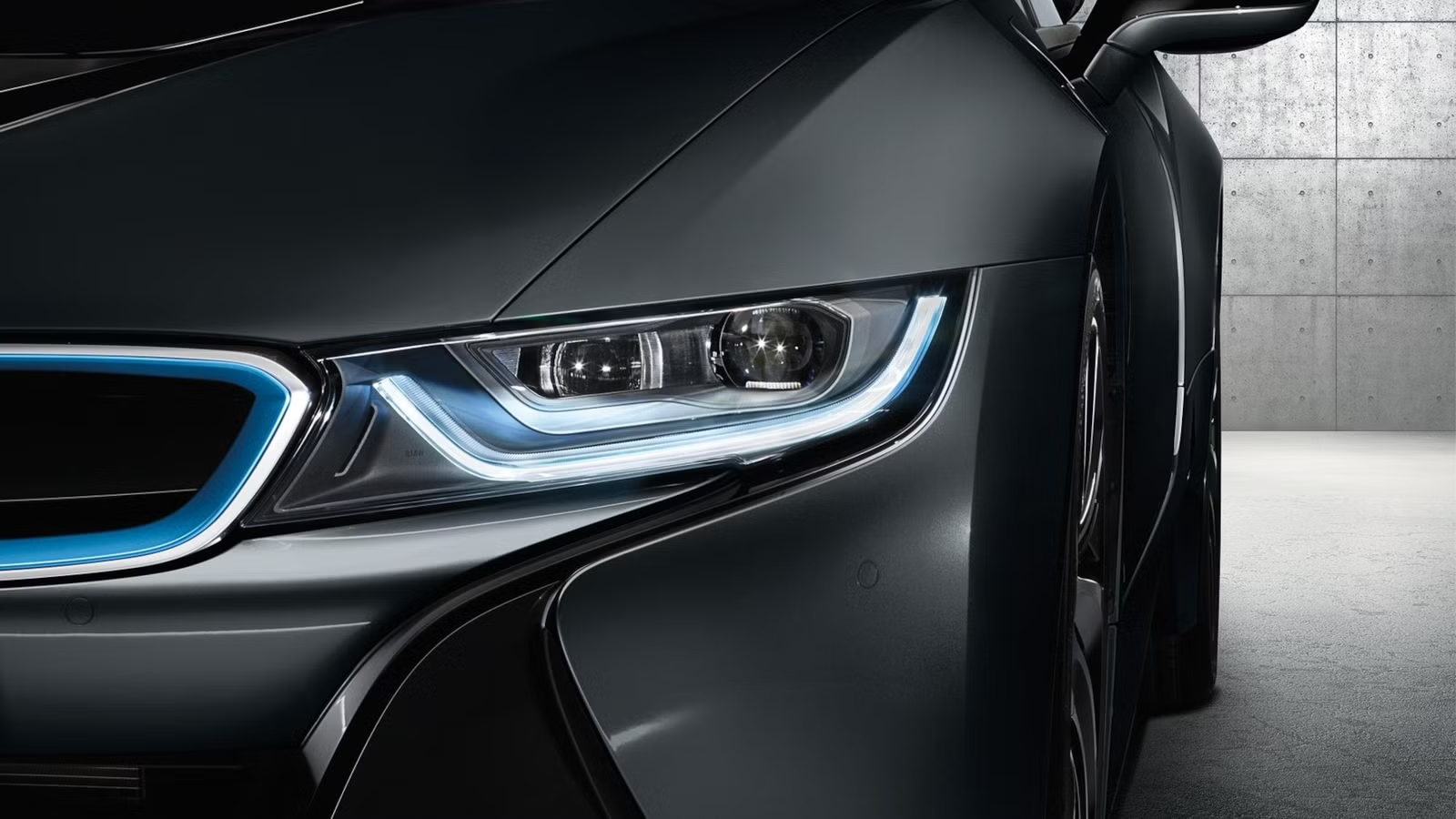
Hybrid supercars have become more common lately, but they’ve been around for more than 20 years. On a concept level, you can trace them at least as far back as the 2004 Toyota Alessandro Volta. The first production hybrid supercar was the Porsche 918 Spyder, going into production in 2013. BMW actually got into the game shortly thereafter with a car that’s been largely forgotten in the meantime, the BMW i8.
The consensus regarding this car was that, while it looked cool and delivered a satisfying driving experience as a BMW-made supercar, $135,700 was a bit steep for something that was less powerful than a $30,000 2013 Ford Mustang GT. Now that it’s selling for as little as a quarter of its original price, that may be less of a concern.
The BMW i8 Was Ahead Of Its Time (But Behind The Competition)
2014 BMW i8 interiorBring a Trailer
If you’re looking at the BMW i8 from a pure numbers perspective, then sure, it comes up a bit short for the price, at $135,700 before you factor in the delivery charge. We think this may be looking at it from the wrong point of view, though.
2014 BMW i8
Engine
1.5-Liter Turbocharged Plug-in Hybrid 3-Cylinder
Power
357 hp
Torque
420 lb-ft
Transmission
6-Speed Automatic
Drivetrain
All-Wheel Drive
0-60 mph
4.2 Seconds
Max Speed
155 mph (limited)
When we last reviewed the BMW i8, for the 2020 model year, we noted that, behind the wheel, it felt its price. Obviously a million dollar Porsche 918 Spyder is going to feel like a million dollars. For under $150,000, you’re getting a car that “acquits itself brilliantly in most scenarios,” with the AWD configuration offering excellent grip on narrow tires.
We ultimately reported that the i8 delivers a pleasing grand-tourer-like experience. It can carry its weight on the track, but it was built for everyday thrills, with a stable, absorbent, refined feel. It’s a BMW, so luxury is just as important as performance.
At worst, the car “isn’t the most predictable” when accelerating through a corner, as it can shift between understeer and oversteer at a moment’s notice. It takes some getting used to.
The BMW i8 Is One Of The Brand’s Bolder Designs In Recent Years
2019 BMW i8 RoadsterBMW
The BMW i8 echoes the Millennium-era futurism of movies like Minority Report, with sleek, smooth lines terminating into sharper corners. The design was handled by Vision EfficientDynamics and Benoit Jacob from a 2011 concept by Richard Kim. The final design is fairly close to Kim’s initial concept, with the butterfly doors the most prominent, and it looks more like a hovercraft than it does like a plug-in coupe. The roadster version, released in 2018 for the 2019 model year, is even cooler.
This forward-thinking design was a big part of the car’s appeal, with a carbon-fiber polymer body on an aluminum chassis, bringing the total weight down to 3,455 lbs, which is remarkably low for a hybrid.
Ultimately, the car was ahead of its time in terms of visual appeal. It would easily fit into a parking lot full of hybrid sports coupes in 2026.
The BMW i8 Looked Too Cool For Its Own Good
2019 BMW i8 RoadsterBMW
In its final model year, a 2020 BMW i8 Coupe started at $147,500, and it only sold 1,102 units in the 2019 sales year. The car’s dramatic, techie design may have ultimately worked against it, not because people hated how it looked, but because its appearance made a bigger promise than its three-cylinder hybrid engine could deliver.
If we can compare the 2014 BMW i8 to its mid-2010s rivals…
Power
0-60 mph
MSRP
2014 BMW i8
357 hp
4.2 Seconds
$135,700
2014 Porsche 911 Turbo
520 hp
3.2 Seconds
$148,300
2014 Lotus Evora S
345 hp
4.3 Seconds
$78,480
2014 Mustang GT Coupe
420 hp
4.3 Seconds
$31,210
We can say “numbers aren’t everything,” but, you look at the numbers, and the BMW i8 just didn’t make a lot of sense brand-new. For a quarter of the price, a Mustang GT would deliver comparable quarter-mile takeoffs. For a little over half the cost of an i8, a supercharged Lotus Evora S would do the same with a comparable sleek, forward-thinking body design.
Worst of all, $135,700 puts you spitting distance of a Porsche 911 Turbo, at which point you might as well buy the Porsche 911 Turbo.
Related
The 15 Best BMWs Of The Last 50 Years, According To CarBuzz
BMW has produced many Ultimate Driving Machines over the last half-century, and these are our favorites.
There’s a perception that the BMW i8 is one of the brand’s “most hated” cars. That’s not really the case. It’s fun to drive, and the striking design has its fans. But the math just doesn’t shake out. It was too expensive to compete directly with more mainstream performance models like the Mustang GT Coupe, and not quick enough to go toe to toe with other models in the low six-figure range. It’s just an awkward place to be, in terms of horsepower-per-dollar.
The BMW i8 Is A Lot More Attractive At $50,000
2014 BMW i8 front quarterBring a Trailer
After more than a decade on the road, our price tracking tool puts a 2014 BMW i8 at a little over a third of its initial MSRP, as of the time of this writing.
We actually have the more common 2015 model trending at an even lower price than that, in the $46,000 range. Checking out our marketplace, we were able to dig up the following listings.
- A 72,741-mile 2015 model is selling for $38,700 in Florida.
- A 99,944-mile 2017 model is selling for $38,999 in Georgia.
- A 79,222-mile 2017 model is selling for $45,998 in Colorado.
- A 62,075-mile 2015 model is selling for $45,777 in Texas.
- An 82,650-mile 2019 model is selling for $51,995 in Virginia.
Note that these listings are just to give you an idea of what’s out there. They may not be available by the time you read this, and they might not be in driving distance for you. But they should give you a rough estimate of what to expect when you’re ready to buy.
At these numbers, you’ll likely get the best deal by budgeting $45,000 and looking for the lowest mileage you can find under that price. At $50,000 you’re probably overpaying, but if you buy something with 100,000 miles or more on the odometer, you’re likely buying something in the final stages of its life.
The BMW i8 Is Affordable To Own… For A Supercar
2014 BMW i8 sideBring a Trailer
Checking in with RepairPal, the BMW i8 is estimated to cost around $979 a year to maintain. That’s pretty good for a supercar, but it’s a few hundred dollars more than you’d spend keeping a Mustang on the road. To go over the most expensive common repairs.
- Suspension shock or strut replacement $4,169–$4,439
- Knock sensor replacement $3,601–$5,254
- Exhaust manifold gasket replacement $1,188–$1,709
- Engine oil cooler replacement $968–$1,274
- Variable valve timing control solenoid replacement $787–$866
According to users in the r/BMWTech subreddit, the BMW i8 might be more trouble than its worth when it comes to maintenance.
One user states that they owned an i8, but “had to get rid of it in the end, due to things going wrong”. Namely, the high-voltage aircon compressor, used to cool the traction battery, which they state can cost more than $20,000 to have replaced. The user also experienced steering issues, and noted that the car really isn’t worth owning outside of warranty. Note: this was the opinion of one user. Replacement parts costs can vary. However there did seem to be a trend online, with another user simply saying: “It will break the bank.”
It should be noted that many i8 owners report having loved their time with the car, but that the maintenance costs had them selling it off as soon as the warranty was up.
The BMW i8 Was A Beautiful Failure
2014 BMW i8 rear quarterBring a Trailer
So it’s not as quick as its competitors, it was too expensive at launch, and now it’s too expensive to maintain. Still, it’s hard not to love this swing-for-the-fences supercar. It looks awesome, it handles beautifully, and there’s nothing quite like it on the road today.
Our advice: wait a few more years until you can buy it at a beater price. You don’t want to be on the hook for maintenance with this car, but it could be a lot of fun to drive as a throwaway for a year.
Sources: BMW, RepairPal, r/BMWTech.
