

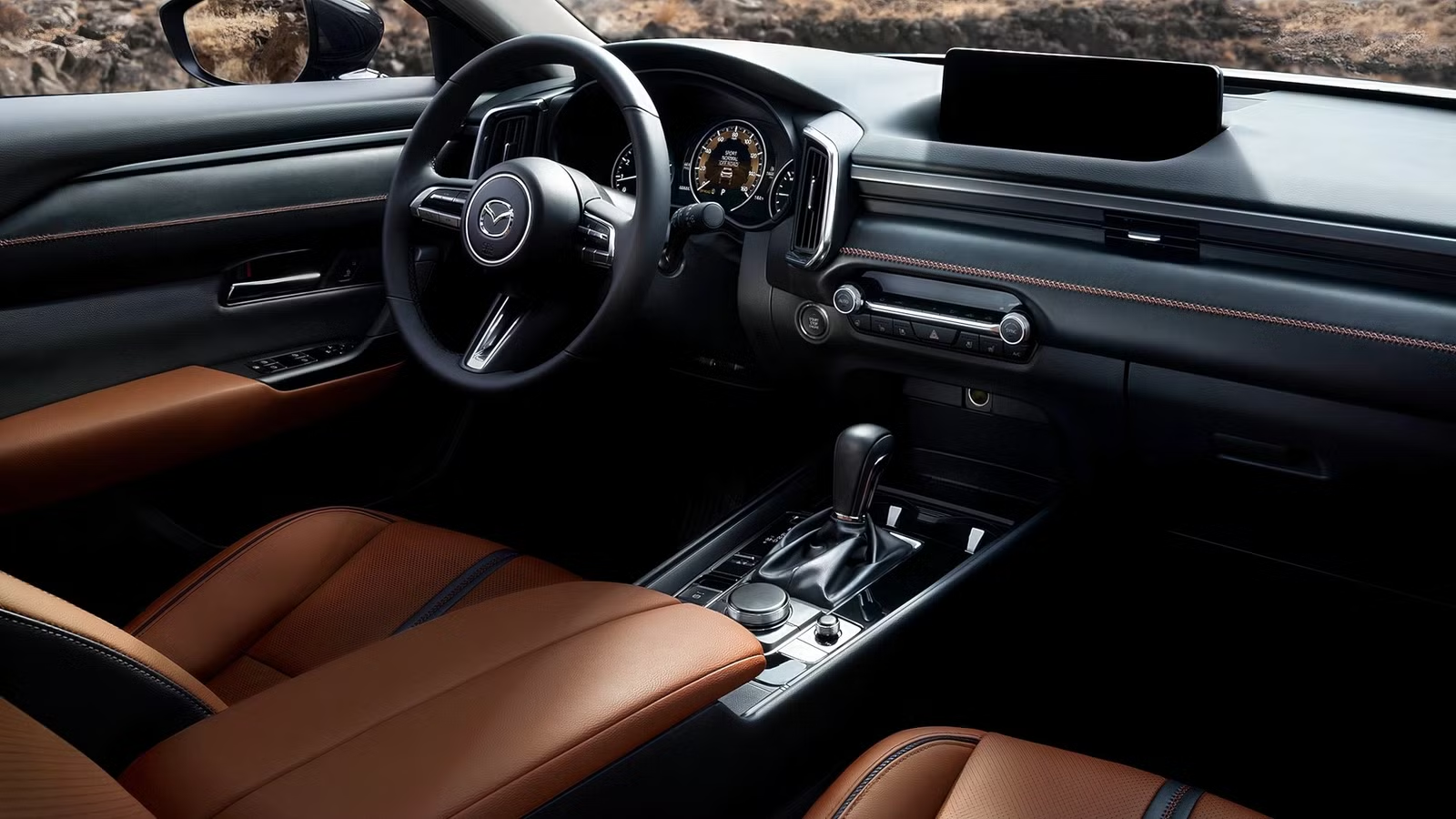
If you spend a lot of time scanning through car reviews, you know all too well about the generous usage of the word “premium.” Splashed on the page to denote paying a fine for added features or hideous dealer markups, as well as to describe the use of materials in the cabin. “The seats look and feel premium,” or my favorite, “The steering has a premium feel.” This jargon is overused on our turf, but manufacturers take pride in the details we tout as being better than others.
Mazda has taken that term and reinvented it to refer to a new market segment. Not quite luxury, but not so much mainstream anymore. The middle ground between expensive cars and everyday runarounds is slowly being redefined by a brand restricted by its majority stakeholder, to selling more cars than ever before that blend two qualities others are severely lacking: genuine luxury features and great handling.
Mazda’s Rise to New Levels
Mazda CX-90, outdoor shotCarBuzz/Valnet
Mazda has differentiated itself over the years in several ways. Engineering prowess and mastery of the Wankel rotary engine propelled the brand to the forefront of Japan’s post-war efforts. Impractical, maybe, but it proved worthwhile to develop new technology to be taken seriously on the world stage. Gone are the radical rotary sports cars and small-displacement V6 engines that made a handful of Mazda models such underrated marvels. Instead, what makes the brand one of our favorites can be found in every car it sells.
Mazda continues to invest in the MX-5 Miata, and it’s still performing well in showrooms. The little roadster quickly became the best-selling two-seater of all time, as recognized by the Guinness Book of World Records, after only a decade of sales. A little bit of the Miata’s spirit is injected into each model, with well-tuned steering, excellent tracking, and sprightly dynamics.
2024 Mazda CX-90 Interior view of the front cabinMazda
Each model – from the compact cars to the SUVs – feels more expensive than it really is. Its mainstream roots might seep through in the cabin noise or jolts over expansion joints at high speeds. However, the quality of the materials used and the tactile controls feel better than anything Jaguar Land Rover has produced in the last five years. But this wasn’t always the case, which leads us into a small social studies lesson to explain why.
History Proves the Jump was Fast and Necessary
2009 Mazda Tribute – front 3/4 angleMazda
Mazda officially entered the US market in the early 1970s, and in 1974 it forged a partnership with Ford. The Blue Oval had purchased a quarter of Mazda’s shares by the late 1970s, giving rise to a long-standing relationship that proved valuable to both. Mazda needed the cash to survive the recession that followed the second oil crisis of the 1970s, and Ford wanted to expand into Asian markets. In the mid-1990s, Ford upped the ante and purchased a third of Mazda, leading to even more co-development and parts sharing between the two entities.
In 2005, Mazda saw its best sales year in history for the US market, with 258,341 cars sold. At the time, Mazda was selling an array of vehicles that kept it in line with other mainstream brands. Underpinning some were jointly developed platforms, with other models requiring a quick scrape of the Mazda logo to reveal the Blue Oval underneath.
The Tribute was a rebadged Escape; the B-Series was a Ranger; and nearly everything that wasn’t Ford-shaped had Ford-built platforms or engines. The joint venture was good, but Mazda’s values of engineering refinement were losing out to Ford’s economies of scale in mass-producing parts for use across multiple vehicles.
By 2008, another financial crisis was underway. This time around, Ford needed to save itself, and the company got rid of its 33.4% stake in Mazda. The Blue Oval’s control fell to just 3% by 2010, allowing Mazda to regain full control over decision-making and market placement. To salvage itself from decades of association with Ford, it would make changes in short order.
Related
The Good And Bad Of Mazda And Ford’s 36-Year Marriage
Ford and Mazda inked an agreement to collaborate with vehicle development, lasting 36 years. But it wasn’t plain sailing, so what was the full story?
Mazda’s Quick Turnaround
2016 Mazda 6 finished in silver with tan interiorMazda
In the years since Ford sold its last shares in Mazda, the company’s engineers were finally allowed to venture beyond the Ford parts catalog. Mazda’s team transformed the brand into something we’d regard as akin to BMW in the late 1970s. Mazda is building the best-driving cars for the price, while packing sufficient luxury chops.
Clearing House & Cleaning Slates
Mazda Shinari ConceptMazda
Soon after Ford sold its first tranche of equity in Mazda, two of the Ford-appointed board members were sent home, and Mazda’s then-executive vice president, Takashi Yamanouchi, became CEO. In 2010, Mazda announced plans to introduce the SkyActiv engine in select models. The Ford-shaped and equally Ford-constrained vehicles (save for the discontinued B-Series pickup) would get their own unique looks, too, by way of its new Kodo design philosophy, which premiered at the Los Angeles Auto Show in 2010 with the Shinari concept.
New Metal for New Models
2014 Mazda 3 Sedan & Hatch Red Front Angled ViewMazda
All models would bear elements of the Shinari, drawing inspiration from its grille, headlights, short overhangs, and body lines to give the brand a unique shape it had been missing for a while. The 2013 CX-5 and CX-9 crossovers would be the first production models to wear Kodo-derived sheet metal, followed by the Mazda 3 and Mazda 6 for 2014. Inside, things would also be addressed, with each redesigned model getting a new, distinctly Mazda interior. Something that would later become known as of premium caliber. Darn, that word!
A Whole New World Inside
2014 Mazda 3 Black/White Interior Front CabinMazda
By the mid-2010s, Mazda was making headway on its own, introducing a new interior with swaths of leather and soft-touch points throughout. The climate and radio controls felt solid, especially compared to a Toyota or Honda competitor. The price didn’t reflect the level of luxury available. Later models then took the torch they were handed and ran with it, with more leather and sticking by physical buttons in the interior.
Post-Ford Sales Boom
US sales did hit 296,110 in 2007, but they wouldn’t fully crest the 300k mark until 2012, when Mazda sold 302,701 cars. In 2014 and 2015, it would reach new highs of 306,000 and 319,000, respectively, with average US sales hovering around 326,000 annually since then. In the past two years, Mazda sold 424,382 cars in 2024 and 410,344 cars in 2025, setting record highs for the brand. Not to say that, under the watch of Ford, Mazda wouldn’t have reached these goals, but Mazda’s free rein over what market it wanted to serve ultimately propelled it far ahead of where it had been before.
Related
Why Mazda Took 20 Years To Design A Brand-New Six-Cylinder Engine
Mazda was forced to drop one of its preferred engine technologies long ago, but technical advancements mean it has been able to bring it back.
What Mazda Got Right
2025 Mazda CX-52025 Mazda CX-5 Exterior
It was clear after Mazda revealed the production-ready redesigned 2019 3 sedan and hatchback that the company wanted to move further upmarket with its offerings. Thankfully, those two models still have a reasonable base sticker of $24,650 and $25,650. The smash-hit CX-30 compact crossover begins at $26,375, and Mazda’s most popular vehicle, the CX-5, slots in at $29,990. Pricing is key to Mazda’s superiority in the game of premium vehicles for a bargain price, something others do but at a much higher level and with a more expensive entry fee.
Mazda has earned dedicated fans both from those who loved it during the zoom-zoom tagline days to folks who came to the brand more recently for the offerings being a little more upmarket than the competition. Expect the company’s dedication to making things feel premium to continue drawing buyers for years to come.
