

For decades, the midsize sedan was the default answer for buyers seeking affordable fuel economy, comfortable highway manners, and enough space for a growing family. Vehicles like the Toyota Camry, Honda Accord, Hyundai Sonata, and Nissan Altima built loyal followings because they offered reliable transportation without excessive fuel costs. SUVs, meanwhile, were often viewed as larger, thirstier alternatives that traded efficiency for cargo room and ride height. That gap has now become dramatically smaller.
Advancements in hybrid technology, lightweight chassis engineering, turbocharged engines, and aerodynamic improvements have allowed a new generation of compact SUVs to achieve fuel economy figures once reserved for smaller passenger cars. In some cases, these SUVs now outperform conventional midsize sedans at the fuel pump while offering substantially greater practicality and versatility.
This shift explains why more consumers are continuing to abandon sedans in favor of crossovers. Buyers no longer want to compromise between efficiency and usability. They want both. The newest generation of hybrid SUVs finally delivers that combination by pairing low fuel consumption with strong performance, advanced technology, spacious cabins, and long-distance comfort that rival traditional family sedans.
Why Fuel-Efficient Family SUVs Are Starting To Replace Traditional Sedans
Front 3/4 shot of 2026 Nissan Altima in red parkedNissan
The family sedan once represented the perfect middle ground between comfort, efficiency, and affordability. However, modern buyers increasingly prioritize practicality over traditional sedan driving dynamics. The elevated seating position, improved visibility, flexible cargo space, and available all-wheel-drive systems found in compact SUVs have become far more appealing to modern families. Historically, fuel economy has remained the biggest reason to stick with a sedan. Most SUVs consumed considerably more fuel because of their larger dimensions, added weight, and less aerodynamic shapes. A midsize sedan capable of returning over 30 MPG combined used to rank comfortably above most compact crossovers. That advantage is disappearing quickly.
Modern hybrid SUVs now regularly produce fuel economy figures that rival or exceed many gasoline-only midsize sedans. Vehicles like the Toyota Camry AWD typically return around 29 MPG combined with their standard gasoline engines, while the turbocharged Honda Accord achieves roughly 32 MPG combined in conventional form. The Nissan Altima AWD also sits near the 30 MPG combined mark.
Front 3/4 action shot of 2026 Toyota Camry in blue being drivenToyota
Meanwhile, several compact hybrid SUVs now exceed those numbers while providing significantly more passenger and cargo space.
Another factor accelerating the decline of sedans is how refined modern crossovers have become. Older SUVs often suffered from excessive body roll, harsh ride quality, and vague steering responses. Today’s hybrid SUVs use more sophisticated suspension tuning, improved chassis rigidity, and strategically placed battery packs that lower the center of gravity. The result is a driving experience that feels far more composed and car-like than many consumers expect.
Families also appreciate the added practicality. Compact SUVs offer larger cargo openings, fold-flat rear seats, improved rear passenger accessibility, and greater versatility for road trips, sports equipment, grocery runs, and child seats. Once buyers experience those advantages without suffering a major fuel economy penalty, returning to a traditional sedan becomes difficult to justify.
Related
How Mid-Size Sedans Are Quietly Beating SUVs In Value And Comfort
Sedans, often overshadowed by their larger counterparts, are proving themselves as smarter, more economical choices for buyers who prioritize comfort.
How The 2026 Kia Sportage Hybrid Delivers Compact-Car Fuel Economy In SUV Form
2026 Kia Sportage Hybrid front quarterNicole Wakelin | Top Speed
The 2026 Kia Sportage Hybrid stands out because it successfully combines the practicality of a compact SUV with fuel economy figures that rival those of smaller passenger cars. At the center of the powertrain is a turbocharged 1.6-liter four-cylinder engine paired with an electric motor and a 1.49-kWh lithium-ion battery pack. Together, the hybrid system produces 227 horsepower and 271 pound-feet of torque. Those are strong performance figures for a compact family SUV, especially one focused heavily on efficiency. The most impressive numbers, however, come from the EPA estimates. Front-wheel-drive versions of the Sportage Hybrid achieve up to 42 MPG combined, including 44 MPG highway and 41 MPG city ratings. Even all-wheel-drive variants remain highly efficient, delivering approximately 35 MPG combined.
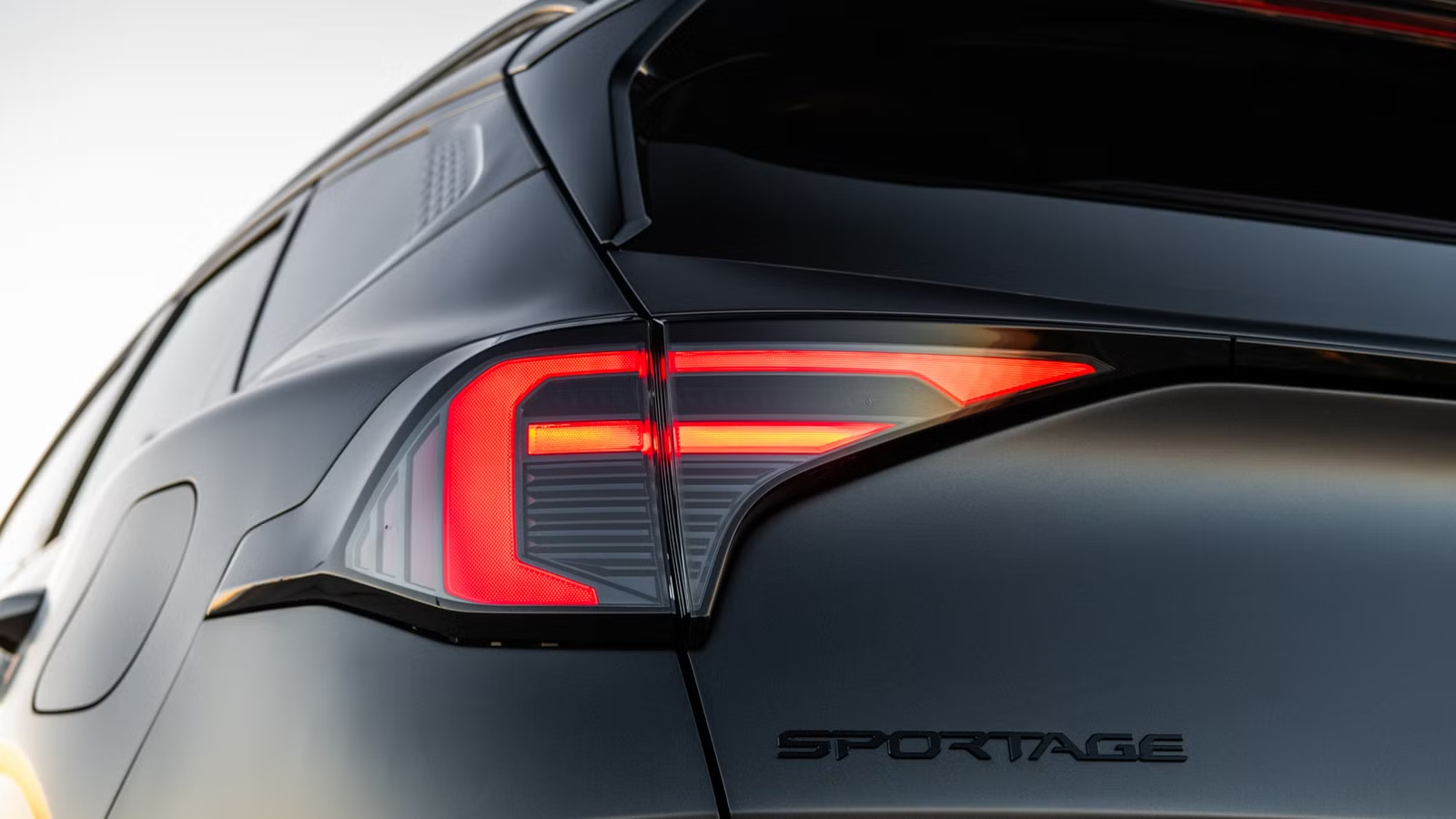
2026 Kia Sportage Hybrid rear quarterNicole Wakelin | Top Speed
These figures become even more impressive when compared directly to several popular midsize sedans:
2026 Kia Sportage Hybrid
42 MPG combined
Honda Accord 1.5T
32 MPG combined
Nissan Altima AWD
30 MPG combined
Hyundai Sonata 2.5
32 MPG combined
The Sportage Hybrid outperforms several mainstream midsize sedans in fuel efficiency despite offering decent passenger space, higher ground clearance, and substantially greater cargo versatility. Part of this success comes from Kia’s decision to pair the hybrid system with a traditional six-speed automatic transmission rather than a continuously variable transmission. Many drivers prefer the smoother and more natural driving feel of a conventional automatic because it avoids the high-revving drone commonly associated with CVTs.
The hybrid system also operates seamlessly in daily driving. The electric motor assists during low-speed acceleration and stop-and-go traffic, helping reduce fuel consumption in urban environments. At highway speeds, the gasoline engine operates efficiently while still benefiting from electric assistance during passing maneuvers and hill climbs. This allows the Sportage Hybrid to deliver excellent fuel economy without feeling underpowered or compromised.
Related
The Hybrid Car With The Best Fuel Economy In 2026
This full hybrid is the fuel-economy champion among cars that require no special charging routine from the driver to attain maximum efficiency.
Turbocharged Hybrid Power Gives Drivers Efficiency Without Sacrificing Performance
2026 Kia Sportage Hybrid engineNicole Wakelin | Top Speed
One of the most important reasons hybrid SUVs are becoming more mainstream is that modern systems no longer force buyers to sacrifice performance for efficiency. The 2026 Sportage Hybrid is a perfect example of that evolution. Instead of relying solely on a naturally aspirated economy-focused setup, Kia combines turbocharging with hybrid assistance to create a powertrain that feels genuinely responsive in real-world driving. The turbocharged 1.6-liter engine provides strong midrange acceleration, while the electric motor delivers instant torque from a standstill.
The result is a hybrid SUV that feels considerably quicker than many buyers expect. Its 271 pound-feet of torque figure is especially significant because torque is what drivers feel most during everyday acceleration. Around town, the Sportage Hybrid responds immediately when pulling away from traffic lights or merging into traffic. On the highway, the additional torque helps the SUV accelerate confidently during overtaking maneuvers.
2026 Kia Sportage Hybrid front quarterNicole Wakelin | Top Speed
This combination creates a driving experience that feels smoother and more refined than many traditional gasoline-only compact crossovers. Another advantage of the hybrid system is reduced noise and vibration. During light-throttle driving, the electric motor can assist enough to keep engine revs low, improving cabin quietness and long-distance comfort. Hybrid calibration has also improved dramatically in recent years, making transitions between gasoline and electric power nearly imperceptible. Range is another underrated benefit.
With a fuel tank capacity of approximately 13.7 gallons and fuel economy figures exceeding 40 MPG in certain trims, the Sportage Hybrid can travel close to 500 miles on a full tank under favorable conditions. That makes it exceptionally well-suited for commuting and long-distance travel. Importantly, Kia achieves this efficiency without requiring premium gasoline. Owners can use regular unleaded fuel, helping keep long-term operating costs low despite rising fuel prices. For many consumers, that balance of performance, refinement, and efficiency makes hybrid SUVs significantly more appealing than either traditional gasoline crossovers or fully electric alternatives.
Related
Why This Japanese Hybrid SUV Is A New Benchmark For Affordable Luxury
This well-rounded compact HEV SUV offers a world-class premium interior experience.
Spacious Practicality And Modern Tech Make Daily Driving Easier
2026 Kia Sportage interiorKia
Efficiency alone would not make the Kia Sportage Hybrid compelling if it failed to deliver the practicality families expect from an SUV. Fortunately, this is one of the vehicle’s strongest areas. The cabin offers generous passenger room for both front and rear occupants, with rear-seat legroom that rivals some midsize SUVs. The flat-floor design and wide-opening rear doors also improve accessibility for passengers and child-seat installation. Cargo capacity is equally impressive. With nearly 40 cubic feet of storage space behind the rear seats, the Sportage Hybrid offers dramatically more utility than a traditional sedan trunk. Fold the rear seats down, and the available storage area expands even further for larger cargo.
This versatility is one of the primary reasons buyers continue migrating toward crossovers. The elevated ride height also contributes to easier daily use. Drivers benefit from improved outward visibility, while passengers appreciate the easier entry and exit compared to lower-riding sedans.
2026 Kia Sportage Hybrid cargoNicole Wakelin | Top Speed
Technology is another area where the Sportage Hybrid excels. Higher trims feature dual 12.3-inch digital displays integrated into a curved dashboard layout that gives the interior a more premium appearance. Wireless Apple CarPlay and Android Auto compatibility simplify smartphone integration, while available features like ventilated seats, a Harman Kardon premium audio system, panoramic sunroof, and surround-view camera system elevate overall comfort.
Kia also retains physical controls for several climate functions, which improves usability compared to touchscreen-heavy competitors.
Safety technology is comprehensive as well. Available systems include adaptive cruise control, blind-spot monitoring, lane-following assist, forward collision avoidance, rear cross-traffic alert, and highway driving assist. Combined with Kia’s generous warranty coverage, these features help position the Sportage Hybrid as a strong long-term ownership proposition for families prioritizing value and reliability.
Why This Hybrid SUV Makes Conventional Gas-Only Crossovers Feel Outdated
2026 Kia Sportage front 3/4 shotKia
The most impressive aspect of the 2026 Sportage Hybrid is how effectively it exposes the weaknesses of many traditional gasoline-only compact SUVs. Conventional crossovers often consume considerably more fuel while delivering less torque, noisier acceleration, and reduced refinement. Many still struggle to surpass 30 MPG combined despite offering similar interior space and practicality. The Sportage Hybrid proves that buyers no longer need to accept those compromises.
Its hybrid powertrain delivers stronger low-end responsiveness, lower operating costs, quieter operation, and dramatically better fuel economy without sacrificing usability. At the same time, it avoids some of the infrastructure and charging concerns that still make certain consumers hesitant about fully electric vehicles. That positioning makes hybrid SUVs especially attractive in today’s market.
For many buyers, a modern hybrid crossover now represents the ideal middle ground between traditional combustion vehicles and EVs. Drivers can enjoy excellent fuel economy and reduced emissions without changing driving habits or relying on public charging infrastructure.
2026 Kia Sportage side shotKia
The Sportage Hybrid also benefits from competitive pricing. Despite its advanced hybrid system and extensive technology features, it remains affordable compared to many similarly equipped rivals. That value becomes even more compelling over time as fuel savings accumulate. Ultimately, the biggest achievement of the Sportage Hybrid is how complete the overall package feels. It delivers sedan-like efficiency, confident turbocharged performance, family-friendly practicality, advanced safety technology, and long-distance comfort in one cohesive vehicle. Years ago, buyers choosing an SUV understood they would sacrifice fuel economy. The 2026 Sportage Hybrid proves that compromise no longer exists.
Sources: Kia U.S. & MotorTrend
