

American buyers are used to looking overseas for their luxury cars. And if they’re looking for a full-size executive sedan or a high-end SUV, they may well buy something with a German, Japanese, or sometimes British badge. China wouldn’t come into the conversation, politics or not, as this was the place known more for inexpensive EVs rather than flagship automobiles. Or at least that used to be the case, as that view is now increasingly out of date.
The Chinese market has become an aggressive proving ground for high-end vehicles, novel electrification, software-defined cabins, cutting-edge chassis technology, and luxury packaging. In turn, this has generated a growing class of luxury vehicles that are genuinely impressive by any worldwide standard. And at least for now, Americans can only watch from the outside while companies like Nio sell these top-notch vehicles in growing numbers to parts of Europe, the Middle East, and parts of Asia.
China And Its World-Class Luxury Cars
2026 Nio ET9 from the sideNio
2026 Nio ET9
Motor
Dual-motor battery-electric powertrain
Transmission
Single-speed automatic reduction gear
Drivetrain
All-wheel drive
Power
~700 hp
Torque
~516 lb-ft
MSRP
RMB 800,000 (approx $112,000)
At some point, China seems to have moved past the catch-up phase and, in terms of luxury car building, seems to be pushing beyond any legacy rivals. Several Chinese brands are redefining luxury when it comes to digital integration, charging speeds, hardware, soundproofing, and on-board experience and the result is compelling in many areas, not just in terms of price.
Take Nio’s ET9, for example, which is a four-seat executive flagship sitting on a 900-volt architecture with rear steering, steer-by-wire, and a fully active hydraulic suspension. Hongqi produces a stately limousine which has a very imposing appearance, a large body, and a high-performance V8 hybrid. These are just a few of many serious players.
The most important takeaway is that Chinese companies are not just building one halo car to test the waters as some kind of vanity project. Instead, they are developing entire premium ecosystems and being selective about their export ambitions. Nio has developed a sales and service network across 24 countries and regions and Zeekr has Europe, the Middle East, and other Asian markets squarely in its crosshairs.
Denza intends to enter Europe in 2026 with its Z9 GT and Hongqi now has a global site with a clear and obvious message. These companies have proved their worth in the domestic market and are slowly but surely widening the net. They’re building internationally credible products first and then expanding their footprint with confidence.
The Nio ET9 Gives Clear Proof
2026 Nio ET9 interior frontNio
Perhaps the epitome of Chinese luxury transportation today is the Nio ET9. The company calls this a smart electric executive flagship, and it went on sale in 2024 at a starting price of RMB 800,000 or approximately $112,000. In terms of its dimensions, it’s in traditional flagship territory at 17 feet 6 inches long, with a 10 ft 8 in wheelbase. In markets where it can compete, it should appeal to those who might have typically defaulted to an S-Class, a 7 Series or similar.
Related
China Just Got Another Step Closer To EV Supremacy
China is setting itself up to be the preeminent EV market. Meanwhile, parts of Europe and possibly soon the US are dropping incentives.
The Nio has a 900-volt electrical architecture with system voltage up to 925 volts and peak charging power up to 600 kW. It also has a novel hydraulic fully active suspension system with rear-wheel steering and steer-by-wire. The company says that the suspension can respond within one millisecond, and its rear-wheel magic can turn up to 8.3 degrees to give the car a turning diameter of 36 ft. Clearly, this is not some impressive but cumbersome flagship of old and Nio seems to be trying to redefine the definition of a flagship sedan.
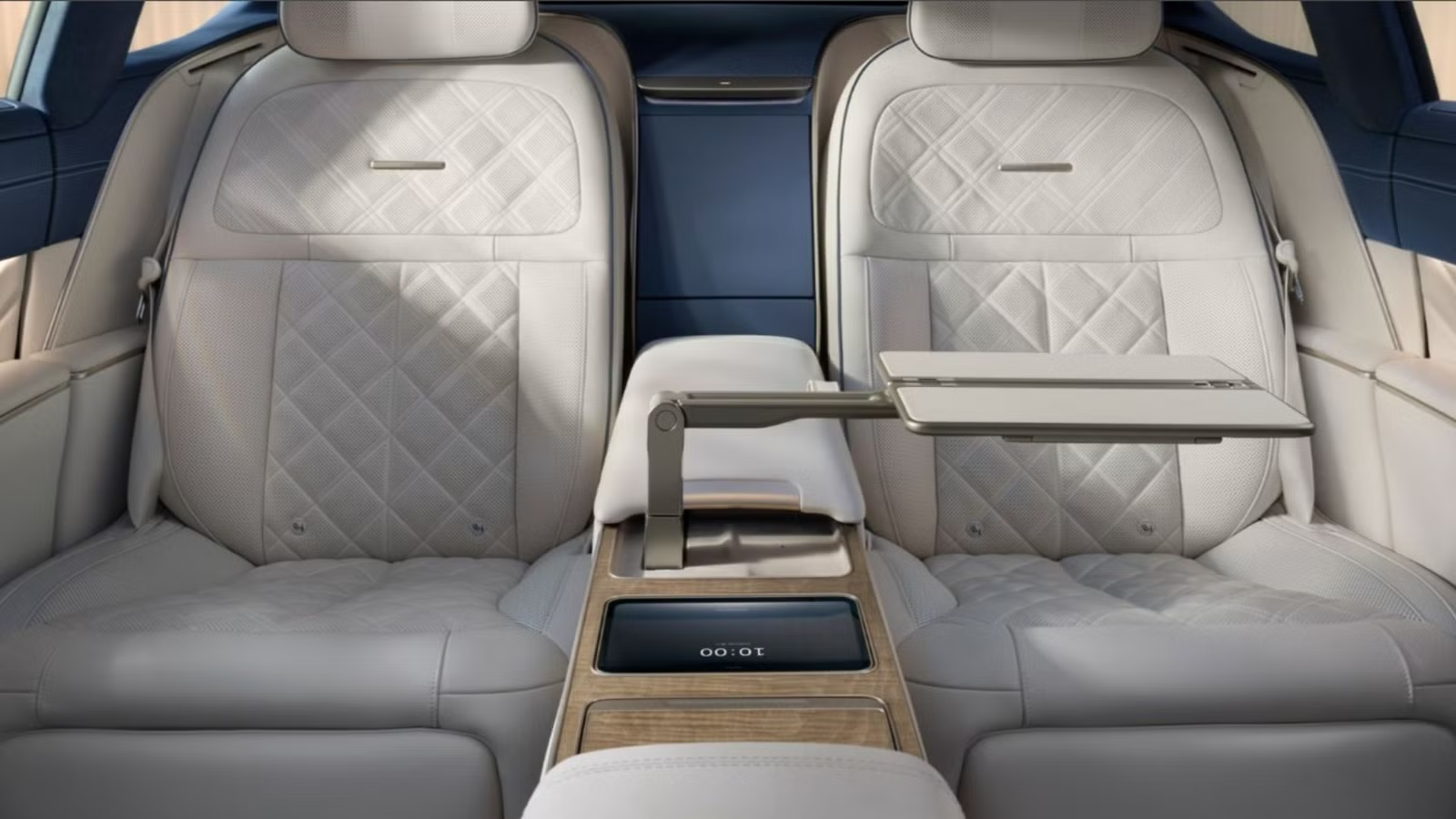
Onboard, Nio refers to its space as more like a suite than a passenger compartment. The ET9 also has a four-seat layout and 35-speaker audio system, and it’s clearly impressive at first glance. Nio has effectively added lots of engineering ambition to a highly refined interior and there’s no doubting the objective.
Hongqi Is Reviving An Old-School Flagship Luxury Idea
2026 Hongqi Guoya from the frontHongqi-Auto
In many respects, Hongqi is going back in time with its very formal limousine. The company is not trying to imitate full-size flagships from other lands, but is explicitly referencing Chinese culture in its marketing materials. Its Guoya is every inch the presidential car and Hongqi has included imperial Chinese design cues, what it calls “palace-grade” audio tuning, and references to the Forbidden City on its website.
The Guoya is also huge by any definition, at almost 18 ft long and 5 ft tall. It has an independently developed high-performance V8 which turns out 576 hp of combined power and 590 lb-ft of combined torque. It also has a hot-vee twin-turbo V8 arrangement with direct injection and all of that puts it squarely in the zone where ceremony and performance coexist.
Related
China’s All-Electric Answer To The Porsche 911 Comes From One Of The Best
Set to arrive under the company’s luxurious Denza brand next year, the BYD sports car is inspired by the roofless Fang Cheng Bao Speed 9 concept.
When you look at the international market and how top-end sedans all seem to be much of a muchness, the Guoya stands out from the crowd. It’s deliberate, stately, and culturally specific, and – above everything else – shows just how confident the Chinese market is in its intent. Hongqi isn’t just joining the luxury conversation; it’s trying to shout everyone else down with its own version of the tale.
Denza, Zeekr, And Yangwang Are Also In On The Game
Zeekr reveals a more luxurious version of the 009 minivan, a four-seater called the Grand.Zeekr
When you look beyond the aforementioned flagship sedans, there’s plenty more to see. Zeekr has its 009 Grand, which is maybe the best example of how differently China now interprets premium transportation. This is a four-seat ultra-luxury flagship MPV, and it’s well and truly loaded. There’s a 43-inch mini-LED partition screen, an 18-liter refrigerator with heating, cooling, and ultraviolet sterilization, a 31-speaker Yamaha surround sound system, and an 800 V electrical system. The company says you can add more than 300 miles of claimed driving range in about 12 minutes. And if Mercedes is trying to redefine luxury family transport with its VLS elsewhere, then this is an entirely different interpretation yet again.
Denza is taking another view of the challenge, and its Z9 GT will spearhead the company’s push into Europe in 2026. It’ll feature flash charging capability in Europe, operating at up to 1,500 kW, and a claimed 10 to 70% charge in about five minutes. Parent company BYD describes this vehicle as a high-tech shooting brake, and it’ll come with either a full-electric powertrain or a triple-motor hybrid setup, so now you have a fast-charging luxury shooting brake as another unlikely contender.
Related
US Buyers Want Chinese Cars. Why Are Dealers Afraid Of Them?
Perhaps it has to do with profit margins on inexpensive cars, but pricing might be less attractive by the time Chinese cars actually arrive.
Yangwang’s U8 Premium Edition goes on sale at RMB1,098,000 or about $150,000 and features the brand’s E4 platform with DiSus-P system. The U8 turns out 1,200 hp and can get to 62 mph in 3.6 seconds. It can also perform tank turns, has emergency flotation capability for up to 30 minutes, and features tire blowout stabilization. If some of those features sound a little absurd in this context, that may be partly the point. Other manufacturers elsewhere sometimes turn to absurd capabilities to carve out a space, but China is clearly on the leading edge of competition in the luxury market, and these manufacturers are doing everything to make a difference.
America Is Missing Out On The Fun
2026 Yangwang U8 Premium Edition cutaway from aboveBYD
American administrations are not interested in Chinese cars flooding the US market and while this means missed access to some interesting vehicles, it also means missed opportunities. In China, manufacturers are giving a clear demonstration of where premium automotive thinking is heading. Its companies build products for customers who expect the very best in luxury while insisting that their cars are technically current. This certainly doesn’t mean that every Chinese luxury car is better than a Japanese or German rival, but it seems clear that Chinese brands are producing serious flagship machines.
Chinese manufacturers are also selling their luxury vehicles in meaningful numbers and launching them into some welcoming overseas markets. And while nobody knows if the American market will eventually get some of the wave, right now other regions are firmly assessing China’s output. They’re seeing an increasing number of vehicles that are not only ambitious and technically daring, but increasingly polished. And that level of polish is clearly enough to force people to look at Chinese vehicles through a different lens.
Sources: Nio, Zeekr, Denza, BYD, Hongqi
