

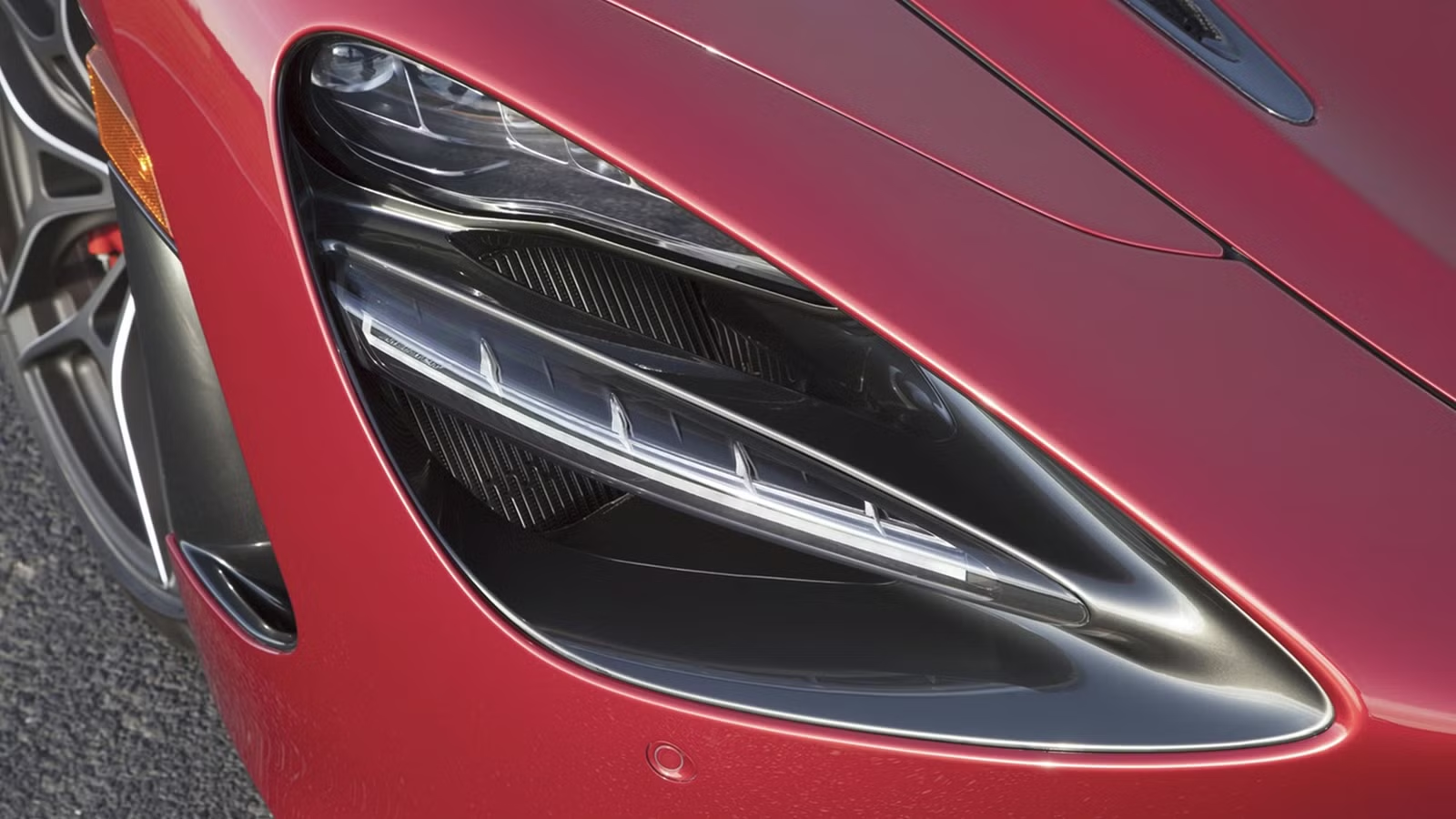
The McLaren 720S was arguably one of the most influential modern supercars from the brand, not only for its performance, but also for its design language. Some may say that it was the choice of enthusiasts who wanted a pure driving experience, following an ethos of a lightweight chassis and hydraulic steering.
To this day, you can find design inspiration from the 720S in the 750S and the newly introduced McLaren 788 HS. So, here is a look at the 720S by breaking down some of its numbers: from horsepower to cargo space. The McLaren 720S 0–60 mph time may be a little hard to believe even today…
All information has been sourced from the manufacturer. We’ll be focusing on the McLaren 720S in this article, looking at some interesting numbers associated with the McLaren 720S, such as top speed, horsepower, 0-124 mph times, etc.
2017: The Birth Of A New Design Formula
2017 McLaren 720S, Front Quarter View, Dark Background w/Spotlight, Light BlueMcLaren Cars
The McLaren 720S was introduced at the 2017 Geneva Motor Show, and was the successor of the 650S. While the car got a new engine, new interior and looked nothing like any other previous McLaren, the ethos remained the same. A twin-turbo V8, rear-wheel-drive, carbon fiber tub and hydraulic steering. It was a part of McLaren’s £1 billion Track22 investment strategy, with plans for around 15 new models by 2022. McLaren claimed that the 720S was 91% new compared to its predecessor.
2: Second Generation Of The Super Series McLarens
McLaren 720s has trick suspension, active aerodynamics and plenty grunt.McLaren
The 720S came a year after the launch of the 675LT Spider, the last of the evolution of the 650S nameplate. The 650S itself was the first Super Series McLaren that sat above the Sport Series offerings such as the 540C and 570S, and below the Ultimate Series cars such as the P1, Senna, etc. The Sports Series offered an entry point into McLaren ownership, whereas the Ultimate Series was the limited-production, most expensive of track-focused weapons. Therefore, the Super Series could be seen as offering a balance of performance learning from the likes of the P1, at a price that undercut it as well. That is not to say that it was cheap, as it was still punchy.
Expert
insight
The McLaren 720S offers brutal straight line performance, class-leading cornering, and supreme comfort. It’s breadth of ability and impressive performance are fast cementing it as a benchmark in the supercar segment. There are few better or quicker ways to reel in the horizon than this.
284,745: Price To Match The Car
2023 McLaren 720S rearMcLaren
The 720S launched with a price tag of $284,745, which was the highest in its class. McLaren, with the 650S, actually slightly undercut its closest rival in terms of price, the Ferrari 458 Italia. With the 720S, you had to pay a premium over the 488 GTB. And while the 488 was its closest rival, it was almost $80,000 more than the likes of the Lamborghini Huracán LP-580-2, which even had a NA V10.
However, it had the performance to match the price as well. It was the most powerful in its class, and had a major upper hand in terms of chassis dynamics, with its carbon fiber monocoque, and the steering feel from its hydraulic rack. It also came standard with adaptive dampers and carbon ceramic brakes that were options on its rivals. However, depreciation has never been easy on the 720S, according to our price trends graph.
720: Power In The Name
2023 McLaren 720S V8 engine TOPMcLaren
2017 McLaren 720S Engine Specs
Engine
4.0L Twin-turbo V8
Horsepower
710 hp
Torque
568 lb-ft
Transmission
7-speed Dual-clutch Automatic
Fuel Efficiency (city/highway/combined)
15/22/18
McLaren has had a history of naming its production cars based on their power outputs. The 720 in this name is the engine’s output in PS, whereas it produces 710 hp and 568 lb-ft of torque in more widely recognized units of measurement. It had 70 more horsepower compared to the 650S. The engine was an evolution of the 3.8L twin-turbo V8 found in the 650S, and with its displacement increased to 4.0L, it was codenamed the M840T. It was a 90-degree V8 with dual overhead camshafts, 32 valves and twin electrically actuated twin-scroll turbochargers, mounted right behind the cabin.
The engine was mated to a seven-speed dual clutch gearbox sending power only to the rear wheels. While rear-wheel drive helps to keep the weight down, it usually hampers performance in a straight line, as most RWD supercars struggle to put down their power. However, the 720S was no slouch on the drag strip either.
7.8: Ballistic On The Drag Strip As Well
2023 McLaren 720S rear wheel shotCars and Bids
The McLaren 720S 0–60 mph was dispatched in 2.9 seconds. However, what is arguably more impressive, is that it can reach 124 mph from a standstill in just 7.8 seconds. When compared to its rivals, it could complete the quarter mile almost half a second quicker than the 488 GTB or the Huracan, which was AWD as well. Its engine placement, extensive use of carbon fiber and ability to deliver its power not only made it a potent track toy, but also rapid in a straight line. While it did not completely eliminate turbo lag, when the turbos did spool up, very few cars could keep up with it. The 2019 McLaren 720S 0–60 time would have been slightly slower, with the introduction of the 720S Spider, which was slightly heavier. That said, the 0–60 time of the 2020 McLaren 720S and the car itself remained the same and received no major updates.
2,828: Lightweight Philosophy
2023 McLaren 720S sideMcLaren
The dry weight of the 720S was just 2,828 lbs. Every other rival tipped the scales above 3,000 lbs. One of the biggest contributors to this low weight was its Monocage II monocoque. This was one of the first McLarens to integrate the roof and windscreen surrounds into the carbon fiber tub. This not only reduced the overall weight, but also increased structural rigidity. It also meant that the A-pillars could be thinner, improving overall visibility. When compared to the 650S, it saved around 40 pounds through its suspension, electrical and braking systems.
Combined with one of McLaren’s differentiating factors, a hydraulic steering rack, it became the epitome of a pure driver’s car. Hydraulic steering offers more feel from the steering wheel on the road when compared to electric steering, which is more precise but also offers less in terms of driver engagement. McLaren took this lightweight philosophy to the next level with the ultimate version of the 720S platform, the 765LT. It featured even more carbon fiber parts, lighter wheels, reduced noise insulation and a titanium exhaust.
12.7: More Space Than Its Rivals
2023 McLaren 720S interiorMcLaren
Not only was the McLaren 720S 0–60 mph acceleration time impressive, but the car was practical as well. It had a front trunk with around 5.3 cu-ft of space and 7.4 cu-ft of storage behind the seats, bringing the total storage space to a total of 12.7 cu-ft. Yet again, this was more than its rivals, who offered bigger front trunks, like the 488 GTB with 8.1 cu-ft, but little to no space behind the seats, apart from flat objects like folders. The 720S Spider offered 7.3 cu-ft of total space due to the inclusion of a folding hard top that ate into the space behind the seats.
80: Degrees Of The Multifunctional Rear Wing
Orange 2023 McLaren 720S tail shotMcLaren
To aid high speed stability, the 720S also featured adaptive suspension and active body work, specifically the rear wing. While stationary, it sat flush with the bodywork. Over a certain speed, the hydraulically operated rear wing rose slightly to reduce drag. When Aero mode was selected on a track, the wing rose even further to add downforce and increase high speed stability. However, under heavy braking, the wing could rise by as much as 80 degrees to act as an air brake and shave off speed as fast as possible. The 720S also featured an automatic drag reduction system, or DRS, that lowered the rear wing at higher speeds to help reach its 212 mph top speed.
In many ways, the 720S was ahead of its time. It laid the foundations of the next few years of McLaren’s supercars and even the 750S, which bears a resemblance to its original design introduced in 2017. With the introduction of the McL 6GT, McLaren seems to be heading yet again in a different design direction.
Fuel Economy
TBC
Segment
Supercar
Sources: McLaren, Ferrari, Lamborghini, EPA
FAQ
Q: Is a turbo s faster than a 720S?
A Porsche 991.2 911 Turbo S is slightly faster to 60 mph due to its AWD setup, but has a lower top speed of 205 mph, whereas the 720S can do 212 mph.
Q: Is the 720S a supercar or hypercar?
The 720S is a production supercar, being a part of McLaren’s Super Series cars.
Q: What is the fastest McLaren 0-60?
McLaren’s newest hypercar, the W1, has the fastest 0-60 mph claimed time of 2.7 seconds.
Q: Is the McLaren 720S faster than a Lamborghini?
The 720S is faster than its nearest Lamborghini rival, the Huracan, against both LP610-4 and LP580-2 guises.
