

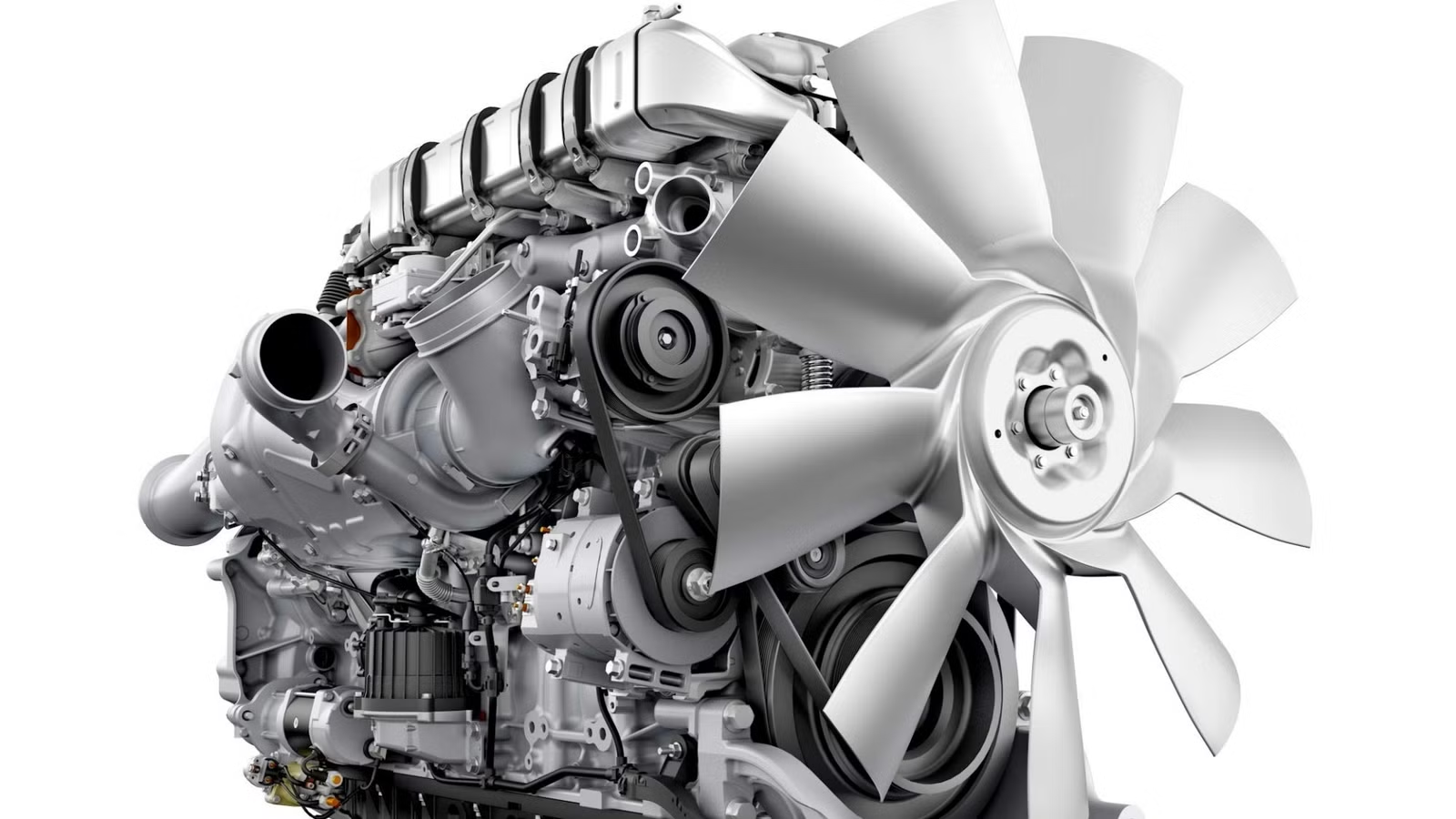
While the spotlight shines brightly on the brute strength of heavy-duty pickup trucks like the powerful Ford F-350 Powerstroke and the legendary pulling power of the Cummins-equipped Ram 3500, there exists an entirely different league of diesel engines built for even greater demands.
One engine that leads this class is the Detroit DD15. As the workhorse of Class 8 trucking, the DD15 powers some of the most capable long-haul and vocational rigs on the road today. With newer competitors and stricter efficiency standards constantly threatening engine performance, the DD15 continues to be a popular choice for operators and fleet managers in 2026.
Not every Detroit DD15 engine will experience some or all of the common problems listed below. If your engine is experiences these or any other problems, it is highly advisable to have your engine inspected and diagnosed by a trained diesel technician for an accurate repair.
The Detroit DD15 Engine
Successor To The Legendary Detroit Series 60
Detroit DD15 Engine side profileDetroit Diesel
Detroit DD15 Engine Specs
Displacement
14.8-liter (906 Cubic-inch) Inline Six-cylinder
Bore
5.47 in
Stroke
6.42 in
Horsepower
425–505 hp
Compression Ratio
21:1
Torque
1,550 to 1,850 lb-ft
Dry Weight
2,718 lbs
Introduced in 1987, the Detroit Series 60 was a revolutionary diesel engine. At the time, it was the first heavy-duty Detroit diesel that fully utilized electronic controls. Considered by Detroit to be one of the most successful engines it has ever produced, the Series 60 was the dominant engine for Class 8 trucking in North America, selling over 1.2 million units by the time of its final year of production in 2011. The 12.7-liter Series 60 was Detroit’s first “clean sheet” engine – meaning it was an entirely new design that used the latest technology for not only its design and development, but its engine controls as well. The new Series 60 was more efficient and powerful than the Detroit engines that came before it. Longevity was also paramount in its design, with a recommended overhaul after the initial 500,000 miles, which, after the engine had fully proven itself, was extended to 750,000 engine overhauls.
Despite the Series 60’s decades of success, tightening EPA emissions standards eventually pushed the engine to its limits of compliance, paving the way for its replacement. Introduced in 2007 as the flagship of Detroit’s new DD platform, the diesel motor DD15 arrived as the direct replacement for the legendary Series 60, stepping into one of the toughest acts to follow in heavy-duty diesel history.
Detroit Series 60 Diesel Engine 3/4 shotDetroit Diesel
Like the Series 60, the DD15 has also proven itself to be a solid powerhouse in the trucking industry. Known for its power, durability and efficiency, the DD15 is a popular choice for heavy-duty applications and over-the-road trucks. Thanks to Detroit’s proprietary BlueTec emissions technology, the DD15 engine offers tremendous power output all while delivering exceptional fuel economy, successfully combining power and efficiency. Further, the horsepower of the DD15 and its insane torque production are supported by its asymmetrical ball-bearing turbocharger, improved swirl piston design, and its Amplified Common Rail Fuel System or ACRS.
Core Architecture Of The DD15
The Benchmark Of Efficiency And Torque Production
Detroit Diesel DD16 engine in a studio renderingDetroit
The widely respected Detroit DD15 engine is a turbocharged 14.8-liter inline six-cylinder. The block’s construction is cast iron with a cast iron, single overhead valve cylinder head, with four valves per cylinder. The cylinder walls are extremely thick, to include a generous amount of material in key high-stress areas. Like most commercial diesels, the DD15 is considered to be undersquare with a bore of 5.47 inches and a stroke of 6.42 inches. As opposed to higher rpm horsepower, this configuration prioritizes low rpm torque, which comes in handy when moving 80,000 lbs up a grade or from a dead stop.
The bottom end of the DD15 is, as you would imagine, well overbuilt – with seven heavy-duty main bearing journals and a substantial amount of webbing to aid in structural rigidity and to combat distortion – especially considering the whopping 1,850 pound-feet of torque that the capable DD15 can deliver. The DD15 also utilizes a forged crankshaft and steel connecting rods with fractured “big ends” (bearing caps) for optimal strength. The pistons are a two-piece design with oil cooling jets. The two-piece design includes a swirled steel crown with an aluminum skirt and oil-cooling jets.
(Getty Images)
As mentioned, the DD15 uses the Detroit ACRS high pressure common rail fuel system. This fuel system is capable of up to 35,000 psi. This high fuel pressure helps the DD15 achieve more efficient combustion, aiding in its overall ability to achieve stellar fuel economy. The Asymmetrical turbocharger balances low-end response with a higher flow capacity, creating eager acceleration and less time waiting for the big turbocharger to start creating boost.
Detroit-Built, German Designed
A row of 2025 Freightliner Cascadia models at a front 3/4 angleFreightliner
While the DD15 is built in America with Detroit engine branding, it’s not totally American. It’s manufactured by Daimler Truck North America at its Redford, Michigan campus — they also research and develop engines and other components, and handle the production of engines, transmissions and axles at this location. The name might sound familiar; Daimler Truck was once owned by the company now known as Mercedes-Benz.
Daimler Truck was introduced in 1895 when Carl Benz debuted the first motorized bus that ran a 15km route connecting three towns. Its first truck came just a year later, having been derived from the Phaeton passenger car, and was capable of hauling up to 600 kilograms (1,322 pounds) in its bed.
Fast-forward to 1981, and you’ll see the company’s acquisition of Freightliner. Daimler-Benz’ technological resources greatly assisted the American company to reach the top of the North American truck market by 1992. While still associated with Mercedes-Benz, Daimler Truck separated from the company to form its own stock in 2022. Freightliner’s affiliated company, Detroit Diesel Corporation, still benefits from German engineering today.
A Leader For Class 8 Trucks
Why Is The DD15 So Popular?
Front shot of two 2025 Freightliner Cascadia models Freightliner
The primary goal for the DD15 was to create an engine capable of running at lower rpm while still delivering strong usable torque. This “downspeeding” approach helps reduce fuel consumption, minimize engine wear, and maintain excellent engine performance. Given the extreme internal pressures found in large displacement diesels, every component in the DD15 engine had to be engineered with durability and longevity in mind. The deliberately overbuilt construction of the DD15 is why this powerful Detroit inline six has amassed such a strong reputation for longevity and durability for both long-haul and severe duty applications.
For those looking to refresh or power up a truck, a new DD15 crate engine is a popular option. Detroit also designed the DD15 with serviceability in mind – many major components were positioned for ease of access, making the engine a favorite not only for drivers, but also with technicians, shop foreman and fleet managers alike.
Common Problems Of The DD15
Injector Failures
Bosch Common Rail Injector close upBosch
The DD15 is prone to injector failures due to carbon build-up. Since injectors are still a mechanical apparatus, they are still also prone to internal wear and breakage.
Symptoms include:
- Rough idling
- Loss of power
- Poor fuel economy
Oil Leaks
As powerful as Detroit Diesel engines are and have a reputation for being, they have always been known for oil leaks. The DD15 is an advanced engine, but it still carries on the Detroit family tradition of leaking oil. The most affected areas for the DD15 are the timing cover and/or the high pressure fuel pump.
DPF & EGR System Issues
Ford diesel particulate filter device for 6.4-liter diesel engineFord
The DD15 engine is EGR compliant, so it relies heavily on its exhaust gas recirculation (EGR) system and diesel particulate filter (DPF) to clean up its emissions. These systems can be problematic on any diesel, and the DD15 is no different. Components of both the EGR and DPF are known to clog and cause issues.
Symptoms include:
- Forced regeneration cycles
- Check engine lights
- Poor fuel economy
- Rough run
Turbocharger Failure
TurbochargerPorsche
Common in older or higher mileage DD15 engines is the failure of the asymmetrical variable geometry turbocharger. In many cases, the turbo’s variable geometry actuator fails, but failed oil seals and waste gate solenoid leaks have been encountered as well. Carbon is also known to build up in the turbine veins.
Symptoms Include:
- Loss of boost
- Uncommon whistling or high-pitched noise
- poor acceleration
- Excessive smoke from exhaust
- Increased oil consumption
Other Massive Diesel Engines Trucks Use Today
Cummins X15D Diesel Engine in redCummins
Some one-ton pickup trucks use fairly large engines, like the 6.7-liter Cummins diesel found in the Ram 3500, but brands like Cummins produce even larger, more powerful engines to carry the weight of fully-loaded semi-trucks for millions of miles. Pictured above is the Cummins X15D, a 14.5-liter turbocharged inline-6-cylinder that makes 651 horsepower at 1,800 rpm and 2,360 lb-ft of torque between 900 and 1,400 rpm.
Other manufacturers contribute to the world of giant diesels, too. Volvo produces heavy machinery and semi-trucks alongside its luxury cars — one Volvo engine that moves the world is the D16K750, a 16.1-liter twin-turbo inline-6 that makes 750 hp between 1,600 and 1,700 rpm and 2,620 lb-ft of torque between 950 and 1,400 rpm.
western star trucks duo red and silverWestern Star
For one more example, let’s look at the Mercedes-Benz OM 473. This 15.6-liter twin-turbo inline-6 shares architecture with the Detroit Diesel DD16. Mercedes-Benz’ version is tuned for 625 hp and 2,213 lb-ft of torque at 1,100 rpm
Base Trim Engine
6.8L V8 Gas
Base Trim Transmission
TorqShift 10-speed automatic
Base Trim Drivetrain
Rear-Wheel Drive
Base Trim Horsepower
405 HP @5000 RPM
Base Trim Torque
445 lb.-ft
Base Trim Battery Type
Dual lead acid batteries
Infotainment & Features
7 /10
Sources: Detroit Diesel, Diagnostic Diesel, Truckers Report, Daimler Truck, Cummins, Mercedes-Benz Trucks, Volvo Trucks
FAQ
Q: Is the Detroit DD15 a good engine?
The Detroit DD15 is an excellent engine that has proven itself in the trucking industry to be a formidable powerhouse that has excellent reliability and fuel efficiency. The DD15 combines performance and economy in a solid package.
Q: How many miles can a Detroit DD15 last?
The DD15 is known by many to last well over one million miles. Of course, like any engine, to achieve a high number of trouble-free miles, a good and regular maintenance routine is compulsory.
Q: How much horsepower does a DD15 make?
According to the Detroit Diesel website, the horsepower rating can vary anywhere from 425 to 505 horsepower.
Q: What are common problems with the DD15 engine?
The DD15 is one of the most reliable engines available for Class 8 trucking. However, it does have some problems related to fuel injectors, oil leaks, EGR and DPF systems, and turbochargers. Some of these problems are more prevalent in the older DD15 engines, or engines that have not been properly maintained.
