

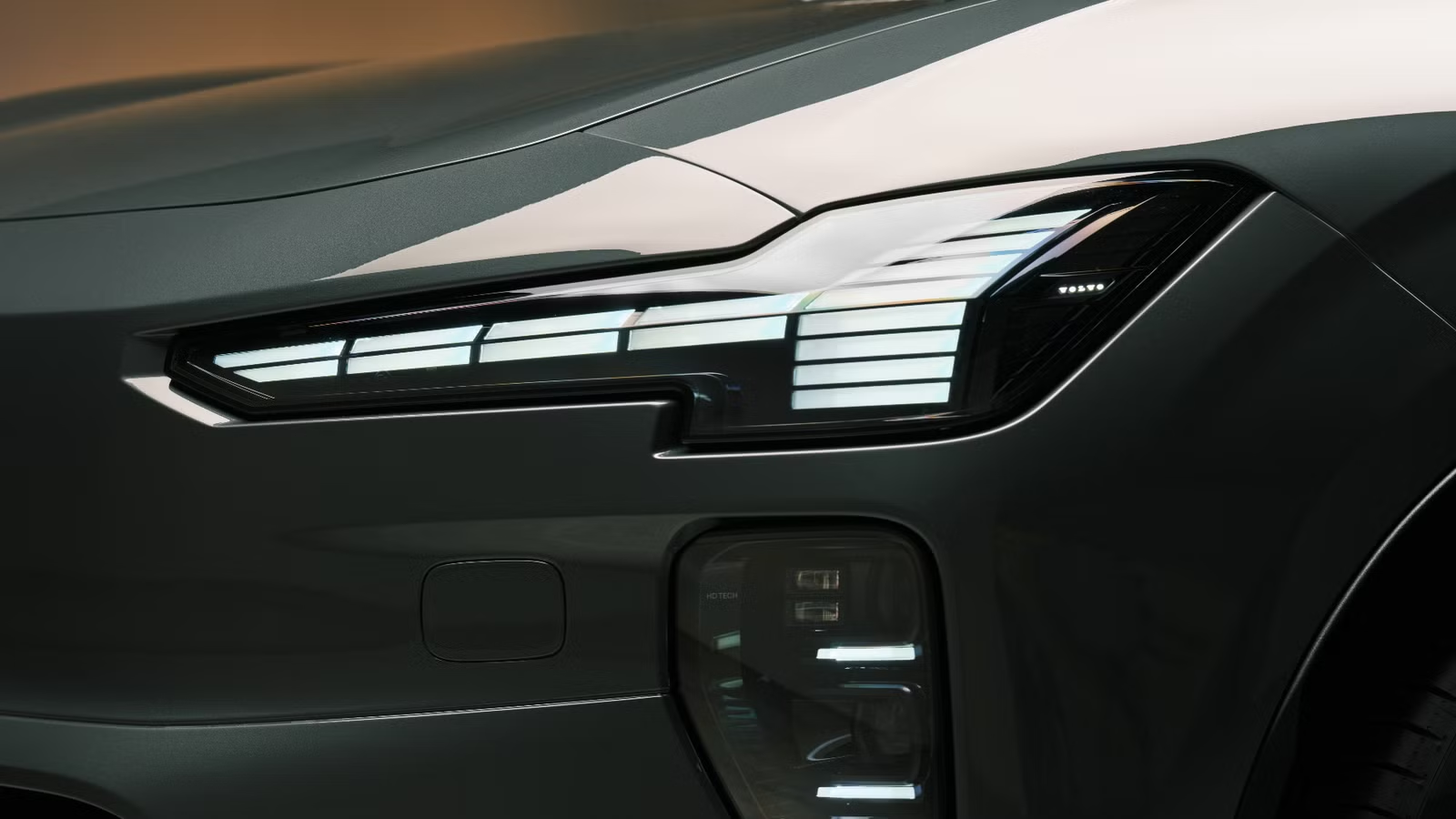
UPDATE: 2026/10/19 11:18 EST BY SEAN MCMANUS
Volvo EX60 Rivals To Shop While You Wait
Since the EX60 won’t be widely available for some time, here are a few rivals that you can either buy or order today.
Volvo expected the EX60 to be its new hot ticket. The Swedish automaker planned to build enough to make it the company’s third-highest-selling model, and to bring close to 10,000 into the US this year. But a new report says manufacturing problems at home are reducing production to a small fraction of the planned number.
These problems could keep the model out of the US almost completely until late 2027.
Volvo’s New Big Deal Is Now A Big Delay
Volvo’s newest SUV was a very big deal. The EX60 launched with 400 miles of range, up to 670 horsepower, and a starting price just under $60,000. Production started earlier this year, and the brand reportedly expected to sell around 7,000 this year.
But the plan is in tatters right now, Automotive News reports. Instead of building around 2,000 per week at its factory in Torslanda, Sweden, it is building around one-tenth of that, the report says.
Citing sources familiar with the situation, Automotive News said that there are two major manufacturing issues that have brought production down to nearly a crawl. The main issues center on the EX60’s megacasting and cell-to-body construction. Both are novel techniques without much in the industry to look to for help.
Megacasting is a method where an automaker builds one massive casting instead of welding multiple sections together. It’s more expensive and complex to create tooling and presses to build the part, but the promise is a stronger, lighter, and cheaper panel in production. Volvo is said to be stuck on that complex early part.
Cell-to-body technology attaches the battery’s cells directly into the frame and floor of the vehicle instead of building a separate battery pack for each vehicle. Once again, it’s complicated, but once Volvo sorts out, the benefits to range and weight should be well worth the effort.
Did Volvo Try Fancy Tech Before It Was Ready?
Volvo EX60 P10 AWD UltraVolvo
“With megacasting, cell-to-body and more, it introduces industry-first state-of-the-art concepts for which there are no blueprints to copy,” a Volvo spokesperson told Automotive News. “Therefore, the ramp-up phase takes a little longer than initially planned.”
As a result of the slow ramp-up, Volvo is said to be prioritizing more EV-friendly markets. Though with the BMW iX3 showing up at retailers, some Volvo dealers in the US are probably not very happy. The EX60 was seen as Volvo’s chance to make up for the troubled launch of the EX90. That EV was more than a year late, with much-hyped features delayed and, in some cases, removed from the options list.
This manufacturing delay doesn’t exactly inspire confidence, though at least the issues are being resolved before vehicles ship to customers.
Volvo EX60 Rivals To Shop While You Wait
2025 Audi Q6 e-tron front 3/4 angle while drivingAudi
Since buyers likely won’t want to wait another year to secure a Volvo EX60 (even if it looks rather promising on paper), we want to showcase some of its rivals that are available to buy or order today. These include the BMW IX3, Audi Q6 E-Tron, and the less luxurious Tesla Model Y.
The Model Y is a given, as it’s one of the most popular models in its class, and it’s available in a range of trims as cheap as $39,990. Buyers can choose between RWD and AWD, up to 355 miles of range, and some luxury features. The BMW IX3 and Audi Q6 E-Tron are more traditionally luxurious models that face Volvo head-on. Audi’s EV starts at $64,500; it offers 456 horsepower, a 4.9-second 0-60 mph sprint, standard all-wheel drive, and many more luxury features.
Finally, there’s the BMW IX3. It was just revealed as a 2027 model that will start at $61,500 for the 50 xDrive base model. Even this base model is impressive, though, with 463 horsepower, 476 lb-ft of torque, standard AWD, a 4.7-second 0-60 mph sprint, and more.
CarBuzz Insight – Why This Matters:
Volvo EX60 P10 AWD UltraVolvo
If Volvo is only building 200 instead of 2,000 cars per week, it doesn’t make much sense to send them to the US. Tariffs and low EV adoption are strong headwinds, while it can sell them in Europe to customers eager to escape high fuel bills. It’s the smart move, even if it leaves US customers anxious and dealers outraged.
Fixing the problem is expected to take some time, meaning that US dealers aren’t likely to see a “significant volume” until late 2027. CarBuzz has reached out to Volvo for comment.
Source: Automotive News
