

It wasn’t until 1847 that the world learned of the tale of The Man in the Iron Mask. Alexandre Dumas’s book portrayed him as King Louis XIV’s identical twin brother in a complex tale of court intrigue. An automotive story paralleled this tale, and it took place within BMW Motorsport in the early 1990s.
BMW Produced Many Heirs To The 8 Series Throne
Enough of the 19th-century French literature lesson. The original BMW 8 Series (known by the internal code E31) launched in 1990 and replaced the shark-nosed 6 Series from the late 1970s and ’80s as the brand’s luxury sports coupe. BMW’s lineage of grand tourers up until this point followed a gradual evolution, with each generation getting steady tweaks in design and gingerly updated powertrains.
That wasn’t the case in the last decade of the millennium, when BMW looked to tear up the rulebook across the board. As for the E31 8 Series, the results spoke for themselves. It was sleek. It was revolutionary. It was Concorde for the road.
The 8 Series wasn’t just a new number in the lineup; it was a totally new look for the brand. The sharp nose sported modern (for the time) pop-up headlights rather than a fixed quad-bulb layout. There was a smaller greenhouse than the 6 Series, and the kidney grille shrank.
The brief for the 8 Series, however, wasn’t to build something as athletic as the 6 Series it replaced. Its job was to host all the new tech BMW cooked up for its next generation of vehicles. Plus, there was a new V12 engine that the company made by conjoining two of its 2.5-liter inline-six powerplants.
BMW unveiled the first concept for the 8 Series in September 1989 at the Frankfurt Motor Show. It was one of the first BMWs designed using CAD modeling and spent a great deal of time in the wind tunnel, shaving the coefficient of drag down to 0.29, versus the outgoing 6 Series at 0.39.
The 1990 850i punched out 296 horsepower from a 5.0-liter V12, available with either a four-speed automatic or six-speed manual. Buyers who opted for the manual were proud owners of the very first V12-powered production car with six ratios shifted by hand. By 1993, both the 850CSi and a V8-powered 840i arrived to add more diversity to the lineup. In total, the E31 8 Series came with five engine options and three different gearboxes.
The 8 Series’ development costs totaled $900 million in the late 1980s. The car was a nerd’s paradise with advanced engine management systems, and even speed-sensing windshield wipers. However, the car wasn’t as exciting to drive as it was to look at. The company aimed to fix the problem by handing the coupe over to its BMW Motorsport division. Whether the $900 million included building the “secret” high-performance prototypes is unknown, but it could have.
The M8 Was BMW’s Worst-Kept Secret
BMW had many goals set for the 8 Series. It wanted to build a worthy successor to the 6 Series, which was apparently selling so well it delayed the 8 Series launch by a full year. The automaker also desired to take on not just Mercedes-Benz, but Porsche and Ferrari, too. To do that, it needed to change a few things and turn this supersonic jet for the road into something with a little more poise and agility. The 8 Series project became distracted by being tech-forward, which arguably compromised the final product. The situation led to the secret development of an M version shortly after the reviews hit.
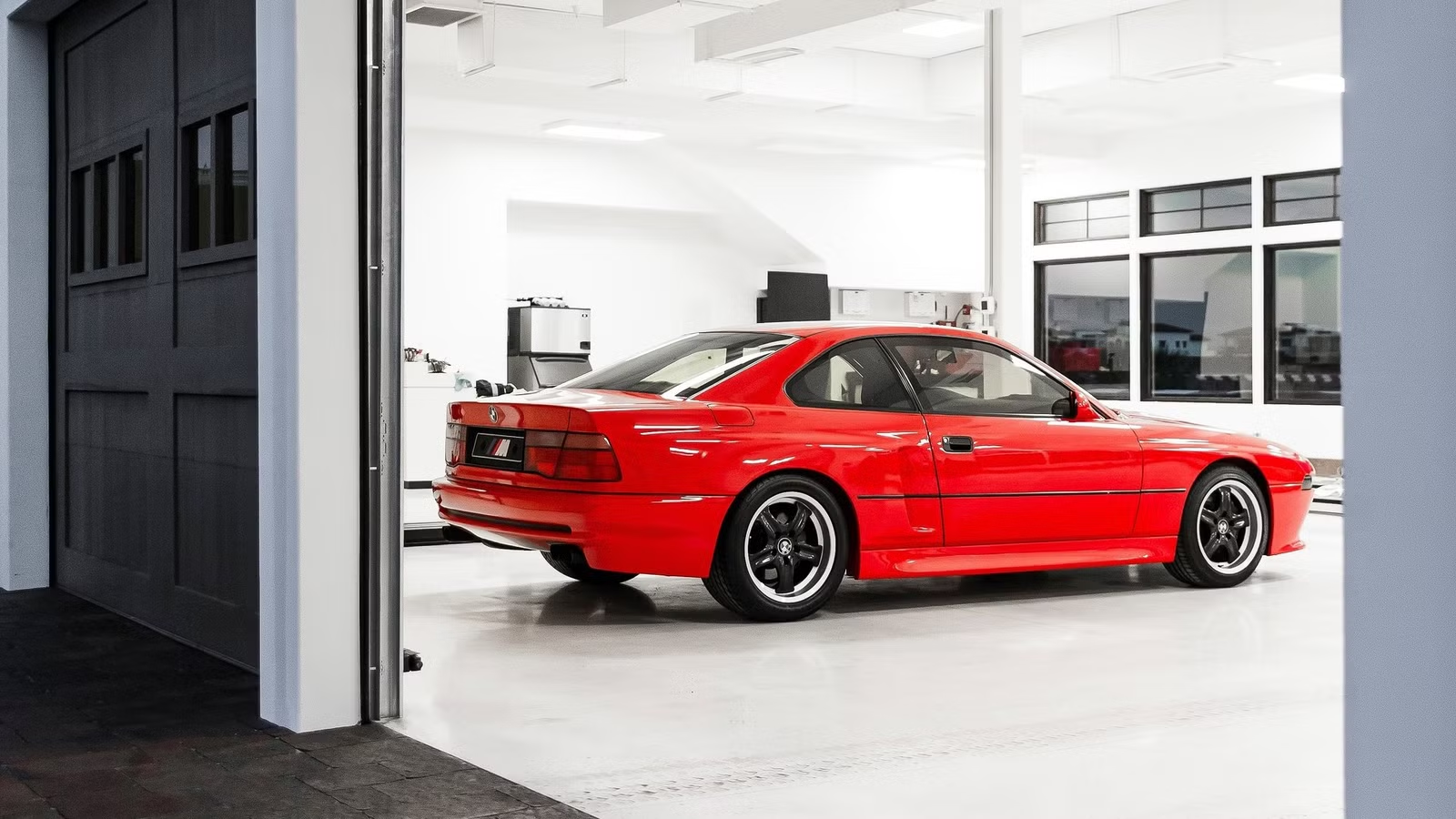
Engineers worked their magic on the E31 by swapping the 5.0-liter V12 for the S70, the same V12 that BMW devised for the McLaren F1. The V12 displaced 6,064 cc. McLaren listed it as a 6.1-liter unit while BMW called it 6.0 liters. Output skyrocketed to 640 horsepower and 479 lb-ft of torque, beating the F1’s 618 hp and matching its torque. According to BMW, the M8 prototype topped out at roughly 186 miles per hour, trouncing the Porsche 928’s achievement of 170 mph and the Mercedes-Benz 500SL with an electronically limited 155 mph top speed.
Close
Helping it hit those targets was a lighter curb weight of 3,197 pounds, which was nearly 1,400 pounds less than the production car. A reworked grille and fiberglass, slotted hood fed air to a revised intake and cooling system. The pop-up headlights were gone, and the main beams integrated into the bumper. The wider rear track accommodated a larger rear end, which also changed the dynamics quite a bit. The end product was an athletic grand tourer that BMW could be proud of, and a vehicle it surely wanted to wave in front of the competition.
Unfortunately, that’s not what happened. The M8, one of many prototypes BMW spent gobs of money developing, was dead in the water alongside the 850i, which was already receiving a poor report card. The M8 would’ve been expensive, too, but it had the power to match the price tag. The machine was more powerful than the fastest production car ever built at the time, and it likely could have beaten a 928 on the straights and in the corners. It was a direct heir to the throne of all grand tourers and the flagship spot in BMW’s lineup.
BMW
The M8 even wore a bright shade of red as a giant German middle finger to Ferrari, but the car would never see the light of day after the project was canceled. BMW wouldn’t publicly acknowledge the relative to the king it kept locked away, like in The Man In The Iron Mask.
The M8’s story has been told many times in books and articles, but BMW didn’t officially disclose it until 2010. The vehicle finally received some well-earned praise in 2019 as part of the promotion while launching the 2020 M8.
The 850CSi Saw The Light Of Day, Its Brother Didn’t
The BMW 850CSi had a bigger and more powerful V12 engine than the run-of-the-mill 850i.BMW
The M8 prototype wasn’t just a direct relative to the McLaren F1; it also had an identical twin that assumed the throne instead. The 850CSi that arrived in 1993 was an M car through and through. Official documents listed the manufacturer as BMW Motorsport, and German certificates of title listed the model as M8. Aside from what it said on paper, the 850CSi received the same treatment as every other car that wore an M badge.
The revisions included a 5.6-liter V12 engine packing more power, a higher redline, and a faster top speed than other 8 Series models. The powerplant had strengthened internals, different cams, and a revised exhaust that brought the output to 380 horsepower and 406 lb-ft of torque. It was a fraction of the output from the M8 prototype, but it was all BMW needed to recapture its audience and improve its standing with journalists. This was worth more to BMW than building more copies of the demonstrably expensive M8 and losing money on each one to be competitive.
Thankfully, the quasi-M8 we got was pretty good in its own right. The vehicle was brilliant, and really was something to behold, even if it wasn’t as eager to be driven spiritedly. The 850CSi changed how we remember the 8 Series, almost to the point that we forgot any 8 Series missing the “CSi” suffix could be as athletic as the ones that do. Still, it’s a grand tourer through and through with a burly V12 and long legs, excellent for cross-continental dashes.
Yes, its brother went to prison for crimes it had yet to commit, and it didn’t deserve the cold shoulder BMW gave it. But it did help create one of the best cars ever built by the Motorsport division, and that’s worthy of great praise.
Sources: BMW M, Hagerty, Robb Report
