

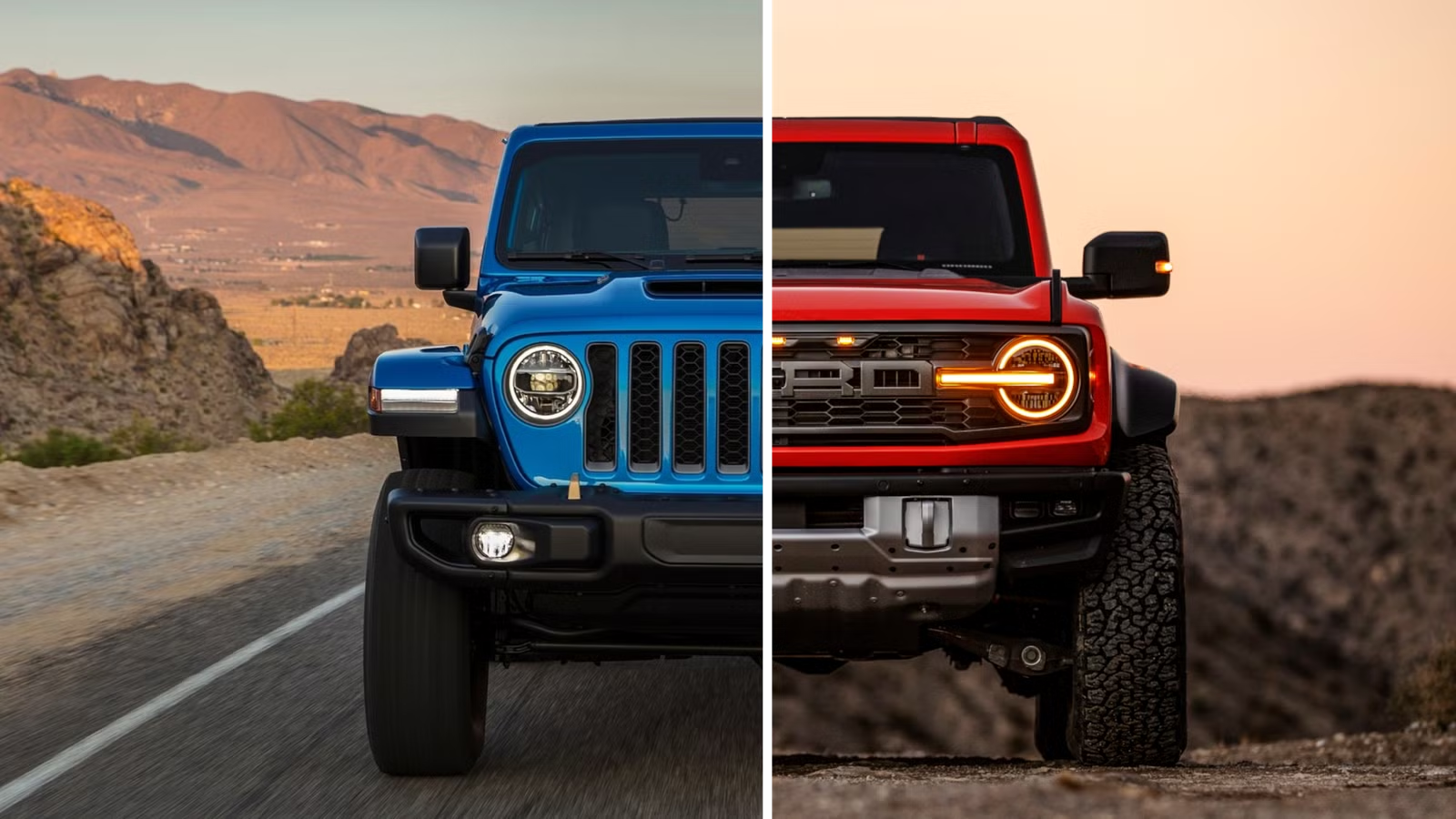
Since the Ford Bronco’s revival in 2021, the Blue Oval has been duking it out with its Jeep Wrangler rival for performance, not only in the dirt and mud, but also on the showroom floor. As recently as this spring, the Bronco beat the Wrangler in terms of new-vehicle deliveries, but according to the automakers’ latest figures, the 75-year-old military vehicle derivative has once again taken back its crown.
It looks like it’ll be pretty secure when it comes to total 2026 sales as well, because the Wrangler is squarely ahead in that metric, too.
Close
The Wrangler Had A Very Strong Summer
Jeep doesn’t break out monthly sales figures the same way that Ford does, but for the third quarter of 2026 – comprising July, August, and September – its signature SUV found 44,757 new homes, an increase of 5 percent compared to Q3 2025. And so far this year, Jeep has sold 131,011 Wranglers, 2 percent more than it had by the same time last year.
The Bronco, by contrast, had much more mixed sales results. Despite leading the Wrangler in Q2 2026, Ford’s off-roader stumbled a bit this summer, with July sales down 5 percent and August sales down 9 percent compared to the same months in 2025. Nevertheless, Ford must have picked up several new customers in September, because the Bronco just enjoyed its best third quarter ever, with 38,020 units sold – a scant 0.4 percent increase over the same time period last year, but an increase nonetheless.
Close
Still, that represents nearly 6,800 fewer customer deliveries for Ford than Jeep, and the Bronco’s 114,956 units sold so far this year mean that the Wrangler is all but guaranteed to take home the cup once New Year’s Day 2027 rolls around.
What’s The Key To Jeep’s Success?
The Wrangler’s staggering brand equity could be one reason it generally outsells most of its rivals. For decades, the word “jeep” was practically generic for off-road SUVs. In fact, the Land Cruiser’s J-oriented terminology – FJ40, FJ60, UZJ100, etc. – comes from the “Toyota Jeep BJ” off-roader it built in the 1950s. The Bronco doesn’t have nearly as much heritage from which to draw. Introduced in 1966 and discontinued in 1996, it suffered from 25 years of relative obscurity before being revived in 2021. The Jeep is also cheaper to start than the Bronco, with a base price of $38,030 compared to $43,290.
That doesn’t make the Bronco a bad pick, however. Its independent front suspension and wider passenger cabin make it a much more comfortable place to be when driving down the highway, with better on-road manners without much sacrifice in off-road capability. Its EcoBoost turbocharged engines, ranging from the base 300-horsepower 2.3-liter four-cylinder to the 418-hp 3.0-liter V6 in the Bronco Raptor, have more grunt than Jeep’s turbo-four and nat-asp V6 engine options, meaning you’ve got to step into the thirsty, V8-powered Wrangler Moab 392 if you want to out-power Ford.
Still, the convertible-roof, off-road SUV market is driven by emotion and desire more than logic, and the Wrangler continues to appeal to both outdoor enthusiasts and lifestyle buyers in equal measure.
Base Trim Engine
EcoBoost 2.3L ICE
Base Trim Transmission
10-speed automatic
Base Trim Drivetrain
Four-Wheel Drive
Base Trim Horsepower
275 HP @5700 RPM
Base Trim Torque
315 lb.-ft. @ 3400 RPM
Infotainment & Features
8 /10
CarBuzz Insight – Why This Matters:
Detroit’s Big Three automakers love to lock horns when it comes to new-vehicle sales, and Ford loves to tout its impressive 49 years of the F-Series being the best-selling vehicle on the US market. Unfortunately for the Dearborn-based company, that same magic hasn’t quite trickled down into the Bronco, leaving Jeep and parent company Stellantis the bragging rights in this particular segment.
Still, it’s good to see sales remaining consistent for both nameplates. Although the flagship models can easily fetch $80,000 or more, the entry-level Bronco and Wrangler still represent some of the least expensive vehicles offered by both Ford and Jeep, and keeping demand for them high sends the right message to American automakers – we want more cheap cars.
Sources: Ford, Stellantis
