

It seems like the V6 is going the way of the dodo these days. If you want a little more muscle than you’d get from a turbo-four, automakers now prefer adding electrification. Companies seem to regard the six-pot as a useless halfway measure, even though some of the most exciting engines ever produced have had a V6 layout.
Here are 10 reasons we think the whole industry needs to take a moment and reconsider phasing out the V6.
The tables below reflect outputs for individual engine tunes. In many cases, there are more powerful or less potent versions of these powerplants, with the output depending on the specific model using the mill.
Toyota 2GR-FKS
The 2GR-FKS Delivers A Lot Of Fun In The Toyota Camry TRD
Displacement
3.5-Liter NA 6-Cylinder
Base Power
301 hp
Base Torque
267 lb-ft
What else could we start this list off with but a Toyota powerplant? The 2GR-FKS produces 301 horsepower through an eight-speed automatic transmission in the Camry TRD, getting the car up to 60 mph in just under six seconds. The Camry TRD is an all-time great for affordable performance, with MSRPs starting at around $31,000 for the 2024 model. Today, the Camry TRD is holding its value.
Supercharged Lotus 2GR-FE
The Toyota-Sourced 2GR-FE Powers The Lotus Evora To 345 HP
Displacement
3.5-Liter Supercharged 6-Cylinder
Base Power
400 hp
Base Torque
310 lb-ft
We could pick any version of the Toyota 2GR-FE as a great V6. Do you want something reliable? Powerful? Sporty? Easy to tune? The 2GR-FE has you covered no matter what level of performance you’re after. The Lotus Emira is worth highlighting because it manages to pull 400 hp out of a supercharged version of the powerplant you might find in your mom’s old minivan.
While 400 hp might not match modern supercars, point for point, the 2GR-powered Emira can still clear 60 mph in 4.2 seconds. If that’s not your definition of fun, then we’re never going to see eye to eye.
Volkswagen VR6
The VR6 May Be Best Known For Powering The MK5 Golf R32
Displacement
3.2-Liter NA 6-Cylinder
Base Power
250 hp
Base Torque
236 lb-ft
Volkswagen calls it a VR6. The V does not refer to a V shape, though. V is for Verkürzt, the German word for shortened, and R is for Reihenmotor, the German word for inline engines, and the six stands for, well, six. The VR6 is a kind of hybrid between a straight-six and a V6, with its banks at a far narrower angle (just 15 degrees in the 3.2-liter powerplant). The narrow-angle design means there’s one cylinder head and a more compact footprint than a traditional V6. It makes the VR6 scarcely larger than a straight-four, bringing V6 power to small hatchbacks.
In the Mk5 R32 Golf, the VR6 gets you to 60 mph in a little over 6.0 seconds through a DSG automatic transmission. The R32 Mk4 Golf takes just a bit longer, with 0-60 acceleration taking around 6.4 seconds, courtesy of a 240-hp version of the VR6.
McLaren M630 Twin-Turbo V6 Hybrid
The McLaren Artura’s V6 Runs On A Little Bit Of Everything
Displacement
3.0-Liter Twin-Turbo Hybrid 6-Cylinder
Base Power
671 hp
Base Torque
531 lb-ft
Purists might not like it, but we dig this trend of building a superpowered engine by packing more stuff onto it. The McLaren Artura has a 671-hp V6 that gets the car up to 60 hp in just three seconds flat, via twin-turbocharging and an axial-flux electric motor. The powerplant’s base output is 577, so it’s pretty potent even before getting hybrid assistance. If you want big performance numbers, a battery pack can get you there quicker than tuning your engine until the block splits in two.
Jaguar XJ220 JV6
The Jaguar XJ220 Was Once The World’s Fastest Production Car
Displacement
3.5-Liter Twin-Turbo 6-Cylinder
Base Power
542 hp
Base Torque
475 lb-ft
Built on engine architecture developed by the legendary Tom Walkinshaw Racing, the JV6 was originally designed by Cosworth for the MG Metro 6R4 Group B rally car. Once the engine found its way into the XJ220, it powered what was once the world’s fastest production car, hitting 60 mph in 3.6 seconds and reaching a top speed of 217 mph. The 1992 Jaguar XJ220 is actually more impressive than the 6R4, which took 4.5 seconds to hit 60 mph and tapped out at 120 mph.
Cadillac CT5-V LGY V6
The Cadillac CT5-V Blackwing May Be Associated With V8s, But Its V6 Engine Sings
Displacement
3.0-Liter Twin-Turbo 6-Cylinder
Base Power
360 hp
Base Torque
405 lb-ft
Cadillac invented the mass-produced V8 back in 1914, packing an eight-cylinder into the Type 51. Cadillac has been a leading name in V8s ever since, including the eight-cylinder CT5-V Blackwing. But, the 360-hp twin-turbo V6 version proves that the brand can produce excellent six-pots, too.
The V6 version of the CT5-V can hit 60 mph in 4.6 seconds in the rear-wheel-drive models, or 4.8 seconds in the all-wheel-drive models. It sounds gorgeous, too.
Ferrari Twin-Turbo V6 Plug-In Hybrid
The Ferrari 296 Achieves Supercar Status With A Three-Pronged Approach To Propulsion
Displacement
3.0-Liter Twin-Turbo Hybrid 6-Cylinder
Base Power
819 hp
Base Torque
546 lb-ft
Vittorio Dini, Ferrari’s head of powertrain design and development, led development of the twin-turbo V6 for the Ferrari 296. Like the McLaren Artura, the car paves a clear path forward for the V6 configuration. Pairing the six-cylinder engine with electric motors and twin turbos adds a lot more power than you’d get with a couple of extra cylinders. The 296 can clear 60 mph in just 2.3 seconds, and it hits a top speed of 205 mph.
Honda C30A
Any Honda C Engine Could Make The List, But We Like The 1992 Honda NSX-R
Close
Displacement
3.0-Liter NA 6-Cylinder
Base Power
276 hp
Base Torque
210 lb-ft
A high-revving engine powering a range of Honda NSX models from 1991 to 2004, the C30A hits peak hp at 7,300 rpm, bringing the NSX-R to 60 mph in just under five seconds, with a top speed of 168 mph. The C series was Honda’s first go at a production V6, dating back to 1985, when the 2.0-liter C20A debuted in the Honda Legend.
Honda is one of the automakers keeping the V6 configuration alive today, particularly through the aluminum-block J engine, introduced in 1996, and powering everything from the Accord and the Odyssey to forgotten sedans like the Saber and the Inspire.
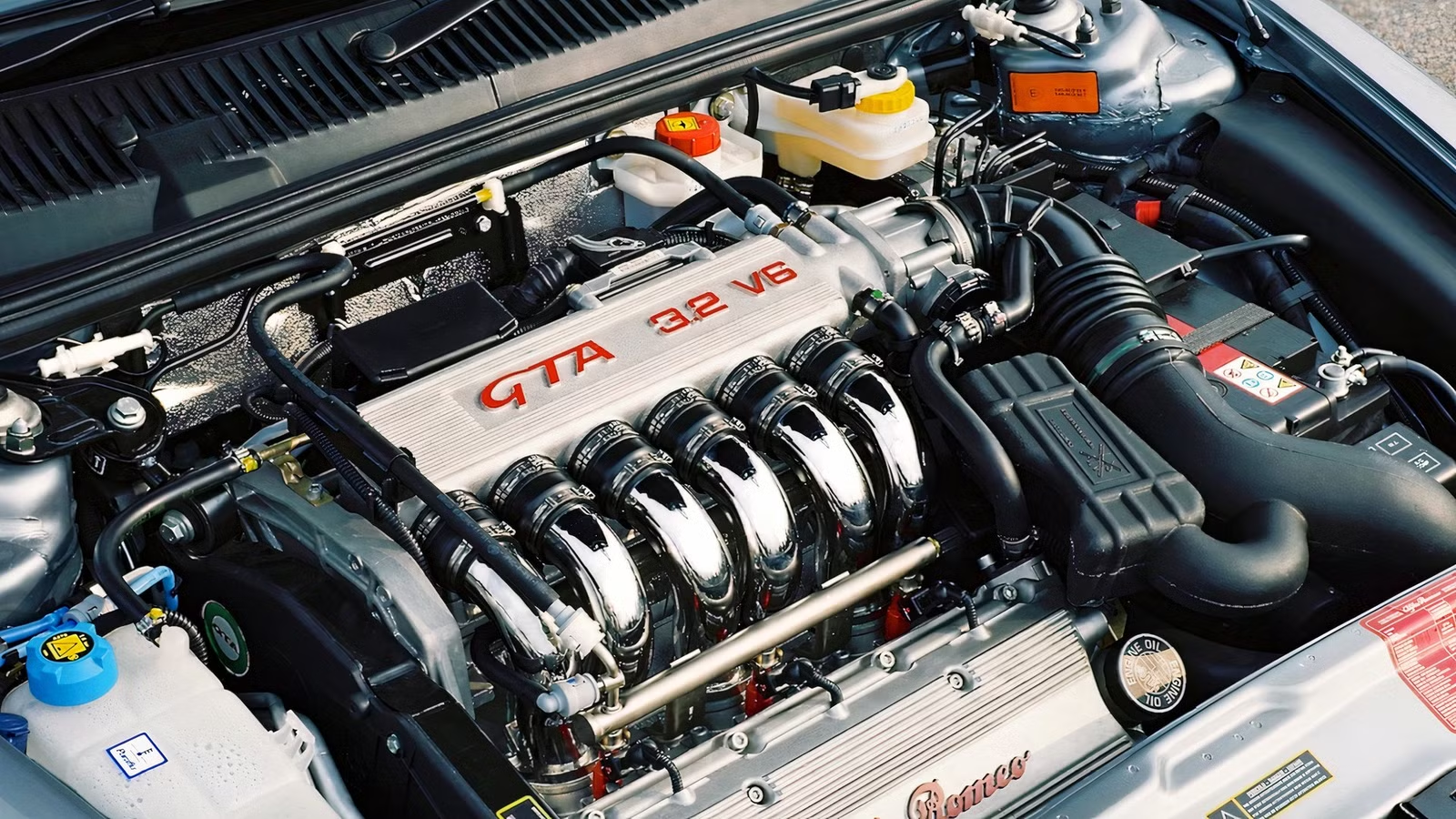
Alfa Romeo Busso V6
The Busso Found In The Alfa Romeo 156 GTA Dates Back Almost Half A Century
Displacement
3.2-Liter NA 6-Cylinder
Base Power
240 hp
Base Torque
221 lb-ft
The Alfa Romeo Busso engine dates back to 1979, when the brand debuted a 2.5-liter V6 in the Alfa 6. Designed by, and named for, Giuseppe Busso, this early version of the engine was state-of-the-art for its time, even if its 10-second 0-60 is nothing to write home about in 2026, no matter how starved your family may be for car news.
The 240-horse 3.2-liter Busso found in the Alfa Romeo 156 GTA hits 60 mph in 6.3 seconds, with an electronically limited speed of 155 mph. That may not put the Busso anywhere close to supercar territory, but the high-revving powerplant, hitting peak hp at 4,000 rpm and gunning it up to 7,000 rpm, is punchy and responsive, and it sings on wide-open roads.
Nissan VQ35DE
A Versatile Engine Found In Drift Cars Like The Infiniti G35
Displacement
3.5-Liter NA
Base Power
228 hp
Base Torque
246 lb-ft
The Nissan VQ35DE is a versatile engine, powering everything from daily drivers to drift cars, with base hp in the low 200s, while the Nismo S1 version produces around 312 hp. The engine gets the Infiniti G35 Coupe to 60 mph in around 5.3 seconds, with an electronically limited top speed of 155 mph.
Far from the most powerful engine on the list, we’re including the VQ35DE because its immediate low-end torque and availability in affordable performance models like the Nissan 350Z make it such an awesome engine for drifting.
Sources: Nissan, Toyota, Honda, Alfa Romeo, McLaren, Ferrari, Cadillac, Jaguar, Volkswagen.
