

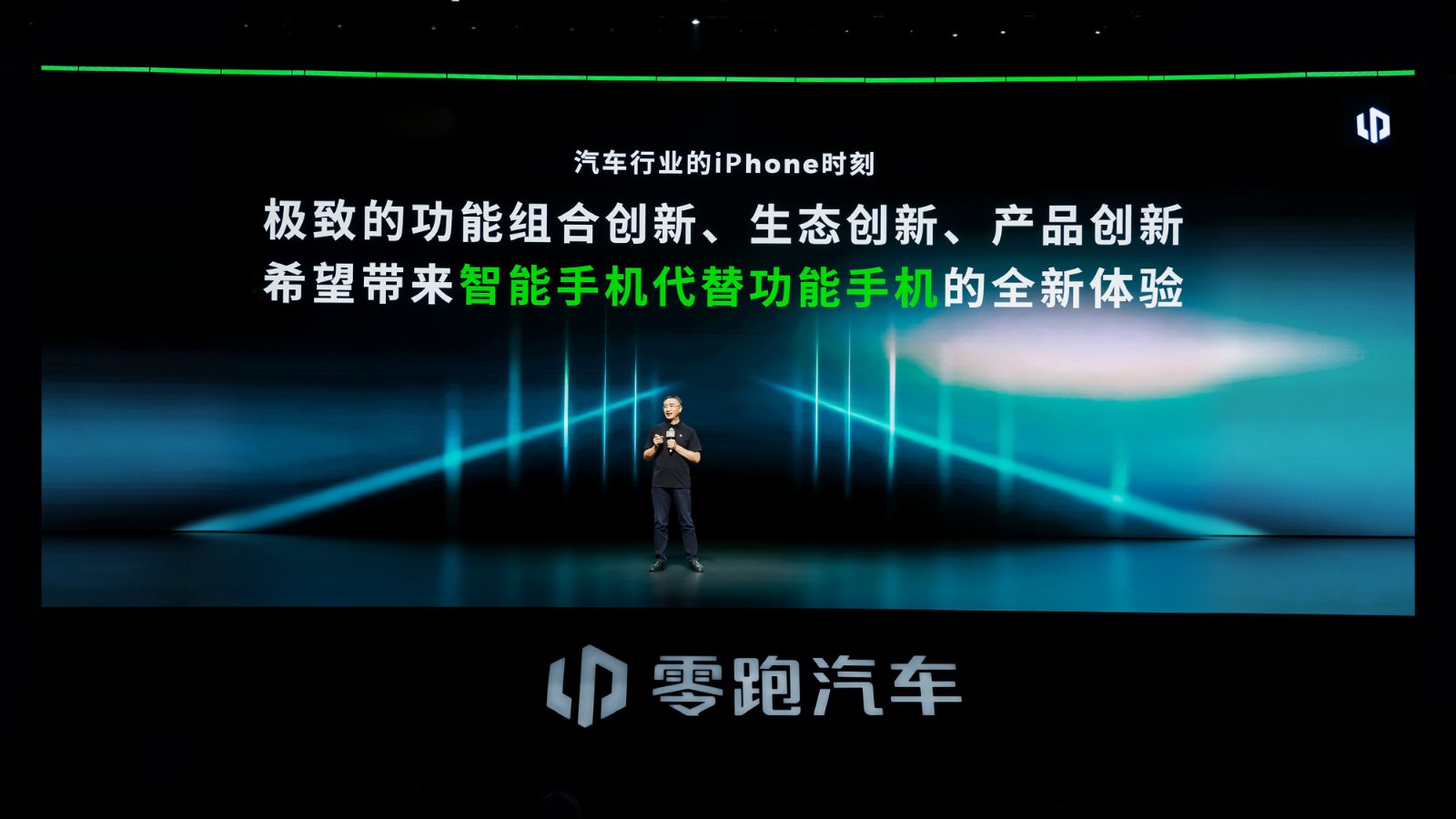
Leapmotor founder, chairman and CEO Zhu Jiangming speaks at the company’s Technology Day in Huzhou, Zhejiang province, on September 17, 2026. Credit: Leapmotor
- Leapmotor’s founder said the second brand’s first product will offer an experience akin to smartphones replacing feature phones.
- Leapmotor unveiled its LWM (Leapmotor World Model) driver-assistance system.
Leapmotor (HKEX: 9863) aims to become the Apple of the auto industry, with its new second brand set to debut and begin vehicle deliveries in the fourth quarter of next year, founder, chairman and CEO Zhu Jiangming said.
The second brand will be the first to use the company’s newly unveiled LEAP 5.0 vehicle architecture, Zhu said at Leapmotor’s 2026 Technology Day in Huzhou, Zhejiang province, on Thursday.
“Apple didn’t invent broadband wireless communications, nor did it invent computers, touchscreens, digital cameras or MP3 players,” he said. “But Steve Jobs excelled at combining functions, building an ecosystem and creating exceptional products.”
Today’s electric vehicles differ little from gasoline cars in their appearance and the layout of cabin functions, leaving substantial room for innovation, Zhu said.
He hopes the second brand’s first product will evoke the feeling of “smartphones replacing feature phones.” He described the product as a “mobile space.”
Leapmotor unveiled the LEAP 5.0 architecture at the event, positioning it as the foundation for its future vehicles.
The architecture replaces the conventional in-cabin HVAC unit with an integrated air-conditioning module and moves the powertrain to the rear. Leapmotor said the changes increase cabin space by more than 19%.
Supporting technologies include the Clover 5.0 centrally integrated electrical and electronic architecture, a vehicle-wide 48V power distribution system, Ethernet throughout the vehicle and an Agent OS that connects the vehicle with the cloud.
Leapmotor also introduced its LWM (Leapmotor World Model) driver-assistance system. The system abandons the conventional bird’s-eye-view (BEV) perception approach, using LiDAR solely as a safety backup.
Zhu Jiangming introduces Leapmotor’s latest vehicle architecture, driver-assistance system, hybrid powertrain and battery technology at its Technology Day on September 17, 2026. Credit: Leapmotor
Algorithm innovation matters more than adding computing power, Zhu said, adding that Leapmotor’s driver-assistance algorithms now rank among the industry’s best.
Leapmotor pledged to upgrade all LiDAR-equipped vehicles to the world model system at no charge and provide free lifetime use. By the end of August, the company had delivered 350,000 vehicles equipped with LiDAR and advanced chips.
Leapmotor also unveiled CTC 3.0 (cell-to-chassis) battery integration technology, which incorporates the low-voltage battery into the battery pack, eliminating the lead-acid battery. The company plans to open-source the technology for industry peers.
It also introduced the MM-i intelligent multi-mode hybrid system for global markets, supporting series and parallel operation across 9 modes.
The system expands Leapmotor’s powertrain lineup beyond battery electric vehicles (BEVs) and extended-range electric vehicles (EREVs) to plug-in hybrid electric vehicles (PHEVs).
Zhu struck a cautious tone on embodied AI, an area attracting intense interest. He said Leapmotor has built a robot developed entirely in-house, but is investing only modestly and taking a follower’s approach.
“A robot that can walk around is no great feat. A robot that can make money is worth showing off,” he said, adding that the company is still looking for viable real-world applications.
Leapmotor delivered 103,129 vehicles globally in August, up 80.72% from a year earlier and exceeding 100,000 for the second consecutive month. Deliveries in the first 8 months totaled 560,883 vehicles, meeting about 56% of its full-year target of 1 million.
Plug-in hybrid models could launch overseas as early as the first half of 2027, as Leapmotor increases investment in their development.
