

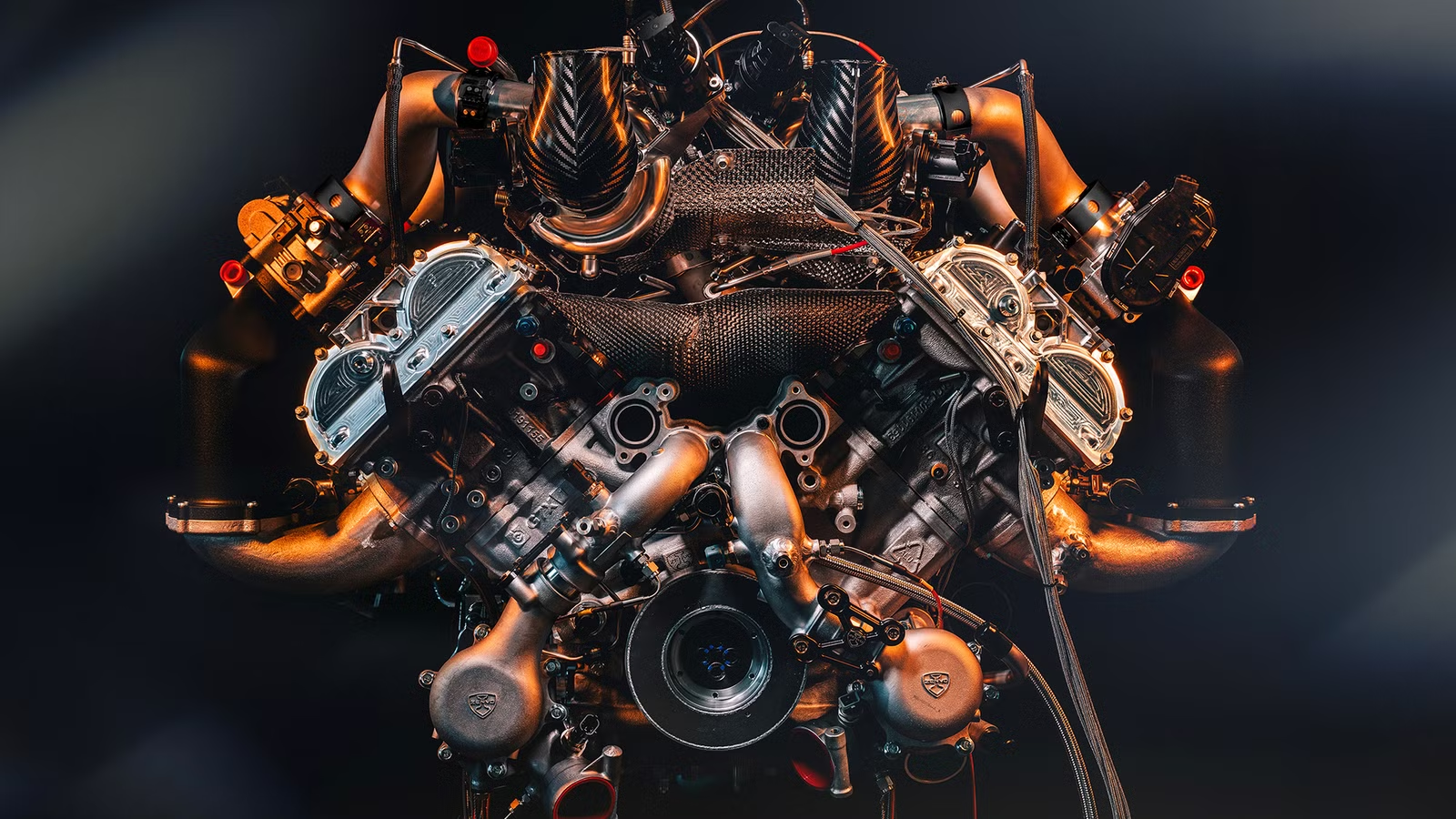
Four turbochargers once represented the ultimate expression of internal combustion performance, but in 2026, they have become an extraordinary rarity. Turbocharging itself is commonplace, yet combining four turbochargers with a high-cylinder count engine is now largely reserved for ultra-low volume hypercars and bespoke projects built for the wealthiest collectors.
That makes the end of one legendary quad-turbo powertrain particularly significant. After years of powering some of the world’s fastest road cars, it has now reached the end of its conventional production life, leaving this once cutting-edge technology surviving in only the most exclusive and limited applications.
Four Turbos Were Once The Ultimate Hypercar Flex
Multiple turbochargers offered manufacturers a clever way to extract enormous performance without simply increasing engine displacement. Using smaller turbochargers could improve response, while staging them to operate at different engine speeds helped broaden the powerband and reduce the lag associated with larger compressors. BMW, for example, used three and four turbochargers on its 3.0-liter six-cylinder diesel (F15 and G05) to build boost more quickly and sharpen throttle response.
Today, however, that level of complexity is increasingly difficult to justify. Stricter emissions requirements demand expensive aftertreatment and calibration, while electrification provides manufacturers with an easier way to supplement low-speed torque and performance. Developing, certifying and supporting an elaborate multi-turbo combustion engine therefore makes far less commercial sense, particularly for low-volume applications.
Bugatti’s Quad Turbo W16 Has Reached The End Of The Road
Bugatti’s 8.0-liter W16 became one of the defining powertrains of the modern hypercar era, first arriving in the Veyron before continuing through the Chiron family and its numerous derivatives. Its final road going application came in the W16 Mistral, an open-top model created as the ultimate expression of the engine.
With 1,600 bhp and four turbochargers, the Mistral provided a spectacular conclusion to Bugatti’s W16 story, even setting a 281.6 mph world record as the fastest open-top production car. Now, that story has officially ended. In July 2026, the final Mistral left Bugatti’s Molsheim Atelier, bringing total production to just 99 examples and closing the conventional road car chapter of the W16.
Bugatti Isn’t Quite Finished With Four Turbos Yet
Bugatti has found a way to keep its most exclusive customers connected to its outgoing powertrain through Bugatti Programme Solitaire, an ultra-limited coach building initiative creating truly bespoke, one-of-one cars. The program sits beyond the brand’s already extensive Sur Mesure personalization service, allowing individual customers to commission creations built around their own vision.
The latest example is the Bugatti Destrier, created for a single customer using the technical foundation of the track focused Bugatti Bolide. Beneath its dramatically reshaped bodywork sits the Bolide’s complete powertrain, including the 8.0-liter quad turbocharged W16. In its 1,600 bhp specification, it represents the peak evolution of Bugatti’s legendary engine, proving that its end as a conventional production powertrain does not necessarily mean its immediate disappearance.
The Destrier Shows How The W16 Could Live On
The Destrier demonstrates just how radically Bugatti can reinterpret its existing engineering when freed from the constraints of a conventional model range. Built around the Bolide’s carbon-fiber monocoque, it strips away the track car’s extreme aerodynamic appendages and replaces them with flowing bodywork, larger wheels and a far more restrained silhouette.
Inside, the transformation is equally dramatic, with leather, nubuck and knitted textiles creating an environment tailored specifically to its owner. Yet beneath this elegant exterior remains the Bolide’s complete W16 powertrain. More importantly, the Destrier establishes a precedent for what Bugatti Programme Solitaire could enable next. If a customer can commission a one-off around an existing quad-turbo W16, the engine’s end as a mass production unit does not necessarily prevent future bespoke applications.
The Zenvo Aurora Is The Last Conventional Quad Turbo Car
The Zenvo Aurora occupies a very different position from Bugatti’s bespoke creations. Its 6.6-liter V12, developed specifically for the hypercar, is fitted with four turbochargers and forms part of a clearly defined production model rather than a single customer commission. Zenvo plans to build just 100 examples of the Aurora, split between the road-focused Tur and track-oriented Agil, giving buyers the opportunity to order one of a finite series of factory-built cars.
That distinction is crucial to its place in the quad turbo story. While a one-off like the Destrier demonstrates that four turbochargers can survive through special commissions, the Aurora is an actual production program. With Bugatti’s W16 now out of regular production, that makes Zenvo’s hypercar arguably the only conventional new road car customers can still order with a four-turbo engine.
Its Quad Turbo V12 Makes The Aurora A Modern Outlier
At the heart of the Aurora is Mjølner, a clean sheet 6.6-liter 90-degree V12 developed with MAHLE Powertrain. The latter has a deep and long relationship with Formula 1. Its four variable geometry turbochargers sit within the engine’s hot vee, while the all-aluminum unit produces 1,250 bhp on internal combustion alone and continues revving to an extraordinary 9,800 rpm.
That would already make it an exceptional engine, but Zenvo has added modern electrification rather than replacing the combustion powertrain altogether. The Aurora Tur pairs the V12 with three electric motors, comprising one transmission mounted motor and two driving the front wheels. Together they contribute up to 600 bhp, taking total output to 1,850 bhp while also providing all-wheel drive and front axle torque vectoring. It is an unusual combination of a traditional V12 character and contemporary hybrid performance.
The Quad Turbo Era May Be Ending With The Aurora
Bugatti has already chosen a very different path for its next generation of hypercars. The Tourbillon replaces the quad-turbo W16 with an 8.3-liter naturally aspirated V16, supported by three electric motors for a combined 1,800 hp. That makes the Aurora increasingly unusual: it represents one of the last chances to order a purpose-built production car whose headline powertrain still relies on four turbochargers.
Zenvo is targeting first customer deliveries for the second half of 2027, with production strictly limited. Yet quad turbocharging may not disappear entirely. Bugatti’s Programme Solitaire is limited to just two bespoke creations per year, creating a pathway for exceptionally wealthy customers to commission machinery that would never make sense as a regular production model. For everyone else, the Aurora occupies a remarkably lonely, but exciting, position.
Sources: Bugatti, Zenvo, BMW, European Commission.
