

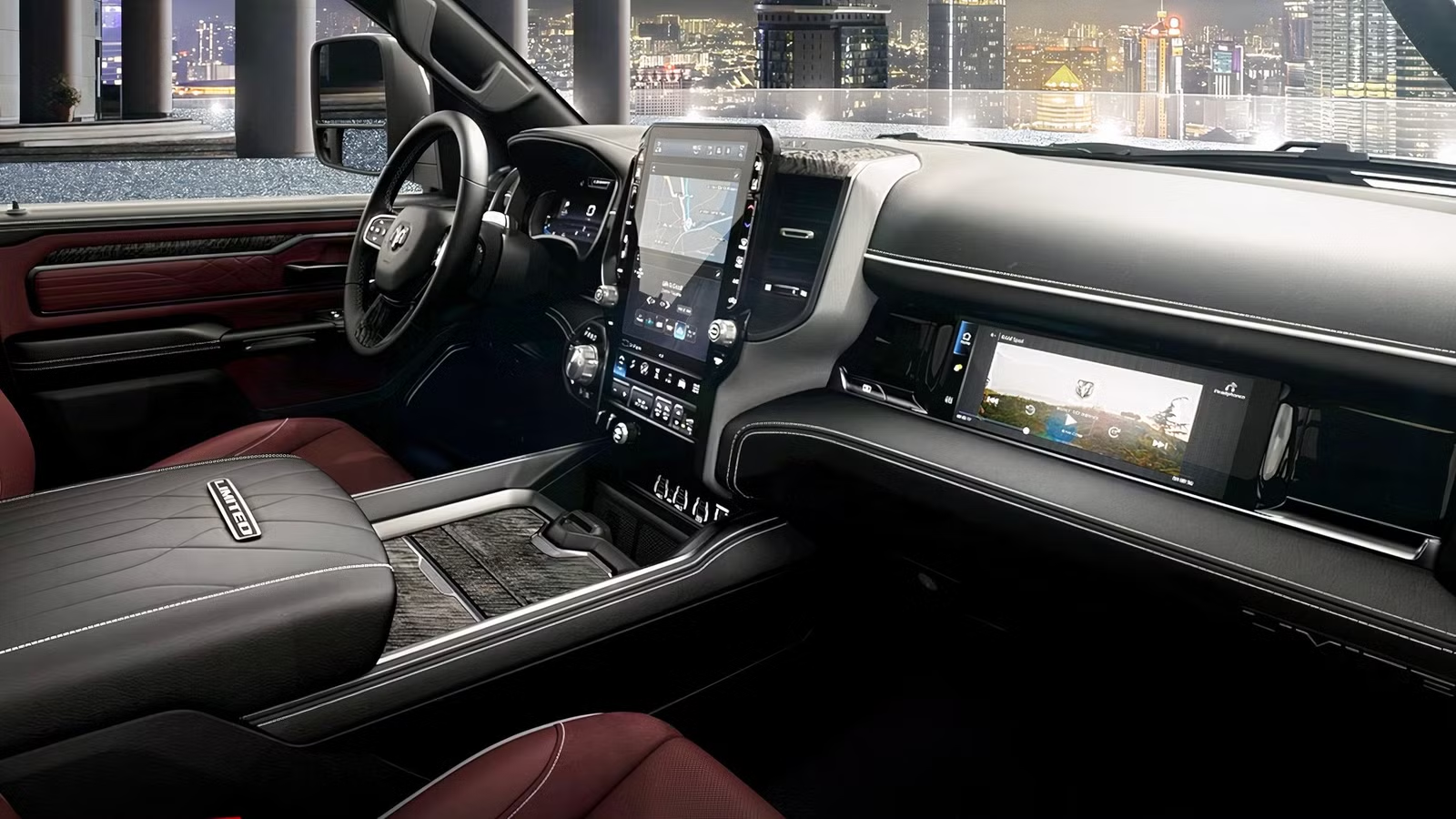
The latest results of the annual JD Power Technology Experience Index (TXI) are out, and American brands sit at both the very top and the very bottom of the list. While the Cadillac Escalade and its siblings are currently outperforming the entire industry by a landslide when it comes to technological user experience, fellow American manufacturer Ram is this year’s lowest‑scoring brand, taking last place on the annual “who’s who” of automotive innovations and tech that owners find most rewarding.
Below, we’ll dig into how Ram got there, what the scoring actually indicates for in‑market shoppers, and whether Ram’s position as a pickup‑heavy brand played into the results.
The Least Innovative Brand Is Ram, But There’s More To The Story
The Ram 1500 Rebel will take you quite a way off the beaten track.Stellantis
It’s been a tumultuous few years for Mopar – with the plug pulled on some hot‑sellers and upcoming plans alike. There’s been turmoil aplenty in the powertrain department, with new straight‑sixes battling long‑running favorites like the Hemi V8, which was killed off only to be resurrected after a short time, to the rejoicing of fans, in a sort of Easter Sunday moment for one of America’s favorite engines.
It’s important to note that while technological innovations are important for any automaker, Ram is the only brand on the list with the vast majority of its sales volume built on pickup trucks – and in particular, pickup trucks commonly bought for well‑established ride‑quality and interior‑quality advantages, not necessarily technological ones.
2025 – 2026 Ram 1500 exteriorRam
The gist? Ram trucks tend to attract enthusiast and power‑user types at a higher rate than average, and these customers often derive more satisfaction from power, style, and capability than from the latest technologies. Still, shoppers want their tech to work seamlessly, and TXI data shows that while Ram has been busy reshuffling engines, trims, and long‑term plans, customers are experiencing too much friction in the day‑to‑day tech experience.
Ram’s challenge is that its historic strengths (ride quality, interior comfort, powertrain character) don’t directly influence TXI scores, which are more concerned with how well technology is executed than with how well the truck drives. Ram is falling behind competitors who have invested more aggressively in intuitive ADAS behavior, cleaner interface design, and more seamless connectivity.
The brand’s bottom-rung showing in the latest JD Power TXI study indicates that customers are struggling with infotainment usability, driver‑assist behavior, interface logic, and the perceived benefit of the brand’s technology. TXI heavily weights owner sentiment, so when a brand scores poorly, it’s a sign that real drivers are reporting friction, including laggy interfaces, inconsistent alerts, confusing menus, or features that feel more intrusive than helpful.
The Ram 1500 Rebel will take you quite a way off the beaten track.Stellantis
A look at JD Power’s own APEAL data provides additional context. In this study, vehicles were evaluated on a different set of measures that seek to rate overall satisfaction. APEAL data shows Ram climbing rapidly in 2022 and 2023, before a 2024 and 2025 decline due in part to aging product and competitive pressures. In 2026, scores stabilize and show a partial recovery.
2025 – 2026 Ram 1500 exteriorRam
The overlap of these two data sets shows a more complete picture of why Ram is where it is: the last‑place TXI scores show that owners find the least satisfaction from the brand’s tech, even as APEAL scoring confirms that Ram’s core truck experience (ride comfort, refinement, power, capability) is fully intact and resonating strongly. In simple terms, owners report that their Rams feel great, but they’re struggling to find value in the latest technological innovations.
Ram’s Latest Innovations Have No Power Here
Ram 1500 Hemi Engine in a studioRam
So if Ram owners are satisfied with how their trucks feel, why is the TXI score collapsing? The answer lies in what Ram has been investing in. Ram’s recent advancements are substantial on paper, including a 12‑inch Uconnect screen, eTorque mild‑hybrid assist, active aero, and frequency‑response damping shocks. The 2025–2026 refresh added even more: Hurricane twin‑turbo engines, Uconnect 5 architecture, expanded driver‑assist capability, a digital gauge cluster, and the ultra‑luxury Tungsten trim. These are not minor updates, and represent a clear attempt to modernize the lineup.
Why More Features Doesn’t Mean Better Scores: What 10 Years Of TXI Data Actually Shows
- Recognition technologies create more issues than benefits; these include interior gesture controls, fingerprint readers, and facial recognition.
- Unused technologies come with a high cost. We watched this unfold with the rollout of auto parking and remote parking assistance—automakers spent millions bringing this technology to market, but consumers don’t want it or use it.
- Passenger screens are classified as “not necessary” by consumers.
- We’ve tracked the rapid growth of key technologies like Apple CarPlay and Android Auto, watching them become “must-have” technology in just a few short years.
- For 10 years, TXI has shown that consumers primarily value ADAS capabilities that truly assist the driver in overcoming known concerns, such as visual blind spots when changing lanes or backing up. Other ADAS features underperform as drivers feel they can manage without them.
But TXI rewards clarity, consistency, and ease of use, not feature count. Ram’s tech stack has grown more functional and sophisticated, but not necessarily more intuitive. Owners report friction with driver‑assist tuning, infotainment responsiveness, and interface logic.
The strongest Ram innovations of recent years fail to move the TXI needle because they’re mechanical, not technological. In other words, Ram is innovating in areas that don’t meaningfully influence TXI scoring, and falling short in the areas that do. Ram’s latest tech offerings might look impressive on the spec sheet, but they aren’t resonating with customers in ways that the TXI measures.
Ram’s 120-Point Collapse Dwarfs Every Other Brand’s Decline
2026 Ram 1500 BackCountryRam
Even competing truck brands show meaningful multi‑year declines, with Ford, Chevrolet, Toyota, and Nissan all losing 30–40 points over the same period. The difference is severity: competitors decline gradually, while Ram’s drop is catastrophic.
In earlier years (2023 and 2024), Ram hovered near the study average but never exceeded it. A 2025 collapse saw Ram land more than 120 points below the study average (504), and even with a modest rebound in 2026, the brand remains over 100 points below average at the bottom of the list.
Chrysler, Dodge, Ram, Jeep: Why Stellantis Owns The Bottom Of Every TXI Chart
2026 Ram 1500 BackCountryRam
Across all five years of TXI scoring, four brands dominate the bottom‑five positions, with a few notable exceptions. The four dominators are Chrysler, Dodge, Mazda, and Ram – with Chrysler specifically appearing in the bottom five four times (2022–2025), including the single worst score in the entire dataset at 346 in 2025.
Dodge appears three times (2022–2024), consistently scoring in the low‑400s and bottoming out at 392 in 2024. Mazda also appears three times (2022, 2023, 2025), with scores of 387, 394, and 415, making it one of the most persistent low performers outside of Stellantis. Ram appears in the bottom five twice (2025: 381, 2026: 399), but those two appearances are significant because they represent the largest year‑over‑year collapse in the entire dataset.
2026 Ram 1500 BackCountryRam
What this means is clear: Ram’s TXI decline is uniquely severe, and Stellantis’ broader TXI performance reinforces that the issue is structural, not model‑specific. Ram, Chrysler, Dodge, and Jeep repeatedly fall into the lowest tier, with Stellantis occupying three of the bottom four positions in 2025 and multiple bottom‑five placements across all five years. Stellantis brands repeatedly score far below the study average, even as their APEAL scores show strong emotional satisfaction with power, comfort, and capability.
Why Ram’s Loyal Buyers May Not Care About Its TXI Ranking At All
2026 Ram 1500Jared Rosenholtz/CarBuzz/Valnet
There’s a sort of silver lining here that matters to Ram’s core audience. The customer base values powertrain character, ride quality, and interior comfort, and places high value on the long‑running popularity of the Hemi, the cultural impact of the TRX, and the availability of high‑output alternatives that have strong take rates. For buyers drawn to styling, feel, and power, older tech simply isn’t a drawback.
2016 Ram Rebel TRX concept based on the Ram 2500/3500 HD.Ram
This means Ram’s reliance on proven mechanical systems isn’t necessarily a weakness. In fact, for a large portion of its audience, sticking to what works is part of the appeal. TXI may paint Ram as “least innovative,” but for the customers who buy Ram trucks, consistency may be a stronger draw than the latest technology. For savvy readers who followed the whole arc, the takeaway is clear: Ram’s TXI story makes more sense in context, and now you’ve seen the full picture behind the headlines.
Base Trim Engine
3.6L Pentastar V6
Base Trim Transmission
8-speed automatic
Base Trim Drivetrain
Rear-Wheel Drive
Base Trim Horsepower
305 HP @6400 RPM
Base Trim Torque
269 lb.-ft. @ 4800 RPM
Base Trim Fuel Economy (city/highway/combined)
20/25/22 MPG
Base Trim Battery Type
Lead acid battery
Infotainment & Features
9 /10
Sources: Stellantis, Ram, JD Power 1 , JD Power 2, EPA
