

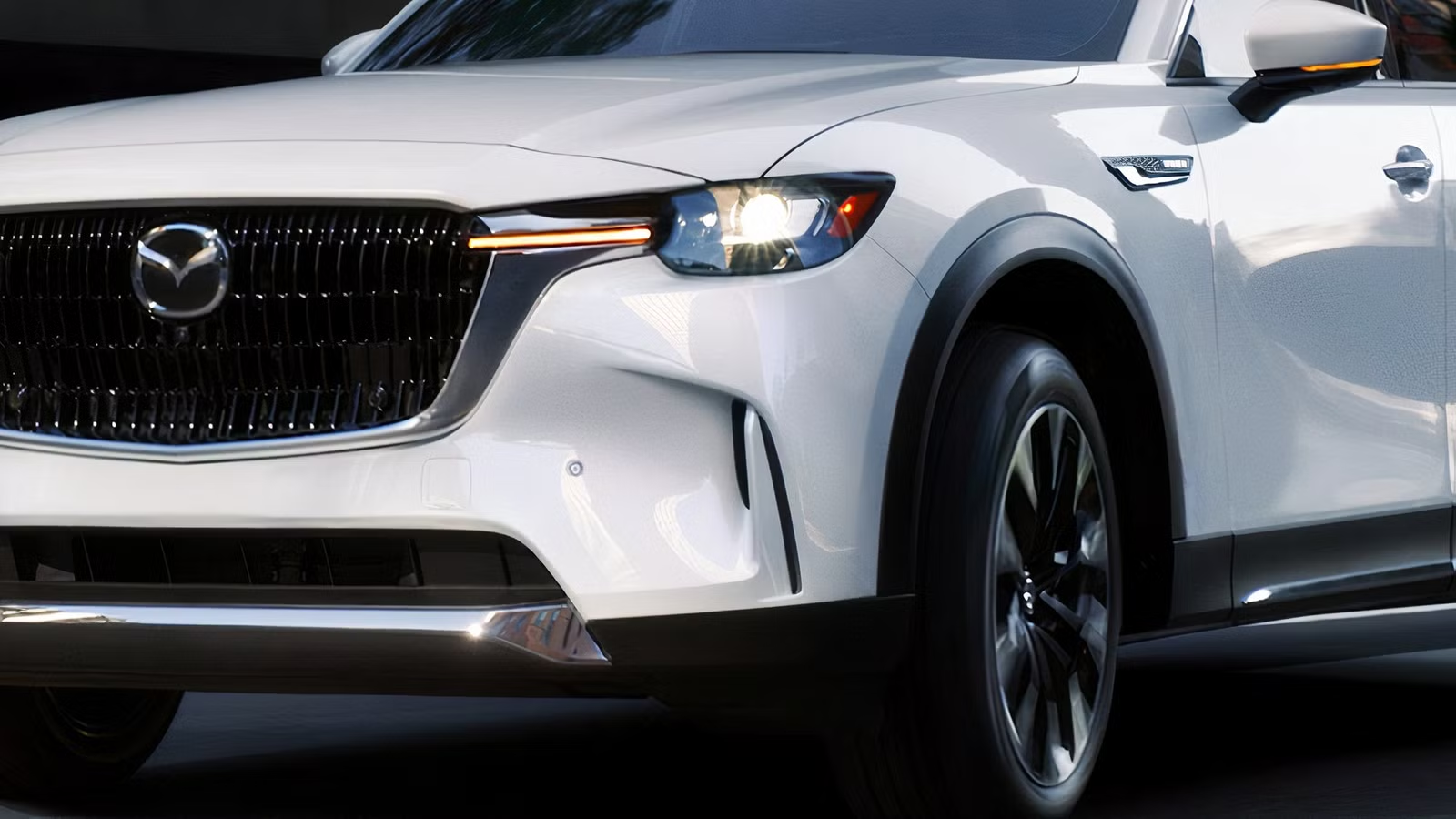
Mazda’s US sales have been on a two-year slump despite the automaker having an SUV-heavy lineup, proving that the body style isn’t a cure-all when the products aren’t resonating with buyers. Despite the brand being responsible for such icons as the MX-5 Miata and evergreen CX-5, total sales numbers for the year to date are down 6 percent compared to 2025 – which was a year in which total sales were down about 3.3 percent.
But Mazda doesn’t plan to sit around and hope things get better. According to its CEO, the automaker is preparing a raft of upgrades to help turn the situation around.
A Second Year Of Slow Sales – For SUVs Only
2026 Mazda 3 light headlightMazda
The Japanese automaker reports a decrease of 8.9% for North American sales in August this year compared to 2025, but fewer selling days this August (26 days in 2026 vs 27 in 2025) may contribute to that percentage somewhat.
Still, year-to-date numbers show 275,749 units were sold in 2026 compared to the nearly 295,000 units moved between January and end of August 2025.
For the Mazda3 sedan, there is some good news, with best-ever sales number for the four-door reported this past month – 3,452 units in August, which is more than double the number from August 2025. Even hatchback models showed a slight improvement in sales, up from 695 last August to 975 units in August 2026. The MX-5 also showed some improvement, from 840 units to 925, which is an interesting trend in the truck- and SUV-obsessed local market.
SUVs for the brand, however, have shown decreases all around, with the CX-5, CX-90, and CX-70 faring the worst.
The Problem Is With Mazda’s Biggest SUVs
2026 Mazda CX-90 side angle in white while parkedMazda
At issue is the sales performance of Mazda’s Large Platform SUVs, which include the CX-90 and CX-70 midsize duo in the US and CX-80 midsize SUV and CX-60 compact SUV globally. The four SUVs missed their sales target of approximately 200,000 vehicles last year, coming in at only 150,637 units, with the US alone accounting for more than half of the total. To rectify the issue, Mazda CEO Masahiro Moro, in an interview with Japan’s Chugoku Shimbun published in August, said significant changes are coming for the SUVs, describing them as being on an “unprecedented” scale.
This ties in with what Mazda Chief Financial Officer Jeffrey Guyton said during a financial results presentation also last month, when he said Mazda plans a number of upgrades for its Large Platform SUVs. He also said Mazda plans to launch a marketing campaign focused on safety.
Another key reason for Mazda’s sales decline has been the top-selling CX-5 registering 13.5 percent fewer sales so far this year compared with 2025. This, however, can be attributed to the nameplate’s redesign, as sales are already starting to turn around. The changeover earlier this year meant many buyers would have held off purchasing the previous model in anticipation of the new design, including those who might still be waiting for a planned hybrid option expected next year. Dealer stock would have also been constrained while production ramped up.
What Upgrades Are Coming For The Large Platform SUVs?
2026 Mazda CX-90 ExteriorMazda
In his interview, Moro said the changes will be wide-ranging, spanning the exterior, cabin, and powertrains. The comments suggest they’ll be more substantial than a typical mid-cycle refresh. Unfortunately, that means potential buyers may need to wait a little longer. Moro said the changes will take time, but in the end, people will view the Large Platform SUVs as the proper flagships Mazda intended.
The three-row CX-90 arrived for the 2024 model year and the two-row CX-70 was added to the lineup for 2025. Both SUVs are priced sharply at around $40,000, deliver impressive dynamics thanks to the rear-wheel-drive Large Platform architecture, and offer smooth and refined powertrains. The standard option is a turbocharged inline-six rated at up to 340 horsepower while a plug-in hybrid using a 2.5-liter inline-four is rated up to 323 hp.
CarBuzz Insight – Why This Matters
Mazda’s Large Platform SUVs show that impressive engineering, strong driving dynamics, and competitive pricing aren’t always enough to win buyers. Their struggles highlight just how tough the midsize SUV segment has become, where established rivals and shifting buyer preferences can make even what appears to be a well-rounded product a challenge to sell.
Time will tell whether the decline in sales from SUVs, and converse increase for the Mazda 3 lineup, hint at a new buying pattern in the USA.
Sources: Chugoku Shimbun, Mazda
