

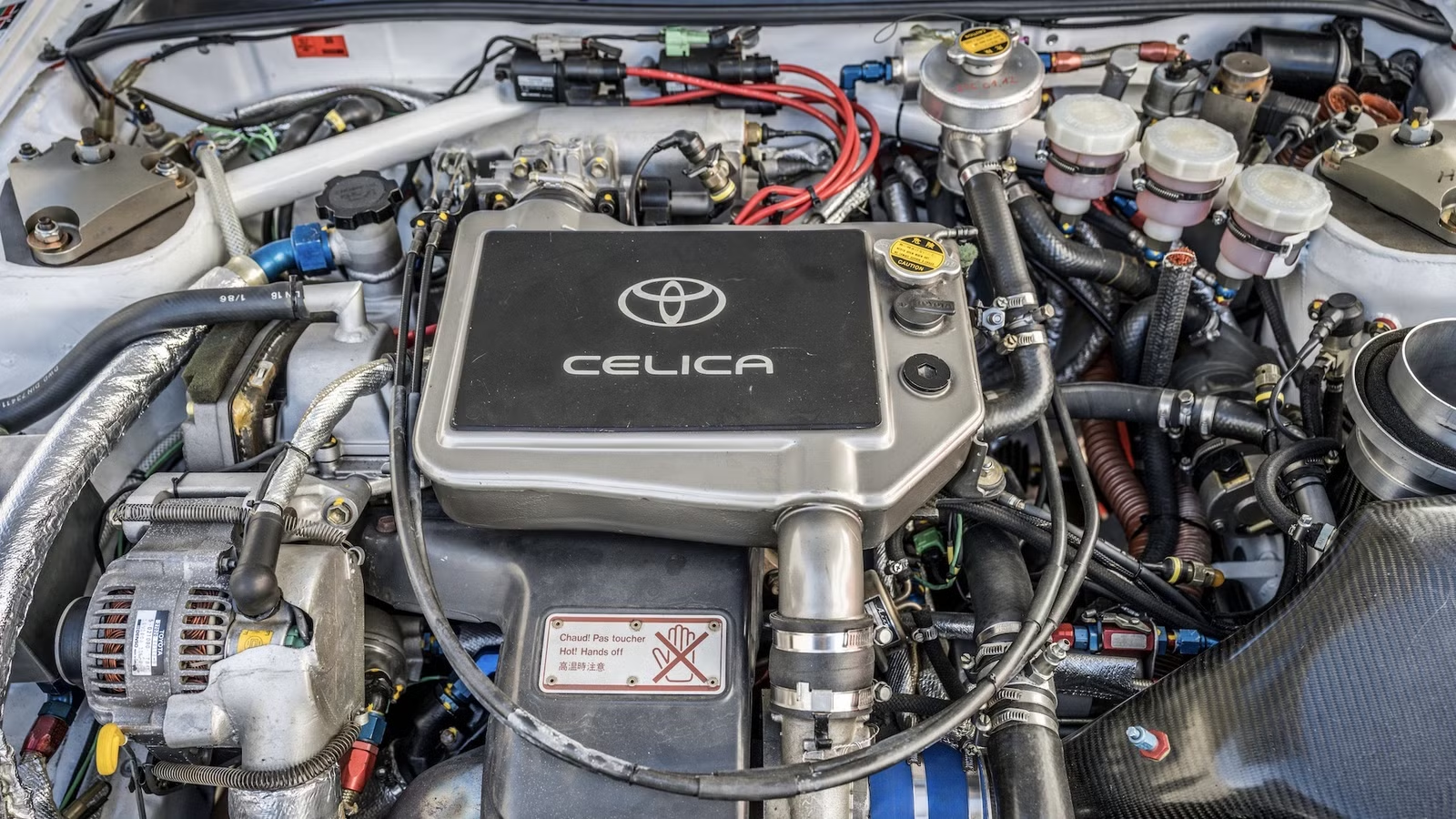
It seems basically certain that Toyota will bring back one of its most venerated names, Celica, in a fitting coupe form. We’ve seen coupe-shaped motorsports prototypes, and the company is building out its GR performance line from top to bottom.
Despite all of this, Toyota has been mum on details about the upcoming coupe, leaving many, including ourselves, to speculate on what it will be like. That includes British auto outlet Autocar, which has some interesting ideas on it.
It May Be A Sort Of Corolla Coupe
The two most interesting predictions Autocar makes regarding the new Celica are that it will be based on the next-generation Corolla platform, and that it will be an all-wheel-drive hybrid. The first makes loads of sense, since Toyota has mixed and matched parts from all over the place to create interesting products.
Exterior view of the Toyota CelicaToyota
The GR Yaris actually used rear-end components from the current generation of Corolla, and even longer ago, you could get the same high-revving 180-horsepower four-cylinder from the Celica GT-S in the plain Corolla and its hatchback siblings, the Matrix and Pontiac Vibe. A parts-bin special would also keep costs down both for Toyota and for customers.
The hybrid prediction makes some sense, since Toyota does use hybrids in just about every product it can, and obviously the next-generation Corolla platform will support hybrids. What complicates the prediction is that it seems Toyota will use a turbocharged 2.0-liter four-cylinder that’s currently in development. Toyota has shown it off in a special mid-engine GR Yaris test car with the potential to make more than 400 hp. Notably absent was any kind of hybridization.
However, it could be that Toyota would use hybrid technology to give the new Celica all-wheel drive. The front engine could provide all the traction for the front, and a separate rear motor could provide power just to the rear wheels as needed. Toyota uses the same basic setup in many of its all-wheel-drive hybrids. That would also be a way to add even more power than the already impressive 400+ hp of the engine alone. All-wheel drive would also make sense as a way to connect it with the rally car that seems to be sporting a Celica body.
Toyota GR Yaris M Concept Disguised Rear View Trunk OpenToyota
What We Know And Don’t Know About Celica
Assuming that the Celica will use a version of the new turbo 2.0-liter engine, we’re betting it will fall somewhere between the GR 86 and the late GR Supra in both price and performance. Even built off of Corolla bits, a high-output turbo engine and hybrid components can still get fairly pricey. Plus, it’ll undoubtedly be much more powerful than the GR 86, and the 86 would probably become a hard sell if you could buy a Celica with way more power for the same or less money. That does leave the question of what to do with the GR Corolla, which occupies a similar position. Will it remain as a practical alternative to the Celica, or would it be dropped to make room?
The motorsports prototypes we’ve seen suggest the body style will be a two-door coupe that could potentially have a hatchback, much like the last few generations of Celica. The prototypes, though, do have significant differences, as one is a rally test car with rather tall and stubby proportions, and the other is a track car that seems longer and lower. That latter one even has proportions indicative of a front-engine, rear-drive car, and sounded as thought it had a manual transmission. Since race cars can have significant powertrain and chassis differences to the cars they’re ostensibly based on, though, it’s hard to derive anything too concrete from them.
2027 Toyota GR GT & GR GT3Toyota
CarBuzz Insight – Why This Matters:
The development of the Celica is a sign of Toyota’s seriousness about both its performance image and its racing business. Toyota recently said that it’s aiming to have racing vehicles at all levels so that it can get drivers and customers to stick with the brand through their whole career. It only makes sense for Toyota to have road-going counterparts to those race cars both to build its reputation with buyers and have vehicles from which it can develop race cars, at least in some cases.
Source: Autocar
