

The biggest car news and reviews, no BS
Our free daily newsletter sends the stories that really matter directly to you, every weekday.
If you find yourself in a big storm without backup power ready to go, you’ll likely have a hard time picking up a generator at the store. Those go quickly when the power goes out, and building a genset yourself can get complicated. But if you have the right equipment lying around—which, surprisingly, can include a 2012 Chevy Cruze—you can keep the essentials going for five days (or more).
Two weeks ago, in mid-August, the town of Valparaiso in Indiana was declared a disaster area. The storms that ripped through the northern part of the state forced thousands to go without power. At least one person who lives there turned to their car for emergency electrical supply, and they uploaded the setup to their YouTube channel.
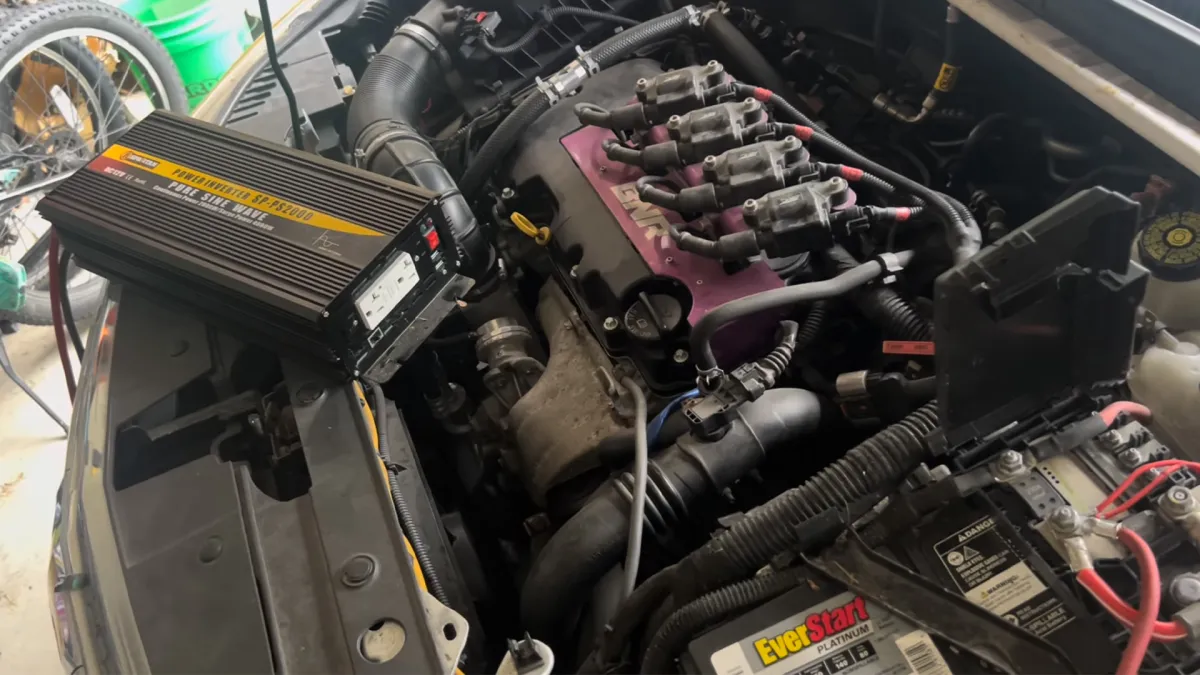
The car in question is a 2012 Chevy Cruze with the 1.4-liter turbo four-cylinder. Now, that’s not especially large as far as car engines go, but it’s plenty big for a stationary generator. Where something like the Bowtie sedan is limited is in its electrical power supply. But as this owner explains, the compact is better suited for this job than others.
Dre Dan via YouTube
This particular Cruze sports an H7 AGM battery, which is an upgrade over the standard flooded lead-acid one, as well as a factory 130-amp alternator. With the battery wired to a 2,000-watt pure sine wave inverter, rated to handle surges up to 4,000 watts, the car handled a decent number of household appliances. It was apparently enough to supply juice to two full-size refrigerators, a full-size upright freezer, a TV, lighting, and office equipment including a printer, a laptop, and an external monitor. Not bad!
With the car running for days on end, it was able to provide a steady range of 12.2 to 12.8 volts—for the most part. Under heavy loads, it typically dipped to around 11.8 volts, but they did see a low of 10.9 volts. That’s enough to trip the circuit, though they didn’t report any damage to their appliances or devices. In fact, the car would reactively increase the idle to 1,000-1,200 rpm to help spin the alternator.
After more than 120 hours of idling, the Cruze ran through several five-gallon gas jugs’ worth of fuel. The owner estimates that it consumed .22 gallons per hour, which really isn’t that bad. He’d get in the car every once in a while to give it a rev, but other than that, it was low-maintenance. And just to be safe, they sent some oil off for analysis to see if the five-day stint had any negative effects on the engine.
I Powered My House With a Chevy Cruze for 5 Days
I’m not telling you to buy a Chevy Cruze just for this purpose. But if you already have one? Shoot. Maybe you should buy whatever you lack to make this happen in a pinch.
Got a tip or question for the author? Contact them directly: caleb@thedrive.com
From running point on new car launch coverage to editing long-form features and reviews, Caleb does some of everything at The Drive. And he really, really loves trucks.
