

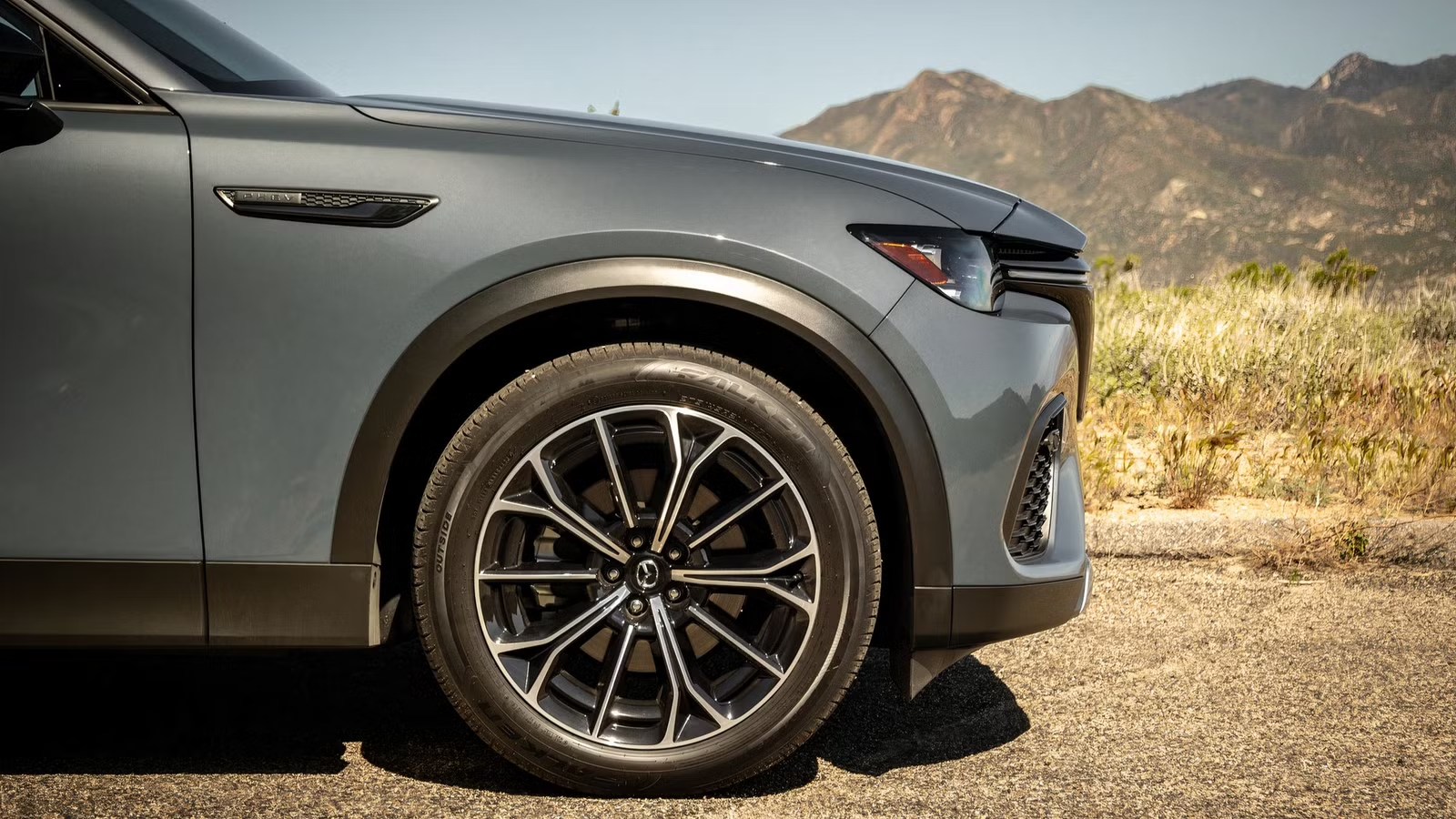
TheMazda CX-70 is one of the more interesting choices in the mainstream SUV market today, chiefly due to its reliance on a longitudinally mounted straight-six as its pure-ICE power plant. The 2026 iteration is offered with three distinct powertrain choices: a 280-horsepower six, a 340-hp six, and a 323-hp PHEV option that uses a 2.5-liter inline-four-cylinder engine.
With a 340-hp version available for a few thousand more, it seems obvious to upgrade. But the math tells a different story.
The CX-70 Has Three Distinct Personalities
2026 Mazda CX-70 front 3/4 angle in black while parkedMazda
The Mazda CX-70 is based on the CX-90, and is virtually identical to the latter. The only major difference is the CX-70 lacks a third row of seats. What makes the CX-70 particularly unusual is that it uses one body yet offers three very different personalities, depending on which powertrain you choose.
The base engine is a 3.3-liter, turbocharged iteration of Mazda’s Skyactiv-G family. It is technically a mild hybrid, sporting a 48-volt system positioned between the engine and the transmission. It also comes standard with a turbocharger, enabling it to produce 280 hp and 332 lb-ft of torque. It’s also able to muster up to 28 MPG on the highway, as well as 24 MPG in the city.
2025 Mazda CX-70 Gray Front Angled ViewIan Wright / CarBuzz / Valnet
Those who want more performance can opt for the 340-hp version of the Skyactiv-G engine. Mazda calls it the “Turbo S,” and it produces 60 hp more than the standard engine by relying on increased turbo boost pressure, from 14 psi to 19 psi, along with anoptimized ECU tunethat requires premium fuel for optimal ignition timing.
The third, PHEV option changes the CX-70’s personality the most. Instead of the 3.3-liter straight-six, it uses a 2.5-liter inline-four without a turbocharger. Instead, it’s hooked into a 17.8 kWh battery pack. With it, the PHEV CX-70 produces 323 hp and 369 lb-ft of torque. You can also drive it for up to 30 miles on electricity only, and it sports an MPGe rating of 56.
2025 Mazda CX-70 Premium Plus Gold RearMazda
So, three personalities, same body. If the CX-70 were a person, they’d probably be referred to a psychologist. However, because it’s a car and not a human, it can use its multiple personalities to appeal to a wide swath of SUV buyers without compromising on all that much.
But a spec sheet can only tell you so much. The real question is what the base engine actually gives up – and whether any of it matters.’
The Base Engine Gives Up 60 hp Without Losing The Things That Matter
2025 Mazda CX-70 driving in black front 3/4Mazda
Of those three personalities, the base and Turbo S are the closest siblings — same engine family, same mild hybrid system, and nearly identical fuel economy. So what does the extra $X and 60 hp actually buy you?
In the grand scheme of things, 280 hp is plenty for a mass-market, midsize SUV today. After all, what exactly are you planning to do with the extra 60 hp in an SUV? A few seconds of flat-out fun are entertaining, but the downsides of the Turbo S engine feel like they outweigh the advantages. Alongside the extra 60 hp, the Turbo S engine also gains an additional 37 lb-ft of torque over the base powertrain. Keep in mind, though, the entry-level six already makes 332 lb-ft. Again, plenty for what it is.
Adding to the confusion is the fact that both the standard and Turbo S iterations of the 3.3-liter Skyactiv-G engine come standard with the same 48-volt mild hybrid system, which helps increase power while slightly reducing fuel consumption. Buyers often have to choose between an underpowered four-cylinder or an upgraded V6 in SUVs, but the CX-70 avoids this trade-off; it offers essentially the same engine with slightly different characteristics.
2025 Mazda CX-70 front angle in black closeMazda
One advantage of choosing the standard, 280-hp iteration lies in fuel economy. Both the base and Turbo S engines deliver a combined average fuel economy of roughly 25 MPG. For all intents and purposes, both engines will consume the same amount of fuel over any given year.
Now, when you factor the average price increase from regular gasoline to premium, which currently sits at about 70 cents, if you drive 15,000 miles per year, you’d be spending an extra $420 on gasoline alone every year. It may not seem like much, but those extra dollars matter if you’re on a tight budget.
The Turbo S does not deliver a gain in efficiency to justify choosing it over the base engine. In the same vein, both the base and Turbo S engines can tow 5,000 lbs when properly equipped. Now, of course, the Turbo S engine will be quicker than the base. According to Mazda, the Turbo S can reach 0–60 mph in 6.2 seconds, whereas the base engine only manages the feat in seven seconds flat. Is that 0.8 seconds worth the extra money? Only you can make that decision.
As for the PHEV, it complicates matters considerably.
The PHEV Is The Performance And Efficiency Wild Card
Detail shot of the exterior accents on a 2025 Mazda CX-70Ian Wright / CarBuzz / Valnet
If the base and Turbo S CX-70s were oranges and tangerines, the PHEV would be a blueberry. It’s an entirely different thing, and it transforms the CX-70 into something not found in either pure-ICE variation. For one thing, its engine is completely different, displacing 2.5 liters and producing power from only four cylinders. However, it produces more power than the base six, and its 369 lb-ft torque output matches that of the Turbo S.
That means PHEV buyers aren’t really trading power or performance for efficiency; they’re merely combining the two. Adding to the PHEV’s on-paper supremacy isits 0–60 mph time, which has been reported to be as low as 5.9 seconds, beating the Turbo S by a decent margin, relatively speaking. On top of it all, it sports that aforementioned 56 MPGe rating and up to 30 miles of electric-only driving.
Ian Wright/CarBuzz/Valnet2025 Mazda CX-70
However, the PHEV only makes sense for a specific type of buyer. Those with a relatively short commute, roughly under 30 miles, who can charge at home can reap the full PHEV benefits. Furthermore, for those who frequently make short trips around town but rarely venture farther, the PHEV can be advantageous.
This all sounds great, and even better than the base, 280-hp powertrain in theory. PHEVs, though, need to be tended to in a specific way. They need to be charged regularly; otherwise, you don’t get the full benefit of EV-only driving. Once that EV range is depleted and the battery is nearly flat, power and efficiency drop sharply.
Once that happens, you’re left with just a 2.5-liter inline-four without a turbocharger. At the end of it all, PHEVs can carry expensive repair costs once warranties expire, and if you plan to keep your CX-70 for a while, it’s worth taking a hard look at what repairs may cost in the future.
The Cheapest CX-70 Is The Best, Unless You Have A Good Reason
2025 Mazda CX-70 Premium Plus Gold Side AngleMazda
At the end of the day, most of us can agree that 280 hp is perfectly acceptable in a family SUV. The 332 lb-ft of torque is more than enough to provide an entertaining amount of oomph, and its 25 MPG is exactly average for its segment. You don’t have to worry about paying for premium gasoline, and you don’t need to worry about constantly plugging it into a wall outlet to get the most out of its engine.
It is also capable of towing up to 5,000 lbs, provided the CX-70 is properly equipped. The higher-powered six and PHEV may be outclassed by the base option, especially when factoring in the extra cost of upgrading to one of the two higher-powered variants.
Those who opt for the Turbo S genuinely care about performance, and that’s perfectly fine. Who wouldn’t want 340 hp at the push of a pedal? Those who go for the PHEV care about EV driving range and having ample power on demand, and may not be overly concerned about maintenance costs down the line. Such buyers are relatively rare, making the base powertrain the obvious mainstream choice in the CX-70’s lineup.
2025 Mazda CX-70 tow hitchMazda USA
Mazda painted itself into a corner with the CX-70, though in the best possible sense. Because the base engine is so adequately powered, the need to get up to the more powerful options is lessened considerably. You don’t need 340 hp over 280 in most applications, as the base engine doesn’t actually feel like a compromise.
Sources: Mazda, TheDrive.com, GreenCars.com, CarPro.com.
