

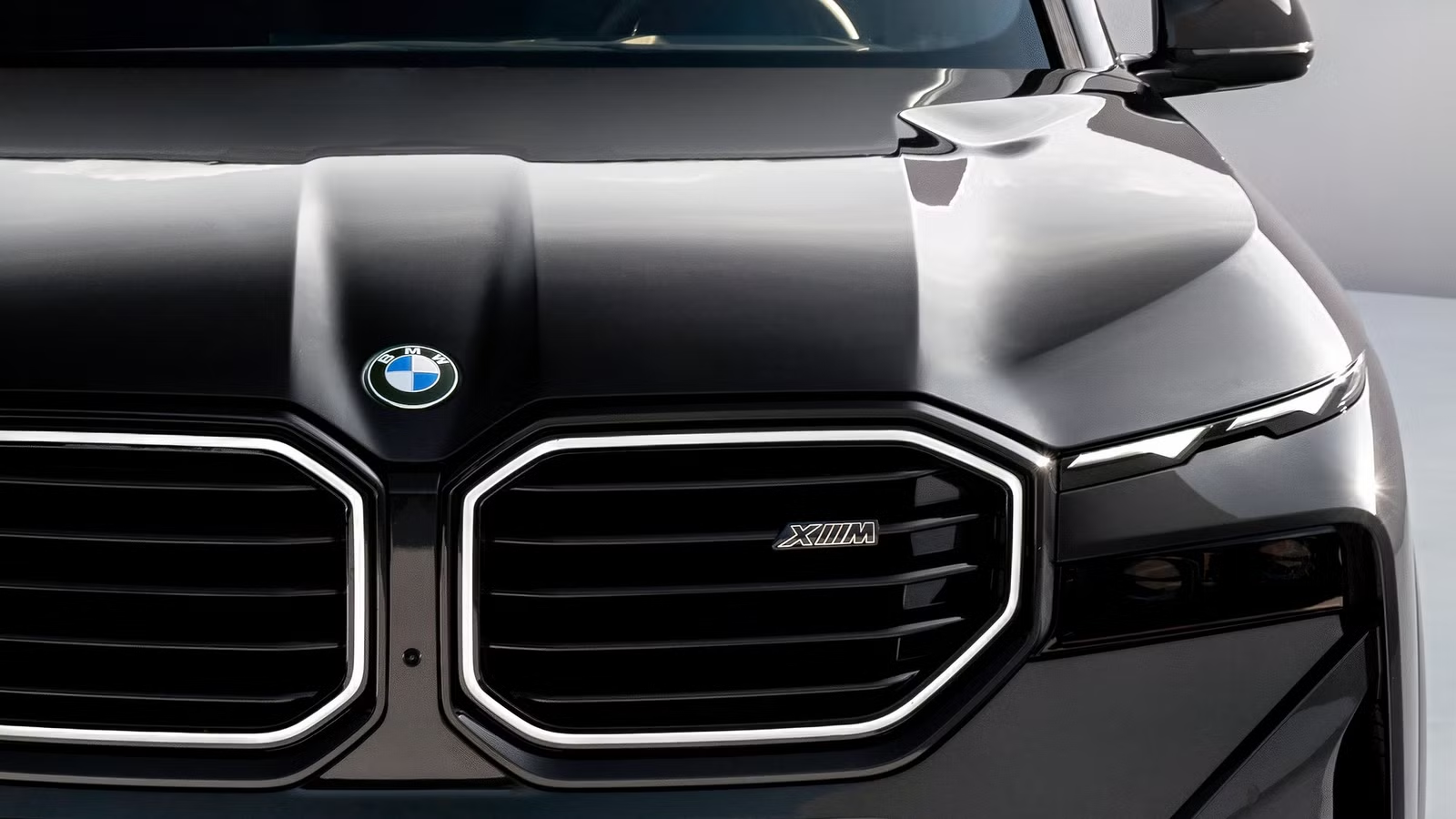
Performance flagships often fall foul of that dreaded depreciation, and BMW’s XM looks likely to join their number. There are estimates that it could lose almost $93,000 over five years, which is more than the starting price of a new M3. And when you consider that early XM Label Reds are already going on sale for about the price of an M3 Competition xDrive, second owners are faced with an interesting proposition. After all, a hefty twin-turbo V8 plug-in hybrid with lots of costly hardware might be especially attractive at a fraction of its original ask.
A $185k XM Label Red Is Already Advertised Below $90k
2024 BMW XM Label Red Black/Red Front Angled ViewBMW
To show just how dynamic the market is in mid-2026, one buyer was recently trying to sell their 2024 BMW XM Label Red with 27,473 miles on the clock for $88,898. Other Label Reds were appearing across the country at prices ranging from $93,000 to $99,000. And these are remarkable prices for a model that initially went on sale at $185,000. In essence, the asking price of that first option represents a $96,102 reduction, or almost 52% lower than the Label Red’s original base MSRP. It also happens to be just $298 more than the M3 Competition xDrive, which starts at $88,600 and is a derivative of the M3 Competition, which starts at $83,500.
Regarding the projected five-year loss, it is important to note that this is an estimate rather than observed behavior. After all, the XM only came onto the US market for the 2023 model year, with production of the XM Label Red beginning in August of that year. This means that no XM has actually completed a five-year ownership cycle. The precise five-year number remains in question and would vary by trim, options, mileage, condition, and market conditions. But the broad conclusion is nevertheless revealing: the XM might shed enough value to move from exotic SUV territory into the same part of the lot as a new M3.
Why The XM’s Value Fell So Fast
2024 BMW XM Label Red driving rearBMW
BMW’s XM is probably fighting a losing battle against depreciation for several reasons. For example, its original price was already high, which can lead to rapid depreciation from the get-go. Whereas a mainstream SUV might lose half of its value and erase $25,000 from its sticker price, an XM Label Red in the same situation could erase more than $90,000.
BMW was also trying to sell the XM to a narrow audience, and it was never going to be a conventional successor to the X5 M or simply a larger M3. Instead, this would be the first standalone BMW M model since the company introduced the M1, and BMW did its best to make it dramatic. The result was immense even by bold SUV standards, with features like over-the-top styling, a luxurious, first-class rear cabin, and a complex plug-in hybrid drivetrain.
Some buyers looking for a traditional M car might opt for the lighter and less expensive M3, M4, or M5. And at the same time, BMW was also selling a more familiar performance SUV in the shape of the X5 M Competition. Of course, shoppers could also look at products from the likes of Mercedes-AMG, Porsche, or Aston Martin, if they were already circling around the original price of the XM Label Red.
Some may even have thought that BMW’s dramatic styling was a little over the top. They may not have liked the Label Red’s illuminated kidney grille, angular bodywork, split headlights, stacked exhaust outlets, and expansive surfaces. And then there’s the plug-in hybrid system, which may also limit demand for used vehicles.
One resource suggests that BMW plug-in hybrids retain less value generally than comparable gasoline models. The XM doesn’t have a direct combustion-only equivalent, and it may therefore start from a relative weakness according to this measurement. And if this BMW declines at a projected rate of 58.1%, that will be much worse than the 44.9% average for all SUVs and the 41.5% average across all vehicles.
But a large part of this vehicle’s problem may have been due to BMW’s original decision-making. As senior editor of CarBuzz, Gerhard Horn, puts it:
What we have here is a $180,000 SUV with a severe identity crisis. It wanted to be the ultimate driving machine, and a luxury SUV, and it ultimately failed at both. BMW should know better. These are the people responsible for the E46 M3, the E39 M5, the X5 (which is all the SUV you’ll ever need), a V10-powered sedan, and my all-time favorite Bimmer, the 1M.
M3 Money Buys A Very Different Kind Of M Car
2025 BMW M3 Competition xDrive Front 3/4BMW
Some striking comparisons arise when you put an XM Label Red and an M3 Competition xDrive in the same price bracket. For some, the M3 would be the traditional enthusiast answer, as it has the redoubtable 3.0-liter twin-turbo inline-six. This engine produces 523 hp in Competition xDrive form and can propel the car to 60 mph in just 3.4 seconds. It’s much smaller, lighter, and more responsive than the XM Label Red as well, and represents exactly what you might expect from an M sports sedan.
Meanwhile, the XM Label has an M hybrid powertrain that combines a 577-hp 4.4-liter twin-turbo V8 with a transmission-mounted electric motor producing up to 194 hp. It’s the most powerful production model BMW M has released, with total system output getting to 738 hp and 738 lb-ft of torque, and it should reach 60 mph in 3.6 seconds, according to BMW estimates.
Still, the XM does have some features that the M3 cannot provide, such as five-seat SUV packaging, a higher seating position, a deeply upholstered rear M lounge, and all-wheel drive. It has up to 64.3 cubic feet of luggage capacity, and its battery should permit short trips without starting the engine.
However, in a straightforward comparison, buyers are certainly looking at two different vehicles. After all, the M3 is lighter, quicker, and more of an enthusiast proposition, whereas the XM is more powerful, more extravagant, and more spacious. This means that the XM is simply a very different expression of BMW’s M mindset.
The First Owner’s Loss Becomes The Second Owner’s Opportunity
2024 BMW XM Label Red front seats side angleBMW
A sharply depreciated XM Label Red is going to face some different owner questions than it might have done when it was brand new. An original owner may have wanted to know why it originally cost more than twice the price of a base M3. But now, a used buyer wants to know whether it would be better to choose a brand-new M3, a well-equipped X5, another premium performance vehicle, or this used 738-hp V8 hybrid.
Still, in the defense of the Label Red, the used buyer is getting a vehicle that is in no way technically ordinary. Its output still exceeds that of every other production BMW M model, and it has an extensive set of features, such as an electronically controlled rear differential and adaptive M suspension, to bolster its case.
Depreciation has therefore reduced the price without reducing the specification. The original owner absorbed the steepest part of the value curve. While there’s no guarantee that XM’s value will stop falling, the relationship between price and hardware has certainly become far more favorable.
The Purchase Price Is Just The Beginning
2025 BMW XM Label Red close-up view of front viewBMW
Flagship luxury vehicles depreciate sharply, so they often become affordable long before their components become cheap. Used buyers should therefore remember that this depreciating XM will still feature a complex V8 plug-in hybrid system, high-performance brakes, active suspension hardware, and a significant amount of electronic equipment. Most importantly, none of those systems will be less costly to repair just because the vehicle is now cheaper to acquire.
A prospective owner will also need to look closely at consumables. A heavy, powerful SUV like this can be particularly hard on tires and brakes. Insurance may also be elevated and requires a solid quote long before purchase. Buyers should pay close attention to the vehicle’s warranty status too. BMW did offer a new-vehicle limited warranty of 4 years or 50,000 miles from the original in-service date. But a 2024 Label Red may not have as much comprehensive cover left, depending on its actual mileage.
In the marketplace, buyers should conduct a proper pre-purchase inspection. During this work, they should confirm the battery’s condition, charging operation, brake life, and other important details, such as recall completion. They may find that it’s better to opt for a more expensive certified example with fresher tires, lower mileage, and meaningful warranty coverage. When they shop using these criteria, buyers may find that a certified example is more expensive than average. But it could still turn out to be cheaper to own over the long run than the lowest-priced vehicle on the nationwide search page.
The XM may have plenty to offer certain buyers due to its 738-hp, V8 performance, electric driving capability, genuine SUV space, and distinctive shape. And all of that may represent a very enticing proposition when somebody else has already paid the first $90K of its original value.
Sources: BMW, iSeeCars, Cars.com.
