

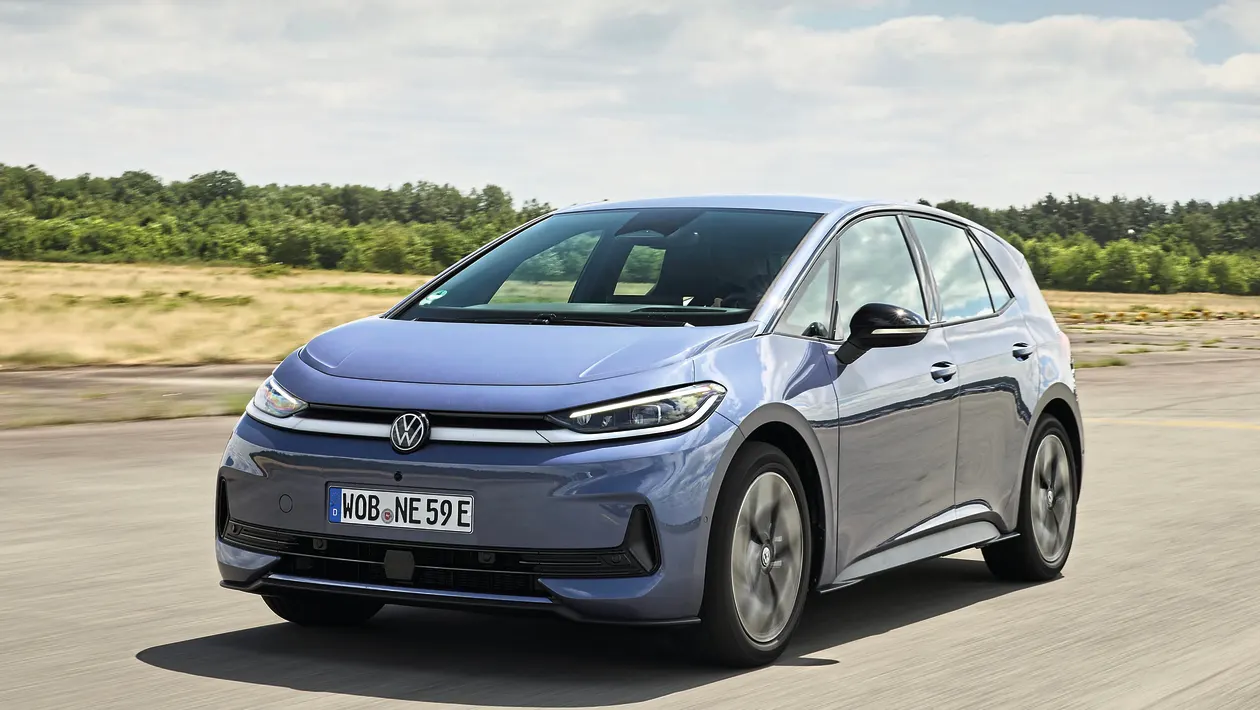
Up front, the bonnet is relatively short, and the ID.3 still does not offer a ‘frunk’ for storing charging cables. Cleverly, though, the rear-view reversing camera remains hidden away under the rear VW badge, keeping the lens clean from road grime.
Performance and driving dynamics
On the move, the ID.3 once again demonstrates exactly what Volkswagen’s engineers are capable of. Although it is certainly no lightweight, at around 1.9 tonnes, the adaptive suspension (DCC) and progressive steering set-up (likely to be a cost option) extract astonishing capability from the chassis.
The 4.27-metre-long EV reacts immediately to steering inputs. It feels remarkably agile, aided by a tight turning circle of just 10.4 metres. At the same time, it remains highly comfortable, thanks to 15 different selectable damping stages.
The rear-wheel-drive layout ensures the car always remains the master of the situation; the healthy 350Nm of torque is kept perfectly in check by an attentive stability and traction-control system. In terms of sheer polished refinement, almost no other car in this class can match it.
Advertisement – Article continues below
Under the skin, the Neo is the very first VW on the market to utilise the updated MEB+ electric platform. This means it benefits from a brand-new electric motor unit which, unlike its predecessor, runs much more efficiently to enable longer driving ranges.
