

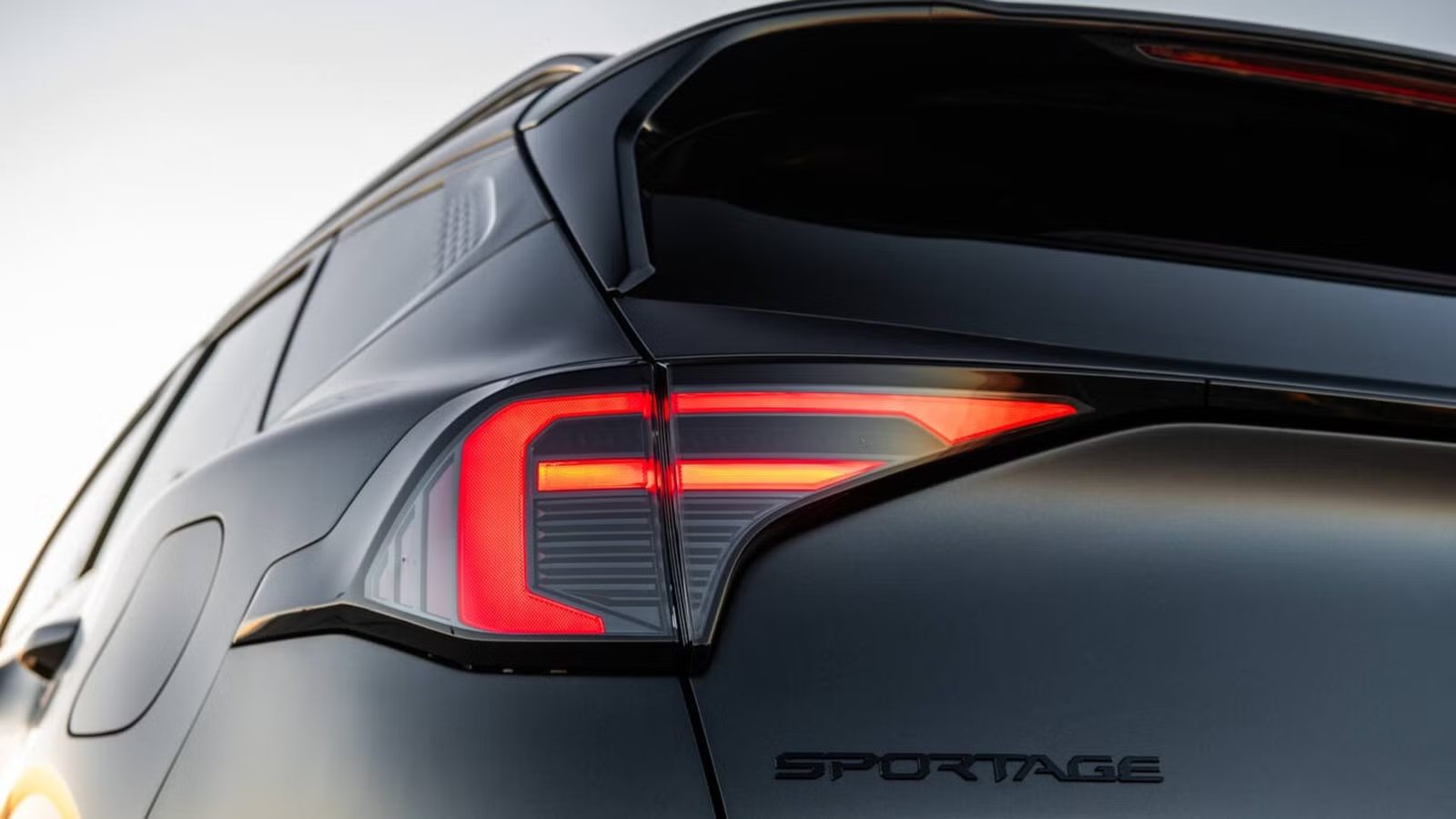
They may share the same platform, have the same engines, even share a class-leading warranty program, but parked next to each other, the latest Hyundai Tucson and Kia Sportage couldn’t look more different. While they are indeed corporate cousins, these two compact SUVs have very different personalities, with one leaning into the more sophisticated and refined look and feel, and the other offering a sportier, more youthful vibe.
But with both these city runabouts offering ICE, hybrid, and plug-in hybrid powertrains that are identical, how do you know which is the better buy? Are the actual differences between them enough to recommend one over the other? There is indeed an answer to which you should buy—and it’s quite likely you’re not expecting it. Here’s our head-to-head comparison of the Kia Sportage vs Hyundai Tucson.
All data, specs, and pricing are from the automaker, and are correct at the time of writing. The automaker may change or update this at any time. This is an on-paper comparison of the Hyundai Tucson vs Kia Sportage that includes test-drive experience, where available.
Kia Sportage vs Hyundai Tucson: Specs Comparison
2026 Hyundai Tucson PHEV front 3/4 angle in silverHyundai2026 Kia Sportage PHEV front 3/4 angle in black while parkedKia
The Kia Sportage and Hyundai Tucson both offer a variety of grades, with the Sportage being spread across seven ICE models that include a rugged X-Pro Prestige model. The Tucson has a slightly tighter lineup, also including a hardier XRT trim, but mainly focused on refined models with comfort features in abundance.
Although the Sportage is slightly cheaper in most cases, it’s not by thousands of dollars, and the Tucson recently got cheaper too:
Kia Sportage Trims and MSRP
2026 Hyundai Tucson Trims And MSRP
ICE*
HEV**
PHEV**
ICE*
HEV*
PHEV*
LX
$28,790
$30,590
N/A
SE
$29,450
$30,950
N/A
S
N/A
$31,290
N/A
SEL
$30,800
$32,400
$40,325
EX
$30,590
$32,390
N/A
SEL Plus
$31,300
N/A
N/A
X-Line
$33,090
$35,790
$40,590
SEL Convenience
N/A
$34,650
N/A
X-Line Prestige
N/A
N/A
$47,390
XRT
$33,475
N/A
N/A
SX
$34,390
N/A
N/A
SEL Premium
$33,800
N/A
N/A
SX Prestige
$36,390
$40,690
N/A
Limited
$39,425
$41,825
$48,550
X-Pro Prestige
$39,690
N/A
N/A
*2026 Models
**2027 Models
Size, Dimensions, And Aesthetics
Close
The Hyundai Tucson and Kia Sportage are corporate cousins—or perhaps twins is a better description—sharing a platform and mechanicals across all three variants. Both are compact SUVs and measure in at similar sizes and weights, with a few inches difference in length (the Sportage is 184.4 inches long while the Tucson is 182.7 inches).
Ground clearance is shared across all models, too, at either 7.1 inches or 8.3 inches, depending on trim and drivetrain. Both have similar curb weights ranging from 3,400 pounds to 4,200 lbs, with the heavier setups belonging to the plug-in hybrid derivatives. The differences, then, are purely aesthetic.
Close
The Sportage has a much bolder and more assertive look that follows the brand’s latest angular design language. The Tucson range is sleeker and more subdued, and would arguably appeal to a broader audience. It’s difficult to pinpoint a winner in the looks department, as that is highly subjective, so we’ll need to look for other important differences to decide on a winner.
Performance And Fuel Economy
2026 Hyundai Tucson tire wheel rimHyundai
The big kicker with these two compact SUVs is the variety available in the lineup based purely on powertrains. Both the Kia Sportage and Hyundai Tucson come in three variants: non-hybrid, hybrid, and plug-in hybrid.
The non-hybrid twins both use a 2.5-liter inline-four to make 187 horsepower and 178 lb-ft, and both have an eight-speed automatic across all trims. These are all FWD by default, with AWD as an option. The HEV Tucsons and Sportages also make use of the same hybrid setup, which comprises a 1.6-liter turbocharged four-cylinder, but the outputs aren’t the same. The Hyundai Tucson Hybrid makes 231 hp combined, while the Sportage Hybrid puts out 232 hp—that’s right, one horsepower more. A six-speed automatic does duty across both models, sending power either to the front wheels or all four corners, depending on trim. Both crossovers have a towing capacity of 2,000 lbs.
Plug-In Hybrid models are also mechanically the same, with the system making a combined 268 hp and 271 lb-ft on both the Tucson PHEV and Sportage PHEV. Towing remains the same (2,000 lbs) and AWD is standard on all models.
Tucson vs Sportage performance winner: Draw.
With so much similarity, what differences are there actually between the Tucson and Sportage?
Gas Mileage Differences: Tucson vs Sportage
2026 Hyundai Tucson HybridHyundai
For the ICE models, gas mileage figures are also identical: front-wheel drive Tucson and Sportage models are rated at 25/33/28 mpg on the city/highway/combined cycles, while the AWD models get 24/30/26 mpg.
Hybrid models finally show some differences with the Hyundai Tucson vs Kia Sportage battle for fuel economy resulting in a surprising winner. The Tucson in its most frugal form (Hybrid Blue) gets 38/38/38 mpg, with other models managing 36/37/36 mpg. The Sportage Hybrid with FWD does the best at 40/42/41 mpg, dropping to 35/36/35 mpg with AWD.
The Plug-In Hybrids are even more different, with a clear winner emerging. Tucson PHEVs have an all-electric range of 32 miles, and manage an impressive 77 MPGe, defaulting to 35 mpg combined when the battery runs out. The Sportage PHEV has 33 miles of range, but earns a healthy 83 MPGe and 36 mpg combined on gas alone, making it the better of the two for efficiency.
Tucson vs Sportage fuel efficiency winner: Sportage
Sportage vs Tucson: Practicality and Versatility Compared
2027 Kia Sportage HEV and PHEVKia2026 Hyundai TucsonHyundai
They may be similar on the outside and share mechanical bits, but there is something to be said for the interior, the available trims, and why there is actually a price difference in the Hyundai Tucson vs Kia Sportage debate.
Space And Dimensions
2026 Hyundai Tucson Hybrid AWD NightHyundai2026 Kia Sportage. Cabin. InteriorKia
Despite both cars having identical wheelbases of 108.5 inches, interior packaging sees some differences in interior space. The non-hybrid Sportage models have 39.6 inches of headroom at the front, and 39.4 inches at the rear, which drops to 37.8 inches with the sunroof equipped. The Tucson offers more at over 40 inches front and 39.5 inches rear. Legroom is the same for both models, at 41.4 inches front, and 41.3 inches rear.
The hybrids are slightly different, but the Tucson Hybrid still has the most headroom at 40.1 inches front and 39.5 inches rear. Legroom in the Tucson hybrids is the same as in the Sportage Hybrid, so the main difference is for front-seat passengers, who lose half an inch in the Sportage Hybrid compared to the Tucson Hybrid.
Cargo volume in the segment matters, with the Sportage being more spacious with all seats up. Behind the second row of seats, it offers 39.6 cubic feet for non-hybrids, 39.5 on the HEV, and 34.5 for the PHEV. The Tucson, by comparison, offers 38.7 behind the back row in both ICE and HEV models, with the plug-in hybrid having just 31.9 cubes. Fold down those seats, and the Tucson takes the lead, with over 74 cubes for ICE and HEV variants, and 66.3 cubes on the PHEV. The Sportage maxes out at 74.1 on the gas model, 73.7 cubes on the hybrid, and 65.5 for the PHEV.
Tucson vs Sportage interior space winner:
- Passenger space – Tucson
- Cargo space with seats all down – Tucson.
- Cargo space with rear seats up – Sportage
Feature Comparison: Tucson vs Sportage
2027 Kia Sportage HEV and PHEVKia
There has to be a reason there’s a price difference between the Sportage and the Tucson, and it comes down to the various trims and what they are equipped with. There are 25 trims between these two models, so to be concise, we’ll look at the base and top model of each.
The base Kia Sportage has basic air conditioning, manual seat adjustment, cloth upholstery, a 12.3-inch touchscreen and matching digital gauge cluster, and a six-speaker sound system. Wireless Android auto and Apple Carplay are standard. The same applies to the base Tucson, except for the base model having a 4.2-inch gauge cluster over the larger 12.3-inch on the Sportage. Top models in the gas lineup have heated and ventilated front seats, dual-zone climate control, a heated steering wheel, a sunroof, faux leather upholstery, an 8-speaker Harman Kardon system, and wireless phone charging. The same applies to the Tucson, but there you get leather seats and heated rear seats in the top trim, too—starting at $39,425, which is a few hundred dollars cheaper than the Sportage.
“A comfortable interior, smooth and quiet ride, and easy handling along with a good range of standard and available features makes this SUV a great pick for families.”
– Nicole Wakelin, Former Road Tester, CarBuzz
For the hybrids, the most expensive Tucson comes in at $41,825, and it’s fully equipped with every available feature, while the priciest Sportage Hybrid goes for $40,690—features are largely the same, save for a few arguably negligible differences in seat adjustment and Harman Kardon sound versus Bose.
The halo models in both lineups are the plug-in hybrids, with the 2027 Kia Sportage X-Line Prestige being the top model, priced at $47,390. The 2026 Hyundai Tucson has the Limited PHEV at $48,550 as its most expensive model, with all the bells and whistles.
Tucson vs Sportage features winner: Tucson
Safety And Reliability: Hyundai Tucson vs Kia
2027 Kia Sportage Hybrid, PHEV and assemblyKia
Even when it comes to safety, the Sportage and Tucson are more similar than anything else: both earn the highest safety scores from the IIHS, including a 2026 Top Safety Pick+ award, which is reinforced by a five-star safety rating from the NHTSA.
As for reliability, the 2026 Hyundai Tucson is rated at 83 out of 100 by JD Power, while the 2026 Kia Sportage is one point up at 84 out of 100 for quality and reliability. The NHTSA shows four recalls for the 2026 Tucson, and one recall for the 2026 Sportage. While both offer the same class-leading warranty cover, it’s Kia that has the edge here.
Tucson vs Sportage reliability winner: Sportage
Kia Sportage versus Hyundai Tucson: Which Model To Buy In 2026?
With more similarities than differences, it’s not as easy to find a winner in this comparison—and much of your decision is going to come down to personal preferences for how each crossover looks, whether you want the most refined features, and which brand you prefer.
In our comparison, the Sportage ticks the most boxes for efficiency, reliability, and value-for-money pricing, even though the Tucson isn’t that much more expensive and offers more features for the money on upper trims.
“However, the Sportage, even if it’s not perfect, still has an amazing combination of practicality, power, and efficiency that is still among the best in class, and this year’s updates just keep the excellent vehicle relevant.”
– Joel Stocksdale, Senior Road Tester, CarBuzz
- Buy the Tucson if you want a reliable, refined, feature-laden compact SUV for your small family.
- Buy the Sportage if you value efficiency, a sportier aesthetic, and bang-for-buck value that will keep you on the road for years to come.
Sources: Hyundai, Kia, EPA, NHTSA, IIHS, JD Power
FAQ
Q: Which is better, Tucson or Sportage?
The Tucson is the better buy if you’re looking for refinement and more comfort and convenience features; the Sportage is better if you want maximum fuel efficiency and reliability.
Q: Which SUV is better, Hyundai or Kia?
Depending on what segment you are shopping in, Kia and Hyundai SUVs can be largely the same – like the Sportage vs Tucson comparison here, it comes down to what your needs are.
Q: What Hyundai is equal to the Kia Sportage?
The Hyundai Tucson is built on the same platform as the Kia Sportage, and they share the same engines, outputs, and even towing figures. With pricing only differing by a few hundred dollars and a very different look, the Tucson is almost identical to the Sportage mechanically.
Q: How much cheaper is the Sportage than Tucson?
At the entry point to the 2026 range, the Sportage is $660 cheaper than the Tucson (correct at the time of this writing).
