

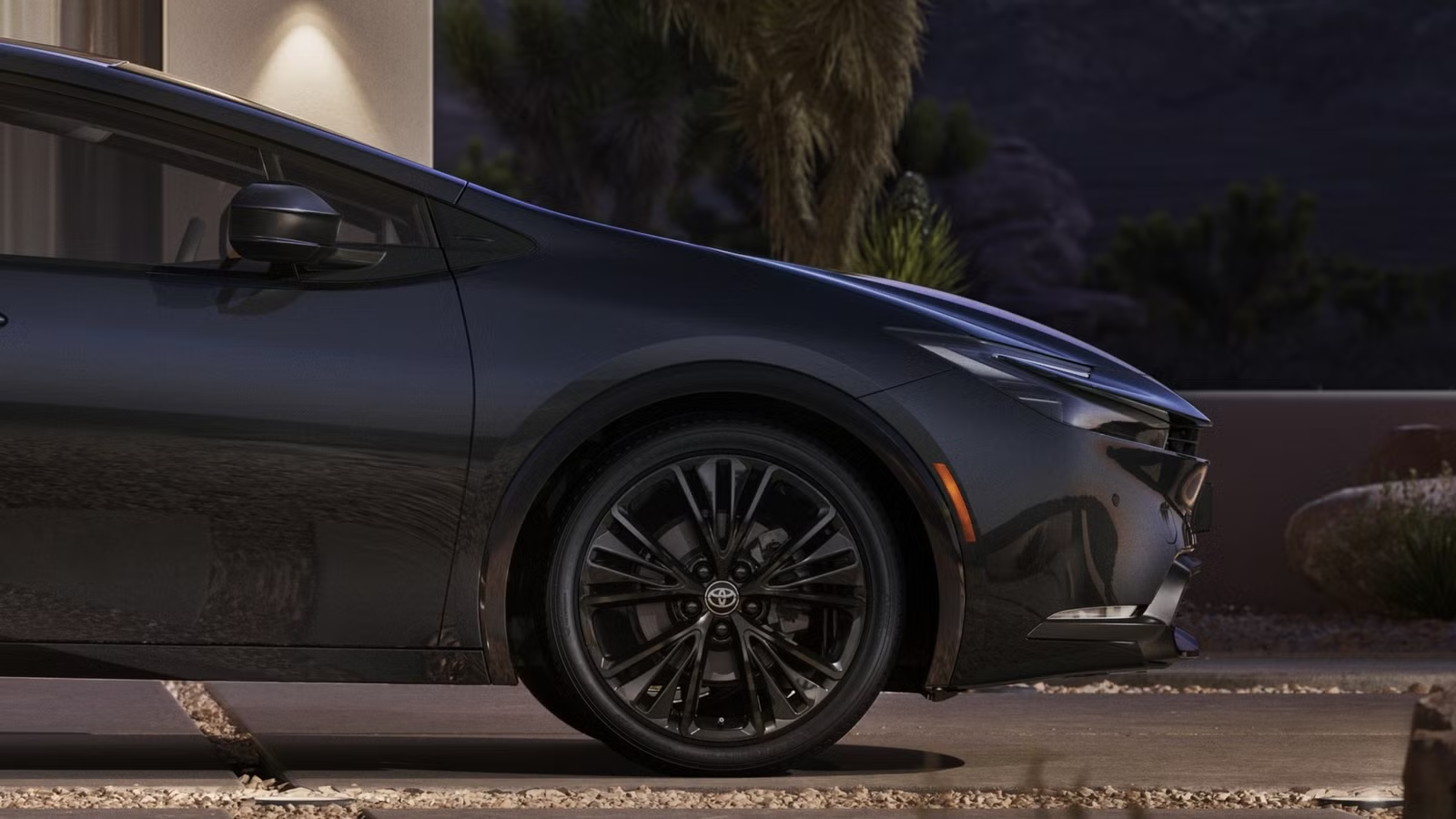
At a time when fuel pricescontinue to be apocalyptically high, with the average price of gas across the US still sitting at north of $4 per gallon as of July 2026, buying a new hybrid seems like a smart plan. Thanks to using an electric motor and battery combo alongside a conventional internal combustion engine, hybrids provide the ideal compromise between day-to-day usability and impressive efficiency that’ll help you extract more mileage from your money.
When it comes to choosing which one to spend your cash on, the choice has never been easier.
The Prius Remains A Truly Excellent All-Rounder
2023 – 2026 Toyota Prius front 3/4 angle in white while parkedToyota
ThePrius was one of the cars that started it all, having only trailedHonda’s Insight in terms of being thefirst mass-produced hybrid machine to reach the US. Toyota’s challenger landed in the States for the 2001 model year, and was aimed at those looking to save money on gas while going about their daily duties, or at those looking to help preserve the environment due to how much less waste the Prius expelled from its exhausts compared to conventional internal combustion-engined vehicles.
It wasn’t the fastest vehicle compared to conventional ICE alternatives when it first arrived, considering it only put out a combined 97 horsepower, but things have changed drastically in the 25 years since.
In 2026, the model has taken its fifth form, and it’s as efficient and usable as ever. In an effort to make the Prius more appealing to a wider range of buyers, Toyota has worked hard to develop the Prius’ hybrid powertrain over the years to provide plenty of usable power, while retaining its class-leading efficiency.
The fifth-gen Prius has achieved this impressively, with its 2.0-liter inline-four and 83 kW single electric motor combo producing a combined 194 hp in base front-wheel drive trim, and 196 hp when the all-wheel drive option is selected. With the latter, a smaller 30 kW motor is loaded onto the rear axle.
This is more than enough power to keep the Prius moving swiftly through the city or on the highway, while remaining competitive with other pure ICE or hybrid options on the market. But, that’s nothing when you factor in just how frugal it is.
The Prius’ Rivals Could Only Wish To Be As Efficient
2025 Kia Niro Hybrid rear 3/4 angle in green while parkedKia
While the Prius ismuch faster than it once was, its real standout quality is just how little fuel it needs to deliver this performance. With an average of 57 MPG, achieved courtesy of 57 MPG city and 56 MPG highway figures, it is comfortably the most efficient hybrid on sale in the US. One of its closest rivals is the Kia Niro Hybrid compact SUV, which can only muster up an average of 53 MPG on the combined cycle.
The upshot is that, despite the Prius only having a fuel tank measuring 0.2 gallons larger, it can be expected to travel 647.5 miles before it needs filling. The Niro, on the other hand, can only manage 588.3 miles, which is a significant difference despite the two cars having practically identical tanks. The Kia will cost a little less to fill based on the current average US gas price of $4.11 per gallon ($45.51), though the difference amounts to less than a dollar. The Prius will cost $46.33 to fill.
Over 10,000 miles, you can thus anticipate roughly 15.4 fills to keep the Prius going, whereas the Niro should need 16.9 fills. This translates to a saving of around $56 for the Prius during this period.But the Niro isn’t even the Prius’ toughest challenger — its longest-standing Japanese rival paints an even starker picture.
The Prius’ Biggest Japanese Rival Fares Even Worse
2025 – 2026 Honda Civic Hybrid 11th Gen (FE) Facelift Sedan side angle in redHonda
This difference increases even further when you factor in arguably the Prius’ biggest and longest-standing competitor: theHonda Civic Hybrid. The Civic also sports a hybrid-assisted 2.0-liter I4 power plant, though the car is well over 100 lbs heavier than the Prius. When combined with a powertrain that is less fuel-efficient than its rivals, you’ll do well to average 49 MPG in the Civic, a full 8 MPG short of what the Prius can manage.
When combined with the Civic’s more compact 10.6-gallon tank, you’ll have tomake do with a 519.4-milerange, which is just shy of 130 miles short of what the Prius can achieve. What’s even more striking is that you’ll only have to spend a few dollars more to travel all this extra distance, as the Civic will require $43.46 to fill it completely based on the current average fuel price.
Over 10,000 miles, you’ll thus have to spend an extra $121 to keep the Civic filled compared to the Prius.Of course, efficiency alone doesn’t win buyers – the Prius also has to justify itself on performance and price. And this is where the argument gets even more interesting.
The Prius Stands Out As Great Value For Money In Performance Terms
2023 – 2026 Toyota Prius rear 3/4 angle in blueToyota
These impressive fuel figures only become more attractive when you figure in the kind of performance you get versus its closest rivals. The Kia comes up well short with a combined power figure of just 139 hp, though the Honda does have it beat thanks to a peak output of 200 hp. A strong 232 lb-ft torque figure for the Civic means that, despite weighing considerably more, it’ll also reach 60 mph just over half a second faster than the Toyota.
Still, given how much more efficient the Prius is, it’s doubtful the extra performance will make enough of a difference to justify the trade-off.
For reference, the Niro Hybrid isn’t even in the same conversation as the other two, as it’ll take north of nine seconds to reach 60 mph. And then, we come to how much of your hard-earned cash you’ll have to hand over.
Whereas the Kia does perform well in this regard, with the base LX variant demanding just $27,090 from your wallet, the more efficient and more powerful Prius LE is only $28,550. The entry-level Civic Hybrid Sport is the most expensive of the bunch, as you’ll need to cough up $29,295 to secure one. Considering how effectively the Prius combines performance and fuel efficiency, though, its very competitive entry-level pricing makes it nearly impossible to ignore.
The Prius Matches Its Rivals On Features – Then Adds More Trunk Space For Free
2023 – 2026 Toyota Prius exteriorToyota
The Prius also scores well when it comes to standard equipment for the money, as you get dual-zone climate control, electric folding mirrors, an Apple CarPlay/Android Auto-equipped 8.0-inch touchscreen infotainment system, and a suite of safety features. Adaptive cruise control is included with the standard LE model, as is blind-spot monitoring and hill-start assist, meaning you get all the modern basics without having to spend a cent extra.
The Prius stacks up well against the competition, as it comes with practically the same standard features as the Niro Hybrid, though the Civic does score well here. Even though it’s $800 more expensive, you do at least get heated front seats, a power moonroof, and a more powerful audio setup for your trouble. That said, the Prius does offer a higher-quality cabin and arguably a sharper exterior design compared to its close rivals. There’s also more trunk space in the Toyota than in either the Civic or the Niro, while its cabin is comparably sized to those of both rivals.
If you do want some extra toys to play with, you can always spend a little more and upgrade to the XLE trim. This will get you front and rear parking assists, more upmarket SofTex-coated seats, a wireless charging pad, and heated seats, among other additions. That said, you will have to spend just over $3,500 more, so you’ll have to consider whether the additional cost justifies the extra features it brings. Ultimately, most families should find the standard equipment in the base Prius LE more than adequate, though the option of some extra creature comforts is there if needed.
Its rivals may well prove stiff competition from a value-for-money standpoint, especially where standard equipment is concerned, but the Prius remains commandingly ahead from a technical standpoint. It stacks up excellently from a performance perspective, but all the while leaves other hybrids red-faced as far as efficiency goes. It’s also reliable, and holds its value as tenaciously as any competitor in the segment.
The Prius, in short, is still better than all the rest.
Sources: Honda, Kia, Toyota.
