

The Acura NSX is often remembered for delivering a level of refinement and everyday usability that made the exotic supercars of its time look like the product of a cottage industry in comparison. But it wasn’t the first supercar to do this. More than a decade prior, BMW achieved something similar with the M1 – a homologation special featuring a wedge shape and a mid-engine chassis initially developed in partnership with Lamborghini. It remains BMW’s only supercar to date.
The M1 stood out for its impressive performance and razor-sharp handling, helped by lightweight construction and an almost perfect 50:50 weight distribution. Its exotic, futuristic styling also saw it quickly become the stuff of bedroom wall posters and automotive legend. However, the M1 was also horrendously expensive – costing more than many Porsches and even some Ferraris when it launched. Combined with a delayed and limited arrival in the all-important US market, the car’s commercial fate was ultimately sealed, leaving it as a rare and revered icon rather than a sales success.
Born Out Of Racing
1978 BMW M1 Race Car Front ViewBMW
It was in 1972 that BMW brought together the company’s motor racing activities under the umbrella of a single company, BMW Motorsport GmbH, known today as BMW M or simply the M division. The division was run by former racing driver Jochen Neerpasch and immediately found success racing the 3.0 CSL Batmobile in various touring car championships, primarily in Group 2 competition. To meet homologation rules, a road-going 3.0 CSL launched in 1972 alongside the race car, which today is considered the M division’s first road car.
1978 BMW M1 Race Car Front ViewBMW
However, Neerpasch and his small team – a total of 35 engineers – always wanted to build a standalone race car from scratch, instead of starting with a regular BMW model like the 3.0 CSL, which was based on the 3.0 CS coupe. Neerpasch eventually got his chance with a new race car to be developed to compete in Group 5 competition. Homologation rules required at least 400 road cars to be launched, and thus the M1 was born.
The inspiration for the car’s wedge shape came from the BMW Turbo concept unveiled in 1972 and designed by the legendary Paul Bracq, BMW’s design chief at the time. Another design legend, Giorgetto Giugiaro, founder of Italdesign Giugiaro as well as the newer GFG Style, which he founded with his son Fabrizio, took on the task of designing the M1. He retained the wedge shape and small nostrils of the Turbo concept, as well as the idea of using two BMW logos at the rear. However, Giugiaro’s design used conventional doors instead of the concept’s gullwing arrangement.
1978 BMW M1 Race Car Aerial ViewBMW
After a protracted development, which we’ll get to later, the M1 finally debuted in 1978, but by then the Group 5 rules had changed. Instead of canceling the M1’s racing program, Neerpasch came up with the idea to launch a one-make series built around the car, which resulted in the M1 Procar Championship. It ran in 1979 and 1980 as a support series for Formula 1 races held in Europe, and many top F1 drivers were involved, like Niki Lauda, Nelson Piquet, and Clay Regazzoni. Later, the M1 raced in various Group 4 and Group 5 competitions through private teams, including the 24 Hours of Le Mans and the IMSA GT series.
An Italian Romance That Didn’t Last Long
1978 BMW M1 Front ViewBMW
Given the M division’s small size at the time of the M1’s development, as well as its lack of experience with mid-engine cars, BMW turned to Lamborghini for help. The Italian supercar marque had just been sold to a group of Swiss investors by founder Ferruccio Lamborghini and was selling the Countach and Urraco. Lamborghini’s finances were shaky at the time, and thus the automaker was willing to take on the extra work.
1980 BMW M1 Rear 3/4 ViewBMW
The plan was that Lamborghini would help develop the M1’s chassis, as well as build both prototypes and production examples. Some of the innovations included a tubular space-frame chassis and lightweight fiberglass body. However, Lamborghini’s poor finances led to the M1’s launch missing the 1977 deadline, forcing the M division to hastily mock up a 320i race car for Group 5 competition. After Lamborghini managed to build the first few M1 prototypes, BMW took back full control of the project, and Lamborghini entered bankruptcy protection.
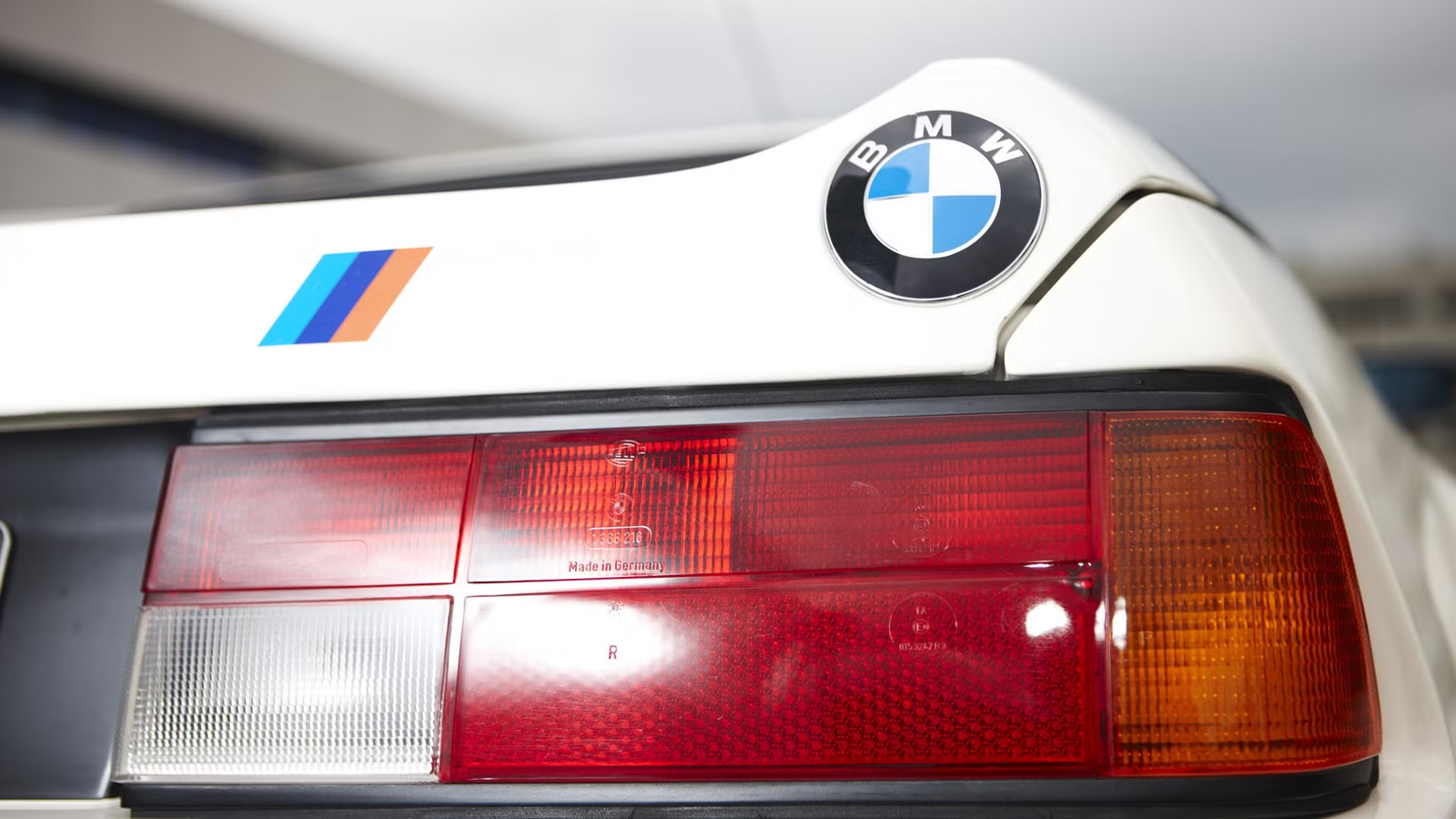
1979 BMW M1 Badge CloseupBMW
It was early 1978, and BMW still needed to complete the car. BMW’s solution was to hire Marchesi, an independent engineering outfit based in Italy, to build a chassis for the M1. Italdesign worked on producing body parts and interiors, while final assembly was handled by German company Baur. BMW needed at least 400 units to meet homologation rules, and ultimately 453 examples were built between 1978 and 1981, when production came to an end. Of that total, 54 were race cars. Given the rarity, today M1s can easily sell for over $500,000 at auction and some with celebrity ownership or racing provenance fetch closer to $700,000.
BMW M1 Driving Impressions
1978 BMW M1 Interior Driver AreaBMW
Although technically German, the M1 was far more Italian in its DNA – and we’re not just talking about the fact that it was penned by an Italian designer. It goes deeper. You notice this as soon as you hop into the driver’s seat. Anyone taller than six feet will have trouble fitting in the M1. Your head will be rubbing against the headliner (the height of the car is less than 45 inches), and while the steering wheel will be straight in front of you, your legs will be angled toward the center of the car. This was common with many Italian supercars of the period, including – unsurprisingly – the Countach. Then you’ll need to get accustomed to the dog-leg shift pattern and a rearview mirror that barely shows anything more than the engine cover.
Collecting Cars. The M Collection. BMW M1Collecting Cars
But beneath this veneer of awkwardness, there’s glorious engineering, including a twin-disc clutch that’s light but still offers a sense of connection. Likewise, the steering is light but communicative, and the shifter, once you’re used to it, is immensely satisfying – though it still shouldn’t be rushed. The suspension, featuring double wishbones up front and a multi-link setup at the rear, is also a real treat. It maintains balance and composure while soaking up bumps in a way automakers seem incapable of engineering some 40 years later.
Collecting Cars. The M Collection. BMW M1Collecting Cars
The star of the show, however, is the longitudinally mounted inline-6 known as the M88. On paper, its numbers don’t look that impressive – especially compared to modern engines – but the M1 weighs less than 3,000 lbs. More powerful rivals were often much heavier. The engine’s sound is also unforgettable, especially as you ring it out near its 7,000 rpm redline. With the engine’s individual throttle bodies mounted just inches from your ears, the sound from behind the wheel is both intoxicating and deafening. You can’t hold a conversation – nor would you want to. Incredibly, some M1 race cars ran turbocharged versions of the M88 with outputs ranging to as much as 900 hp.
Future Attempts At Building A Supercar
BMW NazcaBMW
Even though the M1 wasn’t a commercial success – and not really a motorsport success either – the car lit a passion within BMW to one day return to the supercar arena. Since the M1, there have been two solid attempts. The first came in 1991 with the reveal of the Nazca M12 concept. Conceived as a spiritual successor to the M1, the M12 was also envisioned as a halo car for BMW’s newly developed M70 V12 engine. That same engine would later serve as the foundation for the S70/2 V12 that powered the McLaren F1.
BMW Nazca C2 SpiderBrian Snelson/Wikimedia Commons
BMW once again teamed up with Italdesign for the project, and the collaboration resulted in a more refined evolution unveiled in 1992: the Nazca C2 which was built in both coupe and open-top versions. In 2015, Alpina founder Burkard Bovensiepen revealed that BMW had approached Alpina about potentially turning the Nazca C2 into a production model. However, Alpina’s calculations showed that the car would be so expensive to build that it simply wouldn’t sell. Bovensiepen also revealed that a similar conversation happened a decade earlier. After BMW ceased production of the M1, it asked Alpina whether it wanted to continue producing the car. Alpina again looked into it but concluded that, with the changes it wanted – like fitting its own turbocharger and expanding the interior – the car would end up priced out of viability.
The BMW Vision M Next conceptBMW
BMW made another push for a supercar more recently. Domagoj Dukec, the former BMW designer who now heads design at BMW-owned Rolls-Royce, revealed in 2024 that BMW had seriously considered turning its Vision M Next concept from 2019 into a production car. Internally referred to as the i16, the vehicle would have been a plug-in hybrid supercar, built on the i8’s carbon-fiber chassis and fitted with a more powerful combustion engine. Dukec even released several of the original design sketches. While he never stated exactly why the project was canceled, rising costs and the disruption caused by the pandemic were likely key factors.
And so the M1 remains BMW’s only true supercar – a one-off icon that continues to cast a long shadow. Despite several promising efforts, BMW has yet to bring a true successor to market.
Sources: BMW
