

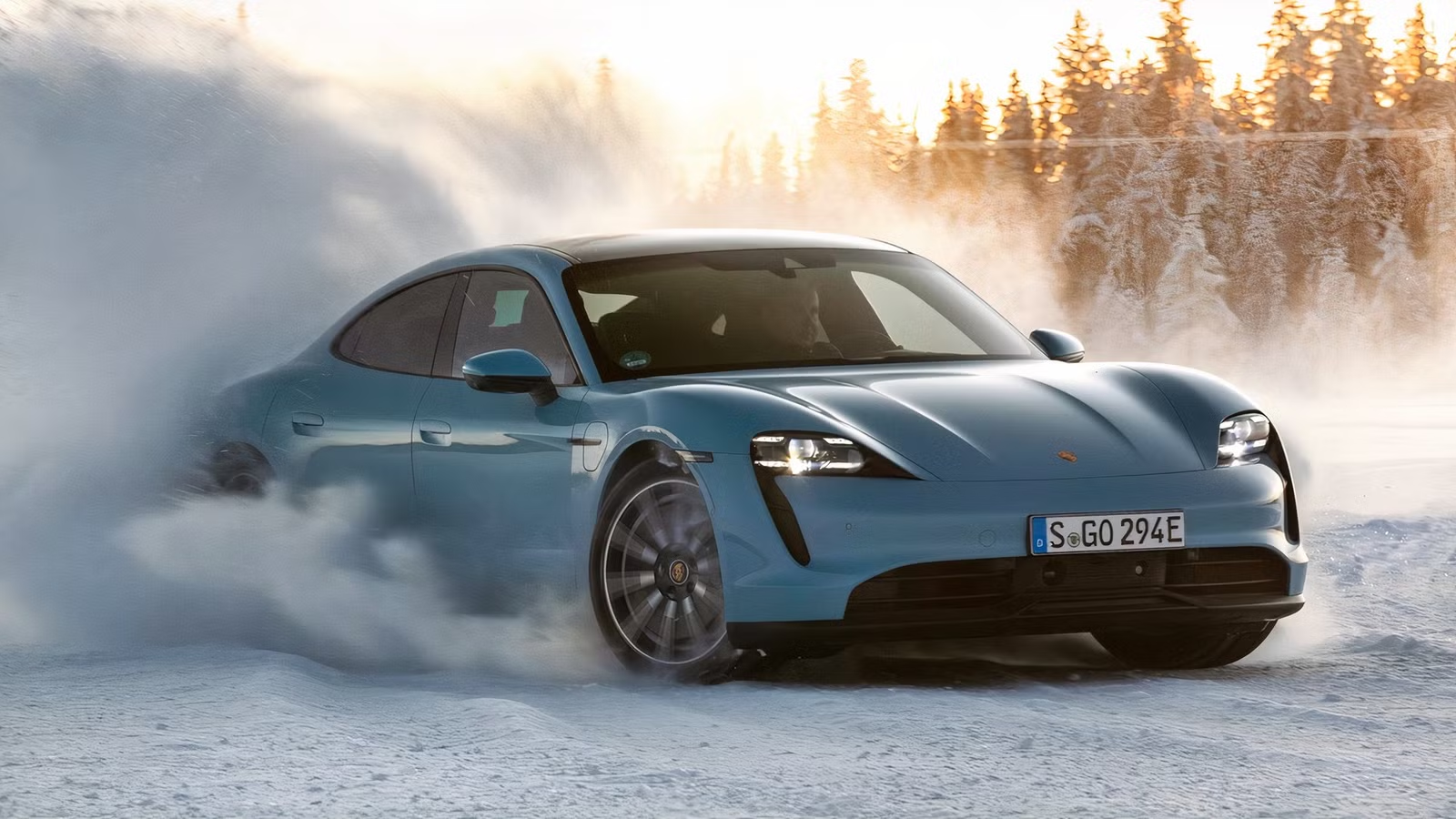
The Porsche Taycan has proven to be an incredibly popular electric vehicle, with a premium interior and sporting twist that truly deserves the badge on the front. However, spending six figures on a brand-new one just isn’t an option for most motorists, and judging by the model’s depreciation behavior, it might not be a great option for those who can afford it, either. Fortunately, shopping around on the used market provides us all with some much more intriguing options.
Once A Segment Leader, Now A Depreciation Magnet
The Porsche Taycan debuted for the 2020 model year, and it immediately impressed in the premium EV sector. Of course, buyers had largely gone for various Tesla models before the Porsche’s release, but now there came a very serious rival from one of the most desirable brands in the business. It had sporting prowess, familiar styling, immaculately presented cabins, and excellent roadholding manners.
In 2020, the Taycan’s first full year on sale, Porsche moved 4,414 examples of the EV. That number more than doubled for 2021, with 9,419 sales reported by the automaker, and 2022 saw the EV’s success continue, with 7,271 sold. While those figures aren’t close to troubling the firm’s SUV sales, they did eclipse 718 and Panamera sales, and got rather close to 911 sales as well.
Clearly, the Taycan made a strong early impression. As the years progressed, another clear pattern was emerging in the price of used examples. The Taycan made a very compelling new EV purchase, but the value of secondhand cars was crashing. There was a simple reason for it.
EVs are tech-heavy and relatively new to the market. Development during the late 2010s and early 2020s was happening at a lightning-fast rate. While that was great for those buying the latest and greatest, it meant that even relatively recent models became outdated rapidly.
Porsche made moves to keep slightly older Taycans as relevant as possible by dishing out over-the-air updates that updated a variety of systems to match the performance and capabilities of newer models, but prices continued to crash. This was far from a Taycan-only issue, with other high-end EVs behaving similarly on the secondhand market.
A Closer Look At The Taycan’s Crashing Residuals
2020 Porsche TaycanPorsche
According to iSeeCars, most new cars tend to shed around 41% of their value after the first five years on the road. That’s a big enough pill to swallow as it is, but EVs fare even worse, even with a Porsche badge on the hood. The same outlet reports that Taycans drop 55% of their value over the same length of time. So with a brand-new 2026 Taycan kicking off at $100,300, that equates to a residual value of just $45,135 after five years of ownership.
Shockingly, that’s actually quite a solid performance, with iSeeCars also reporting the average loss for a luxury EV over the same time period to be 59.5%. Still, that’s not exactly a stat for owners to get excited about. What it does mean, however, is that a five-year-old Porsche Taycan now presents itself as a tantalizing prospect for bargain hunters. All they need to do is figure out which grade to buy.
Picking Out The Taycan Sweet Spot
2020 Porsche TaycanPorsche
Anything older than four or five years is where cars start to become a little maintenance-heavy, and even without timing chains and oil leaks to worry about, a European luxury sedan like the Taycan is not likely to become wallet-friendly when it starts falling apart. So, we would avoid recommending 2019 to 2021 models as the perfect bargain, as after a few years of service, they could be 10-year-old money pits. What we’re looking for here is something to own, thoroughly enjoy, and then be able to move on for respectable money after a couple of years of service, without needing to restore the thing in the meantime. With that being said, the 2022 models look to be the best bet, since they’re heavily depreciated at five years old but not so old that the hardware underneath is failing yet.
As bargain-hunters, what we’re looking for specifically is a grade that A) prioritizes affordability, and B) provides a full, premium experience, worthy of the investment. So, to focus on affordability, we can remove the blisteringly quick Taycan Turbo S because it’s a range-topping model that kicked off with a starting MSRP in 2022 of $186,350. Even with 55% depreciation to hit that price, the Turbo S is still an expensive car, and not what anyone could call a true “bargain.” For the record, a quick search online reveals that Turbo S cars still fetch around $100,000.
Let’s also remove the base Taycan from the running. Yes, it’s a bargain on the used market, but it’s the only rear-drive grade, as it misses out on the front motor and makes do with conventional suspension rather than the adaptive setup from the higher grades. It’s no good simply buying the base model, as that could easily feel like paying solely for the prestige of the badge. Instead, we need to highlight something a little higher up the food chain.
This leaves us with the 4S, GTS, and Turbo. Respectively, the original MSRPs of these models were $105,150, $131,400, and $150,900. While the sporty GTS and unnecessarily (but hilariously) powerful Turbo are no doubt excellent cars, it’s the 4S that really shines as the Taycan sweet spot in 2026.
It sports a dual-motor setup, which sees output swell from the base 402-hp to 530-hp, plus it naturally has all-wheel drive too. It then benefits from the aforementioned adaptive suspension setup, which introduced both an adjustable ride height plus various presets, namely Range, Normal, Sport, and Sport Plus. Other upgrades include larger brakes, better and larger wheel designs, and upgraded headlights, too.
Looking on the CarBuzz Marketplace, we can see the Price Trends tool highlights an average price for the 2022 4S model of $60,590, which is just around $800 more than what a base model commands. That’s a lot of added value, for not much extra outlay. For reference, the GTS model demands almost $86,000, and the Turbo even more, at which point the bargain aspect seems to be lost.
Why Now Is The Right Time To Buy
2020 Porsche TaycanPorsche
Right now is the perfect time to buy a used Taycan, and the reasons are abundantly clear. They are heavily depreciated, but still modern enough to be relevant, and crucially, new enough to qualify for compelling financing options, which only serves to boost affordability. Plus, it’s important to revisit the reliability factor.
At five years old, a quality product like the Porsche Taycan is still a perfectly dependable car that will not be falling apart at the seams. As cars approach 10 years and beyond, they certainly do not become unreliable overnight. Maintenance does become more of a concern, as both mechanical and electrical systems begin to age out of their life expectancy.
What To Watch Out For Before Buying
2020 Porsche TaycanPorsche
That being said, buying a depreciated Taycan is not a purchase to be made unthinkingly. Buyers should be wary of the following when looking to secure Stuttgart’s hugely successful EV:
- Battery packs have been known to fail, and replacement costs are nothing to laugh at because such a job could quickly approach the car’s value. Be sure to check the battery health when inspecting used Taycans, double-check the terms of the warranty offered, and don’t be afraid to pay for an independent inspection from a specialist.
- Tires and brakes on EVs take a particular hammering, so watch out for serviceable items which are approaching end-of-life.
- Issues with infotainment systems have been known, most commonly denying users access to navigation, climate control, reverse camera, and audio sub-menus, so be thorough when inspecting the system.
Of course, there are risks involved with buying a used Porsche, but generally speaking, the Taycan is a pretty safe space to throw $60,000 in when looking for a dependable commuter. Pick the grade well, but be even pickier when singling out the correct example; spending time buying the right car could save buyers thousands in unwanted repair and maintenance bills further down the line.
Sources: Porsche, iSeeCars.
