

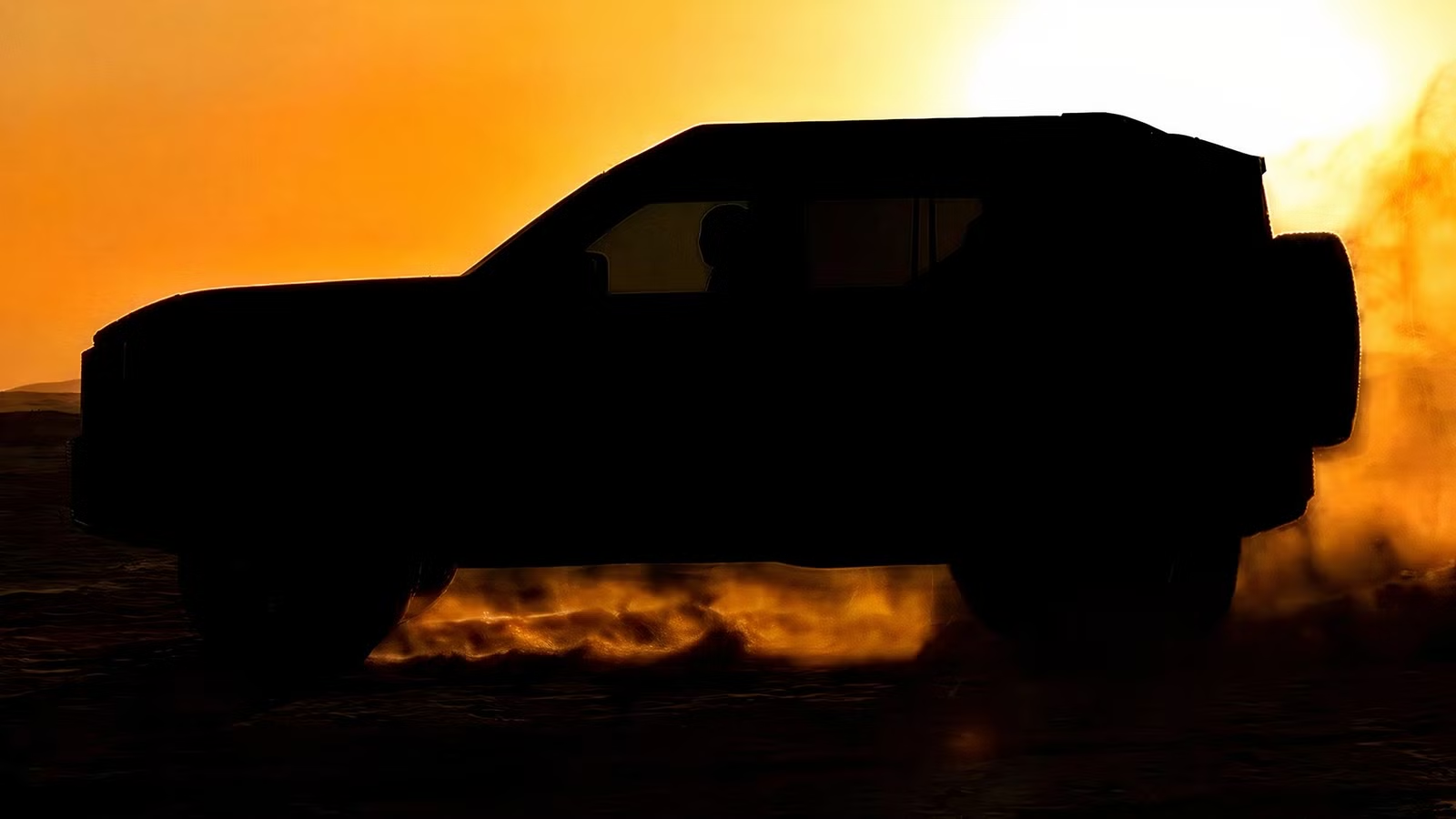
The ladder frame has been around for nearly as long as the automobile itself. Its basic design is relatively easy to manufacture, not to mention its strength and durability. However, unibody chassis are usually far more comfortable on the road. With buyers favoring comfort and convenience over all else, it only made sense to switch over to unibody platforms that could accommodate family, commuter, and other basic needs that don’t require towing or hauling frequently.
Plus, unibody designs are better suited for an all-electric future that so many automakers promised (unless you count the upcoming Scout Terra pickup truck that uses an EV or EREV system on a ladder frame — more on that later). As brands continue to roll back their EV promises with declining customer interest and a persistent lack of infrastructure investment, body-on-frame models are making a comeback.
Ladder Frames vs Unibody Chassis: What’s the Difference?
Bare frame and drivetrain from 2027 Ram 1500 SRT Rumble BeeJoel Stocksdale / CarBuzz / Valnet
Body-on-frame vehicles, otherwise known as ladder frame vehicles, are exactly what the name suggests. A ladder frame is made up of two frame rails that run the entire length of the vehicle, and are connected perpendicularly by cross members. The photo above shows the ladder frame of the upcoming Ram 1500 SRT RumbleBee. Here you can see how the engine and drivetrain components are mounted in between the two frame rails. The body of the vehicle is constructed separately, then bolted to the frame.
A unibody chassis combines the frame and body into one solid unit. Most passenger cars are constructed using this method, since it’s generally lighter and more rigid than ladder frames.
Despite Aging Design, Ladder Frames Win in Some Important Aspects
2026 Toyota Tundra Platinum trailer towing driving front 3/4Toyota
One type of frame/chassis isn’t necessarily better or worse than the other, they simply have different purposes. The ladder frame design is better for heavy-duty trucks and SUVs, since it can tow and haul more than a unibody model, it sits higher for better ground clearance (making it ideal for off-roading and overlanding), and it’s generally more durable or rugged.
Unibody cars, on the other hand, usually handle better on the pavement than body-on-frame models. They have far lower centers of gravity, their lighter construction means they can get better fuel economy, and flex/twist less than a ladder frame due to being more rigid.
Unibody Trucks Don’t Have the Same Gusto
2026 Hyundai Santa Cruz – rear 3/4 angle in gray while drivingHyundai
While unibody passenger cars are great for most people, there are a handful of unibody trucks on the market that can’t really handle heavy-duty truck stuff. Let’s get down to some numbers here, using the Honda Ridgeline and Santa Cruz as our unibody examples, and the Toyota Tacoma and Chevrolet Colorado as our ladder frame examples, since all four are midsize pickups.
Both unibody examples are the strongest in their segment of unibody midsize trucks, while the Colorado/GMC Canyon represents the highest towing capacity in its segment of ladder frame midsize trucks. The Ridgeline and Santa Cruz can both tow up to 5,000 pounds when properly configured, while the Tacoma peaks at 6,500 pounds, and the Colorado can tow up to 7,700 pounds.
Payload capacity tells a similar story, with the Ridgeline tapping out at 1,583 pounds, while the Tacoma can haul up to 1,710 pounds in its bed. The unibody chassis has its place in the automotive industry, but isn’t the best for truck stuff.
Body-On-Frame Models Are Coming Back
2029 Nissan Xterra teaser closeup of the front fasciaNissan
To be completely fair, the body-on-frame models never left. There have always been ladder frame trucks and SUVs, and there probably always will be in the United States, but we’re about to see a surge of new examples join the market in the next couple of years.
Highlighting Nissan as an example shows previous ideas of an electric future now gone in favor of updating current gas models and even bringing back the famed Xterra SUV. The old model remains a popular choice today, as you can see by its current value in the chart below, which goes to show a new body-on-frame Xterra will be a welcome addition to the brand’s lineup as early as 2028.
Another example of an upcoming ladder-frame model is the Hyundai Boulder concept, which should go on sale as a finalized production model before 2030. Scout Motors’ Terra pickup truck and the Traveler SUV are two of the most exciting upcoming models (set to debut for the 2028 model year), since they combine electric powertrains with rugged ladder frames.
Why Are Ladder Frames Making Their Return?
2027 Scout Motors Terra Pickup Exterior Front 3/4 angleScout Motors
There’s no way to know exactly why there are a bunch of upcoming ladder frame vehicles, but we can draw some conclusions. We attribute the return of the ladder frame to any number of problems and solutions in our politics and societal differences. Our analysis brings us to a few main points:
- Declining EV interest means a return to what was already available
- EV mandates in states like California have been overturned, meaning automakers can invest in less efficient, more rugged platforms
- Since the pandemic, car enthusiasts and other car owners have returned to the outdoors, requiring vehicles to get them there
The electric vehicle craze is simmering down as buyers are realizing how steeply EVs depreciate, how expensive they are up front, and how they’re still afraid of battery replacement costs down the road. Not to mention that the politics of EVs are changing. California once mandated that all passenger cars and light trucks would have to be zero-emission vehicles by 2035; this mandate was overturned by the United States Senate last year. This action can be attributed to helping automakers invest in more rugged, less efficient platforms with ladder frames and gas engines.
Politics aside, ladder frame vehicles are coming back simply due to popular demand. The country saw a mass return to nature during the pandemic, not unlike the Romantic period of literature — car buyers’ desire to get outdoors, go camping, trail riding, desert running, overlanding, and more meant they were buying vehicles that made those hobbies more accessible. Body-on-frame trucks and SUVs are the most capable off-roaders and adventure rigs, so those vehicles surged in popularity.
We can’t forget that some brands are even committed to combining EV architecture with body-on-frame construction. Models like the mentioned Scout Terra and the existing Rivian R1T and R1S prove that you can have the best of both worlds for the right price.
Half of the Best-Selling Cars Use Ladder Frames
2025-2026 Ford F-150 front 3/4 angle in redFord
Ladder frame models are here to stay, and we can prove it with sales figures. Of the top ten best-selling models for all of 2025, half were built on ladder frames. In ninth place was the Toyota Tacoma, which sold 274,638 units, then the GMC Sierra came in sixth place with 348,222 units. Ram picks up fifth place, having sold 374,059 pickups (including the light and HD models). Chevrolet secured second place with its Silverado light and heavy-duty models at 569,093 units sold, and, of course, Ford took first place with the F-Series pickup trucks at 801,525 units sold.
Unibody Models Aren’t Going Anywhere, Either
2023-2025 Honda CR-V Hybrid rear 3/4 angle in silverHonda
It goes without saying that the other half of the list is taken up by unibody models. Most are less expensive, more comfortable, more fuel efficient, and take up less room on the road, so they won’t be going anywhere, either. As far as sales are concerned, 10th place in 2025’s battle for the most units sold went to Chevy for the Equinox, which sold 274,356 units. The Toyota Camry sold 316,185 units and the Tesla Model Y sold ~317,800 units, placing them in eighth and seventh, respectively. Finally, we arrive at everybody’s favorite compact SUVs, the Honda CR-V and Toyota RAV4, which sold 403,768 and 479,288 units, earning them fourth and third places.
Ladder Frames Don’t Have to be Regressive
2026 Toyota Tundra TRD Pro perched on rock in WaveMaker BlueToyota
We talked a lot about how electric vehicles aren’t as popular anymore, thereby handing the future off to ladder-frame gas guzzlers. However, that doesn’t have to be the case. Many buyers and automakers agree that hybridization is the future for gaining better fuel economy and higher power output while reducing emissions. Some automakers are already combining their rugged SUVs and pickup trucks with hybrid or electric powertrains. See Toyota, for example, with its 4Runner, Tacoma, and Tundra — all of which are rugged ladder-frame off-roaders and workhorses that can be equipped with hybrid powertrains.
We’re also excited to see what comes from Rivian next, since its mission as an electric car company coincides with its goal to appeal to adventure seekers. And of course, the Scout Motors models should be a sight to behold when they debut. It goes to show how we can have the heavy-duty, tall, durable models we crave, while progressing towards a cleaner future.
The Ladder-Frame’s Revival Doesn’t Equal the Demise of Unibody Cars
Hyundai Boulder Concept side angle in silverHyundai
No matter why ladder frame models are making a comeback, we’re happy to see it. There will always be a mix to choose from, which is even better; if you want a pickup truck that handles like a car, then the Honda Ridgeline, Ford Maverick, or Hyundai Santa Cruz will have your back. Otherwise, the rest of us have a range of durable SUVs and trucks of all sizes to handle heavier workloads and adventuring. We can have gas and diesel ladder-frame vehicles side-by-side with hybrid and electric models, and all of them can perform well in terms of towing, hauling, off-roading, and street driving.
Sources: Summit Racing, CarandDriver, Chevrolet, Hyundai, Toyota, Honda, Scout, Nissan
