

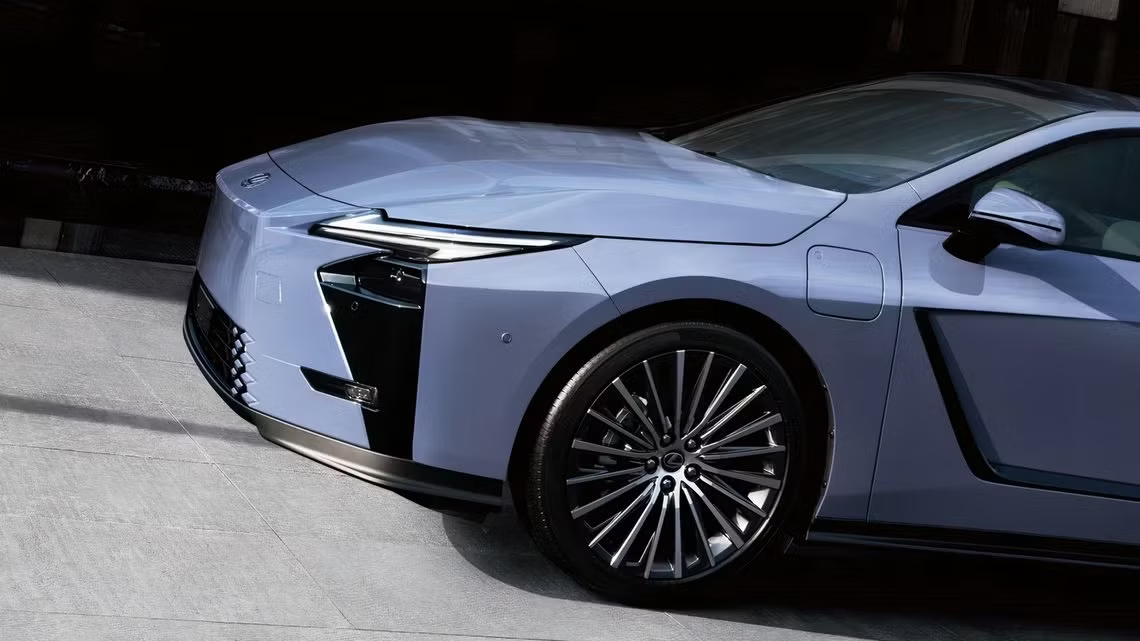
Even luxury car buyers are having to shop thoughtfully, these days. Value for money has never been as important as it is in 2026 where purse strings have been tightened globally. Still, shopping for a luxury midsize sedan isn’t asking for six figures – but if you’re careful, you can get a premium car with all the luxury trimmings for an actually affordable price. No, we’re not suggesting a top-tier mainstream car – but consider the Lexus ES vs Mercedes E-Class. Both are respected sedans from premium automakers, offering similar products, but only one automaker goes all in on giving you the best bang for buck right now.
This is an on-paper comparison that pits the Lexus ES vs Mercedes E-Class with insights from test-drive reviews where available. All prices and data are correct at the time of writing.
Lexus ES vs Mercedes E-Class
Lexus made the ES all new for 2026, and the package is more modern than ever before. It’s been around for eight generations, first introduced in 1990, and has earned a solid reputation for making premium cars accessible.
The new model wears a handsome new suit, and comes with a fresh powertrain lineup that brings efficiency to the forefront without compromising on the expected quiet and comfortable ride. But it goes up against serious competition in the form of Mercedes-Benz’s E-Class sedan.
The Mercedes-Benz E-Class is only a little younger, having made its debut in 1994; there are six generations of E-Class sedan, and it also has an electrified counterpart in the EQE. The brand is known for elegance and luxury, which makes the ES vs E-Class comparison seem like a no-brainer. But what if Lexus had figured out a way to one-up the German brand?
2026 Mercedes E-Class vs Lexus ES: Performance & Specifications
2026 Lexus ESIan Wright/CarBuzz/Valnet
2026 saw major changes for the ES, and the range is now entirely electrified. The standard ES has hybrid power, and there’s an all-electric ES, too. The hybrid lineup has four trims, all with 244 horsepower and 173 lb-ft from a 2.5-liter inline-4 hybrid setup. Power goes to the front wheels as standard, but all-wheel drive is available. FWD models can do 0-60 mph in 7.3 seconds, and AWD versions shave two-tenths off that time. It’s the electric models you have to give attention to, however.
The electric ES models come in two flavors: the 350e with 221 hp, or the 500e, with 338 hp. The 350e models are FWD by default, and need 7.4 seconds for the benchmark sprint. The Lexus ES 500e trims are AWD and can do 0-60 mph in just 5.1 seconds.
2026 Mercedes-Benz E-Class Sedan EngineMercedes-Benz
The Merc E-Class has four models in its lineup, with the base E 350, the E 350 4MATIC, the E450, and the AMG E 53 Hybrid completing the range. Base models have 255 hp and 295 lb-ft (courtesy of a 2.0-liter turbocharged inline-four) and need 6.1 sec for the 0-60 sprint. The E450 has 375 hp and 369 lb-ft and drops the 0-60 time to just 4.4 sec. It has a 3.0-liter turbocharged inline-six under the hood.
The EQE Sedan goes up against the ES electric, with 315 hp as standard from its all-electric powertrain, and either 416 lb-ft or 564 lb-ft, depending on whether you opt for the 4Matic version or not. It can dispatch 0-60 in between 5.5 and 5.8 seconds (the quicker time being for the AWD version).
For pure performance in the Lexus ES vs Mercedes E-Class contest, it’s the Mercedes that leads the way with more power and quicker acceleration. How will it fare when it comes down to brass tacks?
The More Luxurious Sedan For 2026
2026 Mercedes-Benz E-Class Sedan DashboardMercedes-Benz
Despite Lexus’ reputation for being premium, can it really go toe-to-toe with a Mercedes-Benz? The German automaker is synonymous with luxury and comfort – and the price trends that go along with that. The entry-level E-Class is the E350 sedan, which comes with 255 hp, rear-wheel drive, and a host of standard features to justify its $63,900 starting price (this excludes destination fees). For the money, buyers get:
- Leather-wrapped steering wheel
- 18-inch wheels
- 7 airbags, auto parking, blind-spot warning with exit assist
- Faux leather upholstery with heated front seats
- Panorama roof
- Dual-zone climate control
- 12.3-inch digital gauge cluster
- 14.4-inch multimedia display
- 6-speaker sound system
- Wireless Apple CarPlay and Android Auto
There are various optional extras that add to your total price, such as ventilation for the front seats, a Burmester 4D sound system, heated rear seats, a heated steering wheel, and the Mercedes Superscreen. So how does the Lexus ES compare?
2026 Lexus ESIan Wright/CarBuzz/Valnet
Closest in power to the E-Class is the all-electric 221-hp ES 350e Luxury, which has a starting price of $55,900. It’s 23 hp down in comparison, but it also costs $8,000 less – yet it has all of the above features from the Merc E350, as well as:
- Semi-aniline leather
- Heated and ventilated front seats
- Heated steering wheel
- Radiant knee heater
- Power moonroof
- 19-inch alloy wheels
- Head-up display
- Wireless charging for devices
- 17-speaker Mark Levinson sound system
Even at the top of the Lexus ES lineup, you get the ES 500e Luxury AWD, the electric sedan with 338 hp sent to all four wheels, a 5.1-second sprint to 60 mph, and a $58,900 starting price – that’s still $5,000 cheaper than what Mercedes asks for its entry-level E-Class.
For Mercedes, the next step up in the E-Class lineup is the E450 4Matic, which has 375 hp and a 4.4-second 0-60 time – that’s better than what Lexus’ ES 500e offers. It costs $72,300 – a massive $13,400 dearer than the top-spec Lexus… and you still don’t get ventilated leather seats as standard, and you have to pay extra for the head-up display and premium sound system. Similarly, the electric E-Class starts at $64,950 and tops out at $67,450. For luxury content as standard, the Lexus ES vs Merc E-Class winner is the Japanese sedan, by a large margin.
Ownership Cost Breakdown: ES vs E-Class
Fuel Economy
2026 Mercedes-Benz E-Class Sedan Front ViewMercedes-Benz2026 Lexus ESIan Wright/CarBuzz/Valnet
Midsize luxury sedans aren’t always cheap to run and maintain, especially when you’re shopping at the upper end of the Mercedes lineup where an ‘AMG’ badge comes into play. While Lexus doesn’t have anything performance-focused to compare with, the E-Class does offer two options: the 2.0-liter inline-four or the 3.0-liter turbocharged inline-six. According to the EPA, the most efficient E-Class is the entry-level E350, which earns 25/33/28 mpg on the city/highway/combined cycles, while the AWD version knocks one mile per gallon off the city and combined cycles due to the heavier drivetrain. The more potent E450 4Matic is even thirstier, scoring 22/31/25 mpg.
The EQE sedan offers some better fuel economy, with miles per gallon equivalent ratings for the EV coming in at 94/94/94 MPGe for the rear-wheel driven model, and 87/85/86 MPGe for the 4Matic. All-electric range is 267 miles for the 4Matic, and tops out at 308 miles for the base model.
Lexus has aced the fuel-efficiency problem with the ES lineup, given the electric models score MPGe ratings of 135/118/127 MPGe for the base models, and 119/108/114 MPGe for the more powerful 500e versions. You can travel between 276 and 307 miles on one charge with your electric ES, with the higher number being for the entry-spec versions. As for the hybrids, the 350h gets great gas mileage (48/44/46) and adding AWD to the mix only drops that to 47/42/44 mpg. In the efficiency showdown between the Lexus ES vs Mercedes E-Class, the Lexus sedan is the clear winner.
Maintenance and Repairs
2026 Lexus ESLexus
According to CarEdge, the maintenance costs on your Lexus ES average around $1,961 for the first five years of ownership. The likelihood of owners needing a major repair is just 7.31%; both figures are significantly lower than for other cars in this segment, which aligns with Lexus’ reputation for longevity.
Mercedes-Benz maintenance costs are much higher, averaging between $3,717 and $3,820 for the E-Class over five years. There’s also a slightly greater risk of having a major repair expense in that time, but Mercedes offers a good warranty program should the need arise.
Close
In terms of Lexus ES vs Mercedes E-Class reliability, it’s worth looking at the latest JD Power Vehicle Dependability Study, which ranked Lexus as the most reliable brand for 2026 with the fewest reported problems (151 problems per 100 cars). Mercedes-Benz ranks 23rd for this year with 235 problems per 100 cars (pp100), which falls below the industry average of 205 pp100.
The Best Bang-For-Buck Luxury Sedan In 2026
2026 Lexus ESLexus
To compare the Lexus ES vs Mercedes E-Class may seem strange to some – Mercedes-Benz is, after all, one of the biggest names in the automotive sphere. It comes with a legacy and the brand cachet that has seen it become the default choice for those seeking luxury motoring.
But in 2026, the landscape looks different, and finding a car that offers luxury at an affordable price is more important than ever. In this case, Mercedes only has the upper hand when it comes to potent powertrains – it soundly outdoes the ES when comparing base models against each other. It also offers an AMG version which Lexus doesn’t have an answer to.
But Lexus does offer hybrid power that takes a solid chunk out of your fuel budget. Mercedes only offers hybrid assistance on the $90,000 AMG E 53, which is a plug-in hybrid with 577 hp. There is a further comparison to be made between the Lexus ES against the EQE Sedan, but the latter cannot compete when it comes to efficiency or a standard luxury-for-the-price showdown. The new Lexus ES offers a luxury cabin that feels one-up to the Merc in significant ways, not the least of which is a quiet, comfortable drive:
“For some reason, Lexus describes the interior as minimalist, which it is not, and undersells how lovely a job the designers have done. While not maximalist by any means, there’s depth and texture with a cohesive and inherently Lexus feel. The Luxury trims are based around a bamboo theme, including an LED-backlit layered bamboo wood-trimmed door panel design with bamboo trim on the center console.”
– Ian Wright, Senior Road Tester, CarBuzz
Buyers who may have their heart set on driving a midsize sedan with the tri-star badging will have to pay big bucks to equip their EQE or E-Class sedan to the best levels. Smart shoppers can get all the luxury as standard – and save between $8,000 and $13,000 on base trim comparisons alone. The Lexus ES is the better value-for-money buy in the segment right now.
Sources: Lexus, Mercedes-Benz, EPA, JD Power
FAQ
Q: Is Lexus ES better than Mercedes E-Class?
From a value for money perspective, the Lexus ES offers more features as standard for a lower price. The Merc E-Class is better from a performance perspective, which has the downside that it is not as efficient as the Lexus model is.
Q: Is Lexus less expensive to maintain than Mercedes?
Mercedes repair and maintenance costs are much higher than Lexus’. According to CarEdge, you could spend around $3,800 on maintenance and repairs in the first five years of owning a Mercedes E-Class, while the Lexus averages under $2,000 in the same time span.
Q: What cars compare to Mercedes E-Class?
Traditional midsize luxury sedan rivals to the E-Class include the BMW 5 Series, the Audi A6, and the Genesis G80. The Lexus ES is a non-traditional competitor that offers the same luxury at a much lower price.
