

From their early days, range anxiety has often held back electric vehicle development. And while those range fears are nowhere near as profound anymore, they still surround current battery technologies to a degree, while developers chase the ultimate range solution.
Now, researchers at the Max Planck Institute may have made a significant breakthrough to help solve an issue that has kept solid-state batteries from moving cleanly from the laboratory into mass-produced vehicles. And this could lead to significant developments in the new EV market within a couple of years, potentially affecting the value of today’s EVs.
A 300-Mile EV Is About To Face A New Kind Of Competition
2026 Toyota bZ front quarterToyota
Buyers looking for a new electric crossover in 2026 can reasonably expect it to deliver up to 300 miles of range, have rapid charging capability, and come with years of battery warranty coverage. This already places such a crossover a long way beyond the short-range compliance cars that begged for consumer attention a decade ago. Today’s range can be more than four times higher than some 2011 figures, and in some cases, vehicles can now comfortably exceed the 300-mile threshold.
These developments have already changed expectations in the eyes of the buyer. Such metrics now sit proudly in a normal comparison chart alongside charging speed, price efficiency, and access to reliable public chargers. But the battery itself is still front and center in any EV conversation. After all, it influences range, charging performance, vehicle weight, interior packaging, and is a big part of the car’s ultimate cost. And because the battery contributes so much to this conversation, any major improvement could quickly make an older model look compromised in several areas.
Many factors, including a complicated battery history, are already making the used EV market quite sensitive. For example, one analysis that looks at more than 950,000 five-year-old vehicles sold between March 2025 and February 2026 found that the overall depreciation rate was 41.8%. EVs, however, depreciated by an average of 57.2%, representing the worst performer within any major vehicle segment. So, any significant improvement in battery technology could introduce another powerful variable into this market.
Lithium dendrites moving through a ceramic electrolyteMax Planck Institute
Researchers at the Max Planck Institute for Sustainable Materials have now discovered how lithium dendrites, the soft metallic structures that form inside batteries, force their way through a hard ceramic electrolyte, causing a short circuit. This behavior and subsequent short circuit represented, up until this point, an annoying failure mechanism that had always held solid-state batteries back.
These solid-state batteries work by replacing the liquid electrolyte used in a conventional lithium-ion cell with a solid material. In theory, this should support designs that use lithium metal anodes and allow more energy to be stored in less space while permitting higher output, faster charging, and smaller battery packs.
However, the big issue was that lithium did not always deposit evenly during charging and might form narrow branching structures called dendrites. These dendrites could advance through the electrolyte and connect areas of the cell to create an internal short circuit. Researchers have long wondered how a theoretically softer material could penetrate a harder one, since lithium metal is soft and the ceramic electrolyte is rigid.
The latest findings seem to represent a breakthrough. Researchers examined lithium inside an LLZTO garnet-type ceramic electrolyte, preparing and analyzing their samples under vacuum and at cryogenic temperatures. The method prevented oxygen, water, or the electron beam of the microscope from distorting the findings.
During this experimentation, researchers found that lithium confined near the tip of a crack had metal pressed outward within the defect, just like water would do if it were forced into a crack in a rock. That pressure generated sufficient tensile stress for a brittle fracture to allow the crack and the lithium within it to advance.
The evidence supported mechanical fracture rather than the theory that isolated deposits could form farther inside the ceramic.
The Discovery Is A Map, Not A Finished Battery
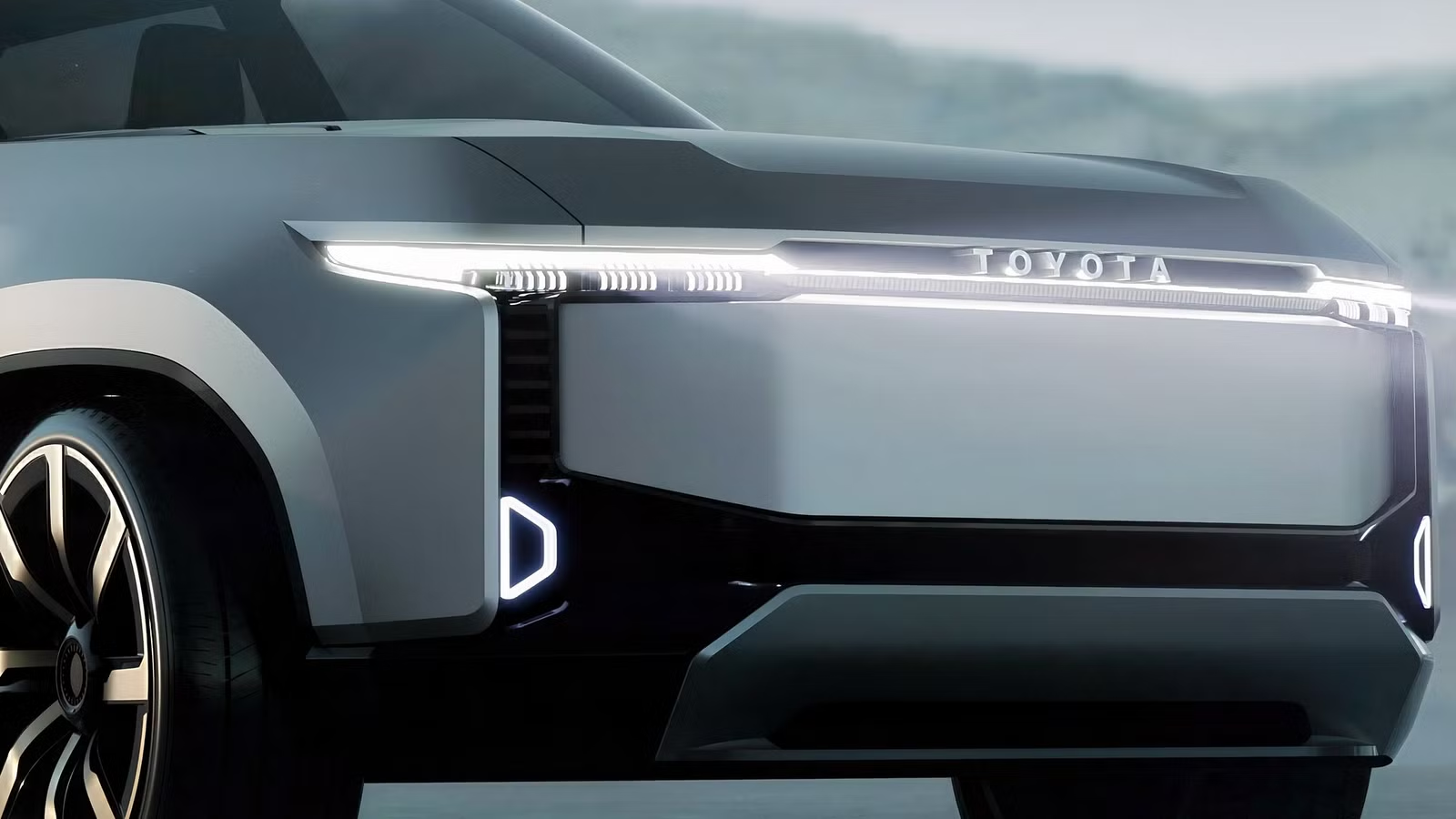
Toyota FT-3e BEV ConceptToyota
As researchers seem to have identified the failure mechanism, they can now design against it. They can concentrate on controlling any existing flaws to increase fracture toughness or redirect the route a dendrite is likely to take.
The solution could involve several possible approaches. Intentionally placed microscopic voids might redirect dendrites or deflect fractures away from a direct route across the cell. A tougher solid electrolyte could also delay crack growth. Protective coatings on the lithium electrode might suppress dendrite formation before the metal reaches vulnerable defects.
However, while these findings are important, they don’t automatically amount to a finished, fracture-proof automotive battery. After all, the concept of solid state is necessarily an umbrella term that covers different electrolytes, electrodes, and cell structures. Each one of them carries distinct challenges involving manufacturing, pressure, moisture sensitivity, interfaces, durability, material supply, and cost. But the findings still present strong evidence about an important failure route and suggest clear targets for material selection and cell design.
Companies like Toyota or Chery still need to turn promising cell-level results into a repeatable production recipe. They need to ensure that their battery packs can reliably withstand heat, cold, vibration, crashes, repeated charging, and years of calendar aging or manufacturing variation. Fundamentally, they’ll also need to ensure that a small laboratory cell can still demonstrate high energy density, rapid charging, and long cycle life when placed into a full-size automotive pack.
Toyota Has The Patents, While China Is Applying The Speed
Chery group Exeed EXLANTIX ES EV front quarterChery/Exeed International
Toyota has more than 1,000 solid-state battery patents, and this is more than any other OEM. The company has also officially said that it wants to introduce an electric vehicle with an all-solid-state battery in 2027 or 2028. The project is aiming for about 20% more range than the 621-mile figure for its next-generation performance lithium-ion battery. The info implies around 745 miles of range with the model with the solid-state pack. Toyota is also targeting a 10% to 80% charge in 10 minutes or less.
To achieve those goals, Toyota may need to reduce vehicle weight and improve aerodynamics, so the battery is not necessarily going to be solely responsible for all improvements. Toyota also needs to work closely with its suppliers on the parts that it will need to manufacture these cells. Here, it’s working with the Japanese petrochemical business Idemitsu to develop a sulfide solid-electrolyte material, and Sumitomo Metal Mining to develop a more durable cathode material.
In China, several automakers are also working on ambitious prototypes. Chery suggests a prototype cell with a claimed energy density of 600 watt-hours per kilogram and a range of around 932 miles. Changan has also discussed initial installations of its Golden Bell battery, with targets of around 400 Wh/kg and 932 miles of range.
The Two-Year Clock Starts At The Purchase Contract
2024 – 2026 Chevrolet Equinox EV 1st Gen SUVChevrolet
Someone buying a new EV in 2026 could be entering their third year of ownership just as Toyota’s target window opens, and Chinese solid-state programs accumulate real-world data. And this could create some real human anxiety rather than just range anxiety for that particular owner. After all, when it’s time to sell in 2029, a potential buyer might judge that car against vehicles that now offer a substantially different combination of range, charging, time, weight and performance.
For buyers who lease their cars, the leasing company itself may carry most of the uncertainty around the vehicle’s end-of-term value. However, for those who routinely change their cars every three years, this situation could be more troublesome, as any revolutionary battery technology could create residual value exposure. And rapid improvements in existing battery tech are already tending to push new EVs ahead of vehicles that are only a few years old.
Much will now depend on the purchase price of a new EV, and how much technology risk that price already accounts for. After all, a heavily discounted new EV has more room to depreciate before it becomes a poor purchase. Yesterday’s expensive technology may also have turned a used EV into an affordable commuter car if its original owner had absorbed much of its initial loss.
Still, used EV supply has tightened, and such cars are not becoming unsellable simply because better batteries may be down the road. Used EV days’ supply fell to 32 in April 2026, down 31.8% from a year earlier. And EV inventory also sat below that of the broader non-EV market for a second straight month.
For some people, it may be better to wait rather than buy an expensive EV at close to sticker price. And for those who may be planning to trade anyway during the 2028-2029 transition period, the greater danger is not in owning a vehicle that has conventional lithium-ion cells but in paying as though its resale value carries no technology risk.
The Max Planck discovery may well have made solid-state batteries more consequential. Such batteries could arrive in the marketplace in the mid-term future, due to China’s aggressive prototype programs or Toyota’s 2027-2028 target aspirations. So, in many respects, this starts a ticking clock even if it remains to be seen how changing market expectations could affect the comparative appeal and residual values of today’s vehicles.
For some, it may still be a good idea to buy a current EV at a substantial discount and keep it going for years ahead. But there may yet be a risk for those who are thinking about paying full price for such an EV in 2026, depending on how and when the battery race permeates the used car market.
Sources: Toyota, Chery, Max Planck Institute, iSeeCars.
