

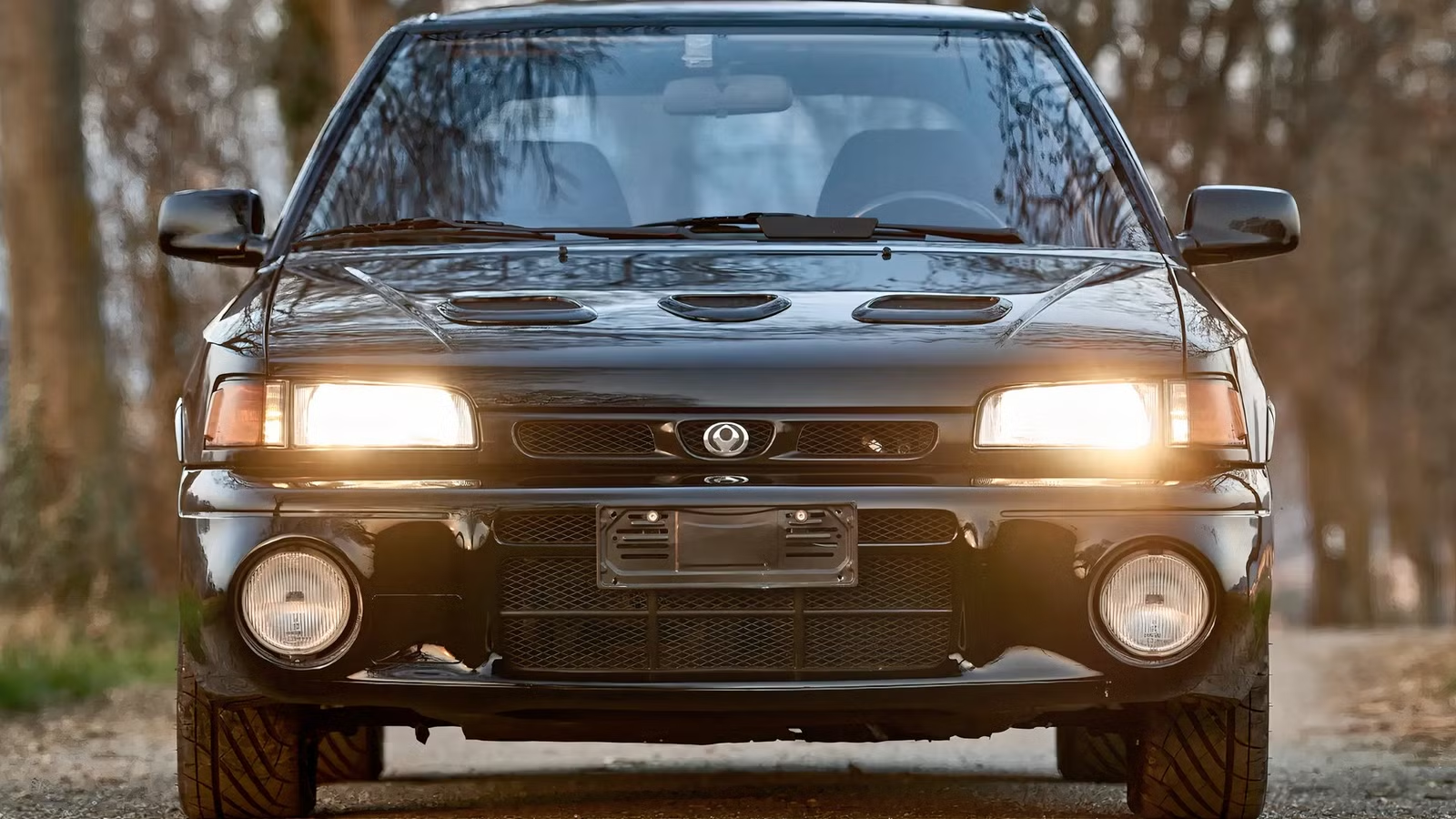
For a brief moment in time, the world’s most unhinged rally championship pitted manufacturers against each other to pack as much power between the bumpers of small sedans and hatchbacks. This, of course, led to epic battles between the Audi Quattro and Lancia Delta, or tales of the Subaru Impreza WRX vs Mitsubishi Lancer Evolution.
Competitors would come and go from Group A and the notorious Group B rally championships, with the legends of winners enshrined in motorsports history, and the rest forgotten. The 1992-1994 323 GT-R wasn’t just another trim level in the hatchback’s hierarchy; it was Mazda handing the keys to its homologated rally car over to customers to stay in the fight a little longer.
323 GT-R: The Rally-Bred Hatchback Mazda Built To Beat Lancia And Toyota
1993 Mazda Familia/323Bring a Trailer
If not for its rotary-powered endurance racers and sports cars, it’s fair to assume Mazda’s hatchbacks would’ve received the same attention as their contemporaries. It also would’ve helped if the 323 GTX won any of the 14 races throughout the 1991 season, let alone compete the following season with a revised plan of action.
1993 Mazda Familia/323Bring a Trailer
The GTX tried and failed for six seasons. This put Mazda in a position to push the 323 to its limits and create a formidable hatchback that could keep up with the competition (comprising the Lancia Delta Integrale, Toyota Celica GT-4, and Ford Sierra RS Cosworth). Yearning for another trophy, of which the 323 collected one in 1987 and two in 1989, Mazda gave the 323 one last shot before deciding its fate.
Mazda bolted a massive turbocharger to the 1.8-liter engine and bumped power up to 206 hp and 184 pound-feet of torque. A larger intercooler and reworked oil cooler helped boost the GT-R’s output as well, and a reinforced AWD system ensured reliable shipment of power from the engine to the tires. Flared fenders and a squared stance hinted at the other changes hiding underneath: race springs, bigger brakes, and stronger anti-roll bars.
Where Are The 323 GT-Rs Today?
Mazda 323 World Rally ChampionshipMazda UK
Mazda built exactly as many GT-Rs as the rules demanded – 2,500 units in under two years – and that production rush is exactly why finding a clean one today is so difficult.
Of the 2,500 GT-R models built between 1992 and 1994, a handful remained in Japan as the Familia GT-R, with the rest being delivered to European markets. A few pop up here and there, but, because of how quickly these cars were produced and the nature of their intended purposes, the ones still on the road have been modified in some way to keep on the road or include some extra creature comforts.
A 1993 Familia GT-R imported from Japan was listed for sale on Bring A Trailer in January 2026. It sold for $21,000. The Blaze Red GT-R had done roughly 29,000 miles before being sold and had zero performance modifications listed. Upgraded speakers were added to the doors and cargo area, which offered some modern amenities. Lightweight versions of the Familia/323 called the GT-Ae—which are even rarer—weren’t completely stripped out but offered even fewer luxuries than the standard models, such as hand-crank windows and no available sunroof option.
The market for imported 323/Familia GT-R models ranges between $20,000 and $27,000 depending on condition, with no previously sold models having fewer than 100,000 miles on the odometer. Since they’re still relatively unknown, listings don’t generate much excitement when posted, nor will values appreciate, since the model’s history doesn’t include a memorable number of victories. The 323, however, was the first rally car made by a Japanese company to win a Group A rally race.
From Group B Wildcards To Le Mans: How Mazda’s Racing Ambitions Outlasted The 323
Group B Rally RX-7Mazda UK
The company put a greater emphasis on racing in Group A, though for a brief period, Mazda-backed efforts to enter an RX-7 rally car into Group B nearly took shape. The European-based rally team threw together a RX-7 with all the goods to make it competitive in one of the world’s most lethal spectator sports. The rules were merely guidelines, with nothing stopping manufacturers from building the most extreme race cars they could conceive.
Work started in 1984 to assemble the cars required to compete, with the team getting two seasons out of the handful of cars built before the FIA announced plans to phase-out Group B after the 1986 Championship. The best the RX-7 ever did was place third in Greece at the 1985 Acropolis Rally.
In 1991, Mazda’s rotary-powered sports prototype race car took form, where it would revive Mazda’s attempts to achieve legendary status in the racing world. The 787B, powered by a 2.6-liter 4-rotor Wankel engine, raced to victory at Le Mans that same year. That victory would prove to be the only win the car would earn, despite the car being remembered by enthusiasts more for its banshee-like exhaust note than for the historic win itself.
No other rotary-powered car would be entered into any sort of motorsport again, and Mazda would move away from rally racing altogether after it stopped supplying rally-ready 323 GTX and GT-R race cars after 1994.
Mazda’s Racing Pedigree
The 650-hp Mazda 787B, powered by a four-rotor Wankel engine, is the brand’s most successful racing car. It was the first Japanese car to win the legendary Le Mans 24-hour race in 1991.Wikimedia Commons
Going racing in a Mazda is very easy. Spec Miata racing, overseen by the Sports Car Club of America (SCCA) and the National Auto Sport Association (NASA), is one of the most popular amateur road racing series in the world. Owners build their own MX-5 race car and compete in races sanctioned by either of the governing bodies, with thousands of dollars in cash prizes up for grabs.
In addition, Mazda announced the Mazda 3 TCR in 2019. It was a race car based on the Mazda 3 Hatchback built to compete in Touring Car Racing. It packed a 350-hp turbocharged 4-cylinder engine and 6-speed sequential transmission good for a top speed of 150 mph. It was set to race in the IMSA Michelin Pilot Challenge, a supporting race to the 24 Hours of Daytona, in 2020. The COVID-19 pandemic derailed Mazda’s plans to enter the car in the series and offer customer versions, and the company ultimately abandoned those plans.
The 2021 season was the last year Mazda raced competitively in an international series, campaigning the Daytona Prototype RT24-P from 2017 to 2021 in the IMSA WeatherTech Sports Car Championship. It earned seven victories and 25 podium finishes in its five years of service, but that’s not nearly as many as the most decorated Mazda race car in history. That title goes to the RX-7, which competed in IMSA GTU and GTO classes from 1979 to 1991. There, it gathered 106 victories, giving it not only the title of Mazda’s most successful race car, but the most successful model to ever race in the series.
Mazda Race CarsMazda UK
Mazda’s racing pedigree may be absent from its current lineup, but its heritage remains present in nearly every model. Each of its crossovers and remaining sedans carries with it a part of its ancestors’ DNA, returning sportier dynamics than anything else in the class. As for the 323’s legacy of homologation, the closest thing we have to a modern incarnate is the Mazda 3 Hatchback 2.5 Turbo Premium AWD, which puts down 250 hp from a 2.5-liter turbocharged 4-cylinder to each corner.
Its near-$40,000 MSRP is double what you’ll pay for a used imported 323 GT-R, but even if it lacks the homologated charm that put the GT-R on the map, it’s still a strong reminder of Mazda’s rallying heritage — and one imagines more than a few Mazda employees still dream of those days, three decades on.
Sources:Inside Mazda,Bring a Trailer,Top Gear
