

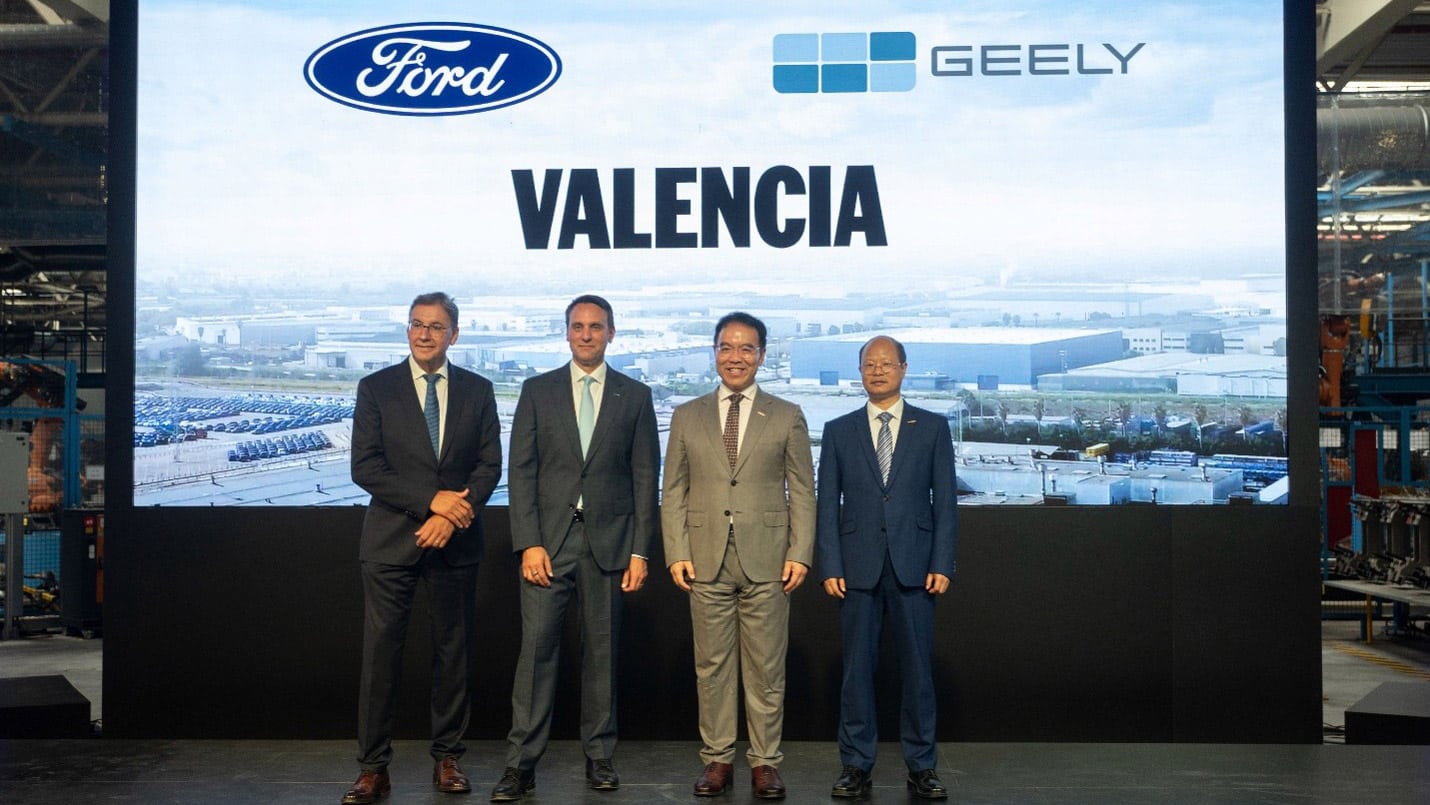
Geely and Ford have reached an agreement to establish a joint venture in Valencia, Spain, to share factory capacity. Credit: Geely Auto
- The joint venture is expected to begin operations in the first half of 2027, with the first new vehicle set to roll off the line in 2028.
- Ford will own 66 percent of the new entity, while Geely Auto will hold 34 percent.
Chinese auto giant Geely Auto (HKEX: 0175) will form a joint venture with Ford Motor (NYSE: F) in Spain, sharing capacity at a major plant and gaining a production foothold in Europe.
The two companies announced on Thursday that they will establish a joint venture in Valencia, Spain, to build multi-energy vehicles under both brands for the European market through shared production capacity.
Pending regulatory approvals, the joint venture will officially begin operations in the first half of 2027, with the first new vehicle scheduled to roll off the production line in 2028, according to the companies’ statements.
Under the proposed ownership structure, Ford will own 66 percent of the new entity, while Geely Auto will hold 34 percent.
Ford’s Valencia plant has an annual capacity of about 500,000 units and is one of Europe’s largest and most advanced automotive plants. Once the joint venture is established, the facility will become a shared manufacturing hub for both companies.
Bloomberg reported earlier today that the plant is currently running at less than a quarter of its capacity. Bringing in Geely is expected to boost the plant’s utilization and preserve or restore local jobs.
Under the plan, the joint venture will produce three Ford-branded multi-energy models, including the existing Kuga crossover, a rugged compact SUV from the Bronco family set to enter production in 2028, and an all-new crossover designed by Ford and jointly developed with Geely.
Geely Auto will produce two NEV models at the plant, with the first rolling off the line in 2028. It will be the company’s first production plant in Europe.
The first Geely SUV planned for production at the plant will be the EX5, which has already been launched in Europe and is known as the Galaxy E5 in China, according to a Reuters report.
Talks between Geely Auto and Ford have been going on for months. In February, Reuters reported that the two sides were in discussions about a potential partnership, hoping to share technology and manufacturing costs.
In May, Spanish media outlet La Tribuna de Automoción reported that Geely would take over an assembly line at the plant and planned to produce a new energy vehicle (NEV) model based on its GEA (Global Intelligent New Energy Architecture) platform.
Producing vehicles locally in Europe will help Geely avoid the European Union’s tariffs on China-made electric vehicles (EVs) and save on shipping costs. It also signals to dealers and consumers that the company plans to stay in the European market for the long term.
Exports are becoming Geely Auto’s strongest growth engine. The company sold 474,228 vehicles overseas in the first half of 2026, up 158 percent year-on-year, making it one of the fastest-growing Chinese auto brands in overseas markets.
Geely Auto Monthly Exports 2024-2026
Month
2024
2025
2026
January
26,262
27,354
60,506
February
24,373
25,552
60,879
March
36,405
37,047
81,639
April
38,151
24,133
83,186
May
36,890
30,017
85,144
June
35,816
40,011
102,874
July
33,283
35,272
August
46,102
36,077
September
40,319
40,665
October
33,904
41,568
November
34,447
42,091
December
27,050
40,310
Geely Auto monthly exports
2024
2025
2026
Ford and Geely’s ties date back to 2010, when the Chinese company acquired Volvo Cars from Ford.
“This strategic cooperation with Ford is an important step towards open collaboration and mutually beneficial to both parties. It represents a milestone in Geely Auto’s global development and will further solidify Geely’s presence in Europe,” said Alex Nan, vice president of Geely Auto Group.
“Together we can fully utilize a great plant with a great workforce and match the industry’s new cost benchmark,” said Jim Baumbick, president of Ford Europe.
The partnership also underscores Spanish Prime Minister Pedro Sanchez’s determination to elevate the country’s position in European automotive manufacturing.
Another Chinese automaker, Chery (HKEX: 9973), has already revived a former Nissan plant in Barcelona together with Spanish brand Ebro.
The rugged plug-in hybrid SUV delivers a combined system output of 830 kW, or 1,113 hp, and can wade through water as deep as 800 mm.
