

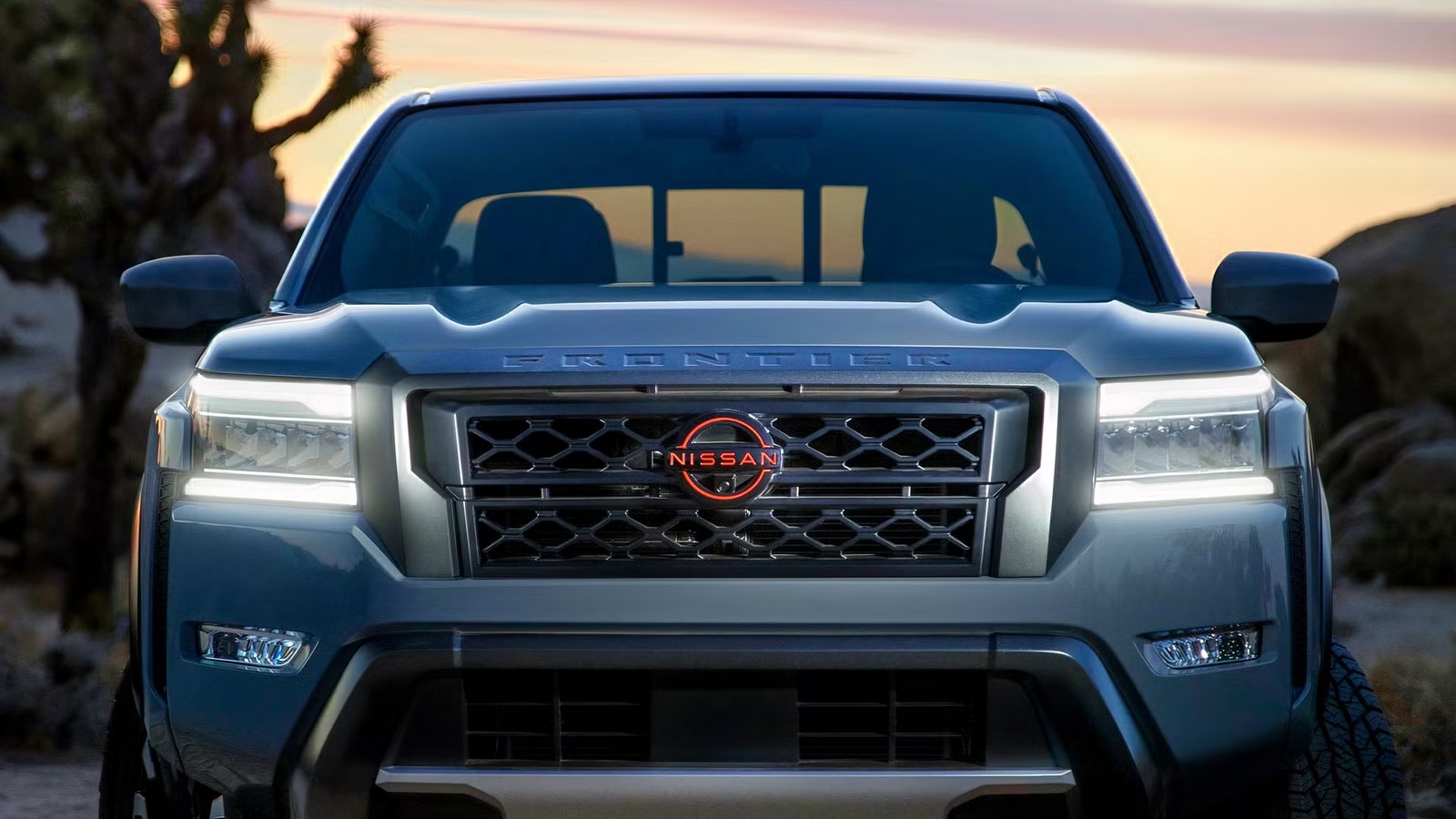
The midsize truck market is small but mighty, with some of the best off-road vehicles on the market. Among them are the Toyota Tacoma and its intensely capable TRD Pro trim level, and the Nissan Frontier, which has an available Pro-4X off-road trim. Everybody knows how great the Tacoma is, but the Frontier remains a capable underdog that’s worth a test drive at the least.
Putting the two head-to-head reveals a closer competition than one might think when taking pricing into consideration. The Tacoma wins in terms of resale value, but buyers who choose a truck based on their own needs (not the needs of whoever comes next) usually don’t place as much weight on that aspect as you might think.
All specs have been pulled directly from the manufacturer. Prices are correct at the time of writing, and exclude destination, options, incentives, and other potential dealer fees. Automakers reserve the right to change prices at any time without notice.
The Tacoma Monopoly (And Why It’s Not Inevitable)
2026 Toyota Tacoma TRD Pro driving front 3/4 angle in whiteToyota
While the Tacoma is obviously a powerful, capable truck that earned its reputation through decades of reliability and hard-core driving, its newest generation hasn’t had the same time to develop its own reputation. The Tacoma dominates buyer perception due to its past reputation. However, that perception and reputation are not rooted in current specs.
Let’s take a couple of steps back: historically speaking, the Tacoma has been the most reliable midsize truck with reasonably powerful engines, respectable towing and hauling capacities for its size, and it wasn’t always that expensive. It’s impressive, don’t get us wrong, but its current competition caught up in big ways.
The Chevrolet Colorado and GMC Canyon match or beat it in terms of power output from their TurboMax engine and towing capacities. The Ford Ranger has an available Raptor variant that can handle desert running and jumping, with all four tires off the ground, better than any Tacoma variant. And we can’t forget that Nissan currently offers a sweet off-road version of the Frontier that undercuts the Tacoma TRD Pro’s price.
This isn’t all to say that the Tacoma has been dethroned. In fact, we still view the Tacoma as the most well-rounded model. That said, its current generation has only been around for a couple of model years — it still has time to prove itself as the Tacoma we all know and love. It dominates buyer perception for all the right reasons, but its rivals are up there with it in some respects.
Where the Frontier Actually Wins
2026 Nissan Frontier Pro-4X trailer driving rear 3/4 angleNissan
Off-road trims aside, the Tacoma and Frontier are pretty impressive trucks in the midsize segment. Both models use ladder frames that increase rigidity, towing capacity, and more. Under the Tacoma’s hood is a gas-only 2.4-liter turbocharged four-cylinder that makes 228–278 horsepower and 243–317 lb-ft of torque depending on the trim level. If that’s not enough for you, then the i-FORCE MAX hybrid system uses the same engine in addition to an electric motor to produce a combined 326 hp and 465 lb-ft.
On the Frontier’s side is a single engine: a 3.8-liter naturally aspirated V6 that makes 310 hp and 281 lb-ft of torque no matter the trim level. It may not be as powerful as the hybrid Tacoma, but it is simple and robust, with many more years of data underpinning its reputation for reliability.
That said, the Frontier wins in terms of towing capacity: the Tacoma, with its non-hybrid engine and XtraCab configuration, can tow up to 6,500 pounds, while the Frontier can pull up to 7,150 pounds when properly configured. Payload falls in the Tacoma’s favor, though, with its capacity landing at 1,705 pounds, compared to the 1,620 pounds afforded by the Frontier.
In off-road specific trims, Nissan claims its Frontier Pro-4X can tow up to 6,880 pounds with a regular bed, or 6,310 pounds with a long bed. The Tacoma TRD Pro’s spec sheet shows a 6,000-pound towing limit.
Frontier Pro-4X vs Tacoma TRD Pro
The real battle is between the Pro-4X and the TRD Pro trims. The easiest way to differentiate between the two is to put it like this: the Tacoma features more software, while the Frontier focuses on mechanical upgrades. To be more specific, the Tacoma TRD Pro is equipped with a Multi-Terrain Select system, advanced Crawl Control, and precision Bilstein monotube shocks. Ground clearance reaches 11 inches with its standard 33-inch all-terrain tires.
Nissan takes a different approach with the Frontier Pro-4X. It includes Bilstein off-road shocks, underbody skid plates, and a standard rear locking differential. While it doesn’t have the same crawl control software as the Tacoma, it assists drivers with an “Intelligent Around-View” monitor that turns on automatically when you shift the transfer case into 4LO. Ground clearance comes in at 9.1 inches.
If you are of the opinion that pickup trucks should not drive like cars, you may love the Frontier. Heavy steering gives you the feeling of doing an arm workout at the gym, especially for slow parking lot maneuvers. The steering does lighten up at higher speeds, but it always feels vague. We were surprised by the ride comfort, which is pretty docile on normal pavement. Choppy pavement revealed bouncier body motions, but nothing that we’d call unreasonable.
– Jared Rosenholtz, CarBuzz (2025 Nissan Frontier Drive Review)
Initial Costs and Warranty Info
This is where Nissan has a clear advantage over Toyota. There’s one thing that matters more to buyers than almost everything else — money. Buyers can get their hands on a 2026 Frontier Pro-4X with a crew cab with a regular bed for just $41,870 before destination and options, or $42,370 for a crew cab with a long bed. Toyota’s Tacoma TRD Pro comes in at a significantly higher $64,650 before destination and options.
The two brands match one another as far as warranties go. Both trucks come with a 5-year/60,000-mile powertrain warranty, 3-year/36,000-mile basic coverage (bumper-to-bumper) warranty, and a 5-year/unlimited-mile corrosion warranty.
On that note, Nissan is currently offering Frontier buyers 0% APR financing for 36 or 60 months. Buyers will pay no interest, but they will have to pay $16.67 per month for every $1,000 financed at 60 months, or $27.78 per month for every $1,000 borrowed. The offer excludes the S trim levels, including the King Cab S and Crew Cab S, in both rear-wheel-drive and four-wheel-drive configurations. Lastly, the offer only extends to current dealer inventory in order to clear out room for a new Frontier for the 2027 model year coming soon.
The Resale Reality Check: There’s No Competition
2026 Toyota Tacoma TRD Pro interior steering wheel viewToyota
There aren’t many new vehicles in general that can hold value as well as a Tacoma. According to CarEdge, Tacomas only lose about 22% of their value after their first five years on the road. That’s nearly unheard of, since most cars lose about half their value in that time. Nissan doesn’t do too badly, though — the Frontier depreciates by 37% after five years of service. However, resale value matters most to those who plan on selling their vehicles early. Anyone who buys a truck to drive it how they want to, and not baby it for the next owner, probably won’t care about how well it holds its value. Not to mention the fact that the Tacoma TRD Pro’s resale value advantage shrinks for long-term owners and doesn’t offset the Pro-4X’s upfront savings.
Real-World Ownership: MPG, Maintenance, and Reliability
2026 Nissan Frontier Pro-4X detail shot of the engine bayJared Rosenholtz/CarBuzz/Valnet
More real-world ownership statistics buyers should mull over include fuel economy, how much it costs to maintain and repair the trucks, and general reliability. It’s not surprising that the Tacoma Hybrid is more efficient — what is surprising is that the Frontier’s gas-only engine isn’t far behind. According to the EPA, the most efficient Tacoma with a hybrid engine manages 22/24/23 mpg city/highway/combined, and its most efficient gas-only RWD variant gets 21/26/23 mpg. The Frontier gets 19/24/21 mpg with an RWD setup.
That said, the Frontier Pro-4X, specifically, only gets 16/20/18 mpg.
As far as maintenance goes, CarEdge’s data shows the Tacoma averaging $2,241 in maintenance costs over its first five years on the road. Of course, that accounts for previous generations that were far simpler and notably robust. The current Tacoma uses a relatively new four-cylinder engine in both the gas-only and hybrid variants that could prove more costly to repair or replace in the future. CarEdge says the Frontier costs $2,903 to maintain and repair over its first five years on the road, which is still $1,801 less than the average pickup.
The Most Reliable Midsize Pickup Isn’t What You Think
2026 Toyota Tacoma TRD Pro detail shot of the engine bayToyota
Nobody can say outright that the current Tacoma is unreliable. As much as enthusiasts like to rant about the new four-cylinders, there simply isn’t enough evidence available to prove reliability in one direction or another. For that reason, we’d argue that the Frontier is more reliable — it simply has more data to back it up. In fact, the most reliable midsize truck of the past decade is the 2019 Nissan Frontier. It has a strong J.D. Power quality and reliability score, only one recall, and very few serious complaints filed with the National Highway Traffic Safety Administration.
The Verdict: Which Buyers Should Actually Choose What
2026 Nissan Frontier Pro-4X front 3/4 angle in orangeNissan
Each truck plays to its strengths. Your perfect truck depends heavily on your lifestyle: do you intend to go off-road and enjoy the truck long-term, or do you prioritize looks, perceived capability, and resale value? The Frontier Pro-4X is an obvious value case for buyers who want a truck to last and have fun being engaged while off-roading. The Tacoma TRD Pro has enough software to practically crawl over obstacles on its own, but it costs far more.
At the end of the day, your decision may simply come down to whether you can even afford the extra $22,780 the TRD Pro commands over a Pro-4X.
Sources: Toyota, Nissan, CarEdge, EPA
