

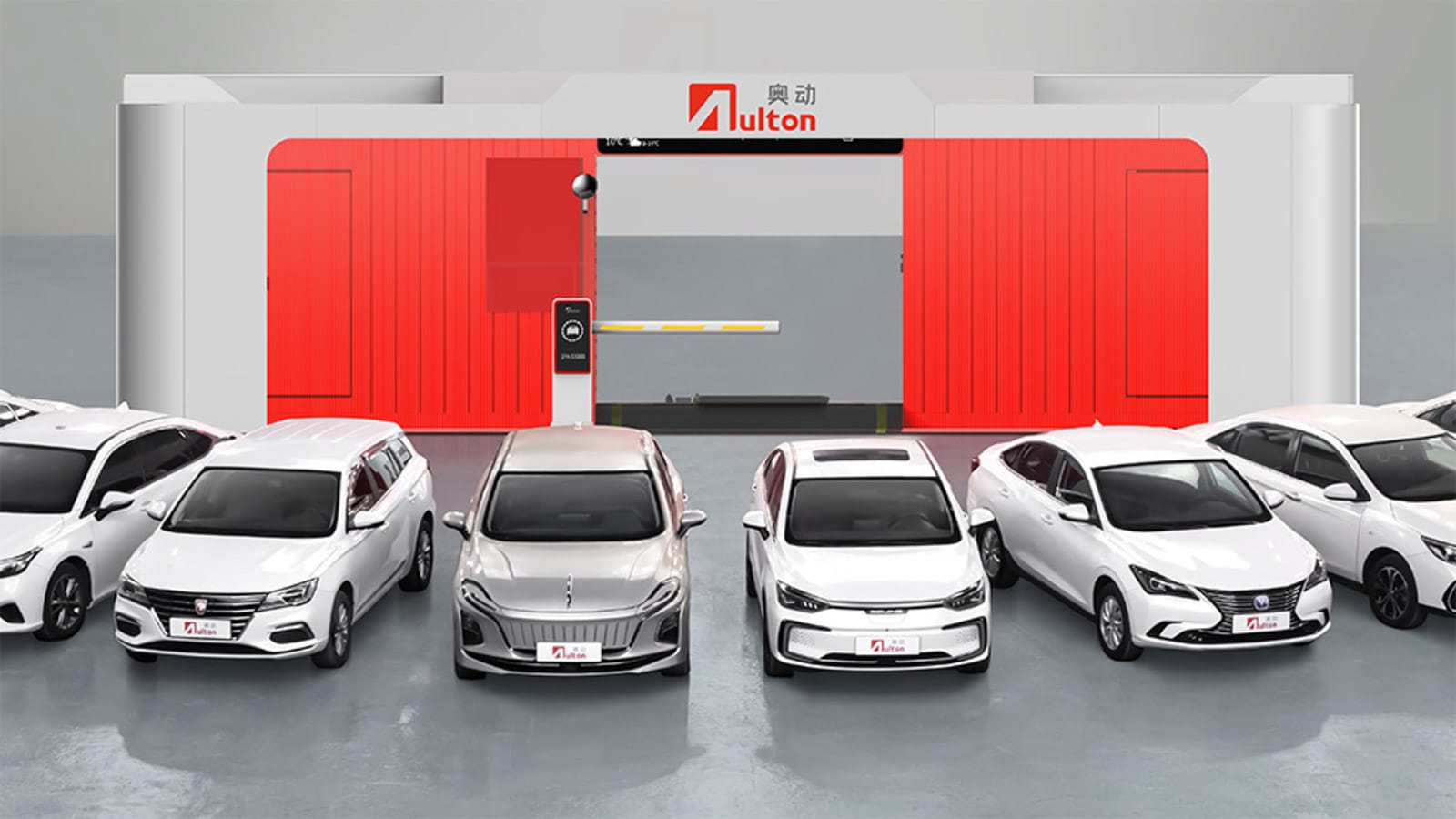
A screenshot from Aulton’s website shows its battery swap station.
- Nio Capital owns a 5.53% stake in Aulton, whose cross-brand model differs from the battery swap ecosystem built by Nio Inc for its own vehicles.
- Aulton’s revenue declined for 2 consecutive years, but it posted a positive gross profit for the first time in the first 4 months of 2026.
Aulton New Energy Co Ltd has again filed for a Hong Kong listing, seeking to become the first company focused on battery swap services to trade on the city’s stock market.
The company first filed for a Hong Kong IPO (initial public offering) in December 2025. It resubmitted its listing application on July 19 after the previous filing lapsed, according to information published on the Hong Kong stock exchange’s website.
CMB International is the sole sponsor for the IPO (initial public offering). The number of shares to be offered and the targeted fundraising amount have not been disclosed.
The company operates across several parts of the battery swap ecosystem, including developing and selling battery swap modules and stations, as well as providing operational and digital platform services for third-party sites.
Aulton also operates some of its own battery swap stations, providing swapping services to drivers of compatible vehicles.
The company ranked third in China by revenue from battery swap station operational services in 2025, according to its prospectus.
It is worth noting that there are currently very few players in China’s battery swap sector; aside from Aulton, the field is essentially limited to Nio Inc (NYSE: NIO) and CATL (HKEX: 3750).
Over the past few years, some automakers have launched models that support battery swaps, but they have since largely abandoned these efforts.
Nio Capital is one of Aulton’s major institutional shareholders, holding a 5.53% stake before its planned IPO.
Nio Capital is an independent venture capital firm, and William Li, founder, chairman and CEO of Nio Inc, is one of its managing partners.
Aulton and Nio Inc have adopted markedly different business models.
As of July 20, Nio had built 3,977 battery swap stations in China. Its network is primarily designed around Nio Inc’s own brands, vehicles and users, creating a relatively closed battery swap ecosystem.
Aulton, by contrast, positions itself as an independent third-party solutions provider. It aims to connect battery swap stations, vehicles, batteries and operational platforms while offering compatible services across different auto brands.
The company has worked with more than 16 automakers, including FAW, Dongfeng, Changan, SAIC, BAIC and GAC, to jointly develop more than 30 battery-swappable vehicle models.
As of April 30, 2026, Aulton’s service platform was connected to 531 battery swap stations, including 214 self-owned sites and 317 third-party sites.
By comparison, the company owned 321 stations at the end of 2023. Its self-owned network shrank by more than 100 sites, while the number of connected third-party stations rose from 231 to 317 over the same period.
More than 130,000 electric vehicles (EVs) were registered on the platform, which managed more than 160,000 batteries. That scale provides a foundation for Aulton to expand its asset-light services business.
The company must still convince investors that its transformation can reverse the revenue decline and eventually produce a sustainable profit model.
Aulton’s revenue fell from 1.16 billion yuan ($170.52 million) in 2023 to 926 million yuan in 2024 and declined further to 677 million yuan in 2025.
That means its 2025 revenue was more than 41% lower than in 2023. The contraction was mainly caused by declining equipment sales, reflecting fragmented battery swap standards, more cautious customer investment and slower capital spending by automakers.
Aulton’s battery swap equipment sales fell from 731 million yuan in 2022 to 195 million yuan in 2025. The business once accounted for about two-thirds of the company’s revenue but is no longer its main pillar.
Meanwhile, battery swap services provided through self-owned stations generated 440 million yuan in revenue in 2025, becoming the company’s largest single source of revenue. The business, however, remained loss-making.
Aulton’s self-owned station swapping services had a gross margin of -21.4% in 2025. Electricity, on-site staffing, property leases, equipment depreciation and maintenance costs made it difficult for stations with low utilization rates to cover fixed expenses.
By comparison, the equipment sales business had a gross margin of 12.9% that year, while operational services for third-party stations delivered a gross margin of 61.4%.
The difference in profitability explains why Aulton has been reducing the number of self-owned stations and shifting its focus toward battery-swapping operational solutions for third-party customers.
Despite falling revenue, Aulton’s losses have continued to narrow. Its net loss fell from 655.5 million yuan in 2023 to 418.9 million yuan in 2024 and 307.4 million yuan in 2025.
For the 4 months ended April 30, 2026, the company’s net loss narrowed further to 91.4 million yuan, from 103.3 million yuan in the same period a year earlier.
Aulton recorded a gross profit of 4.1 million yuan during the period, with a gross margin of 1.8%, compared with a gross loss of 13.8 million yuan a year earlier. It was the company’s first positive gross profit during the disclosed reporting period.
The company also recorded positive operating cash flow in the first 4 months of 2026. However, Aulton said in its prospectus that it still expects to report a net loss for the full year.
Aulton also plans to develop V2S2G (Vehicle-to-Station-to-Grid) technology, enabling bidirectional energy transfers between vehicles and battery swap stations, as well as between stations and the power grid.
The technology could allow battery swap stations to participate in peak shaving and frequency regulation for the grid, generating electricity-service revenue and reducing their reliance on fees from individual battery swaps.
Proceeds from the IPO will be used to upgrade Aulton’s battery swap solutions, develop technologies for unmanned station operations, and strengthen its digital and intelligent energy-management capabilities.
Part of the proceeds will also be used to promote its battery swap solutions, improve operational capabilities, and support potential strategic investments, acquisitions or cooperation arrangements.
Competition is intensifying. In addition to Nio’s self-operated network, CATL is expanding its market presence through its standardized Choco-Swap solution.
Automakers typically build closed networks around their own vehicle platforms, battery standards and customer bases. Aulton must demonstrate that an independent third-party platform can solve compatibility challenges across different brands.
The open model could expand its potential market, but it also means Aulton may find it more difficult to secure a steady and sustained supply of vehicles from any single auto brand.
A successful listing would give Hong Kong investors a vehicle for direct exposure to China’s battery swap services market. It would also make Aulton an important capital-market test case for the independent third-party swapping model.
The signing is the latest progress after the delivery of the first batch of 50 jointly built swap stations in December 2025.
($1 = 6.7733 yuan)
