

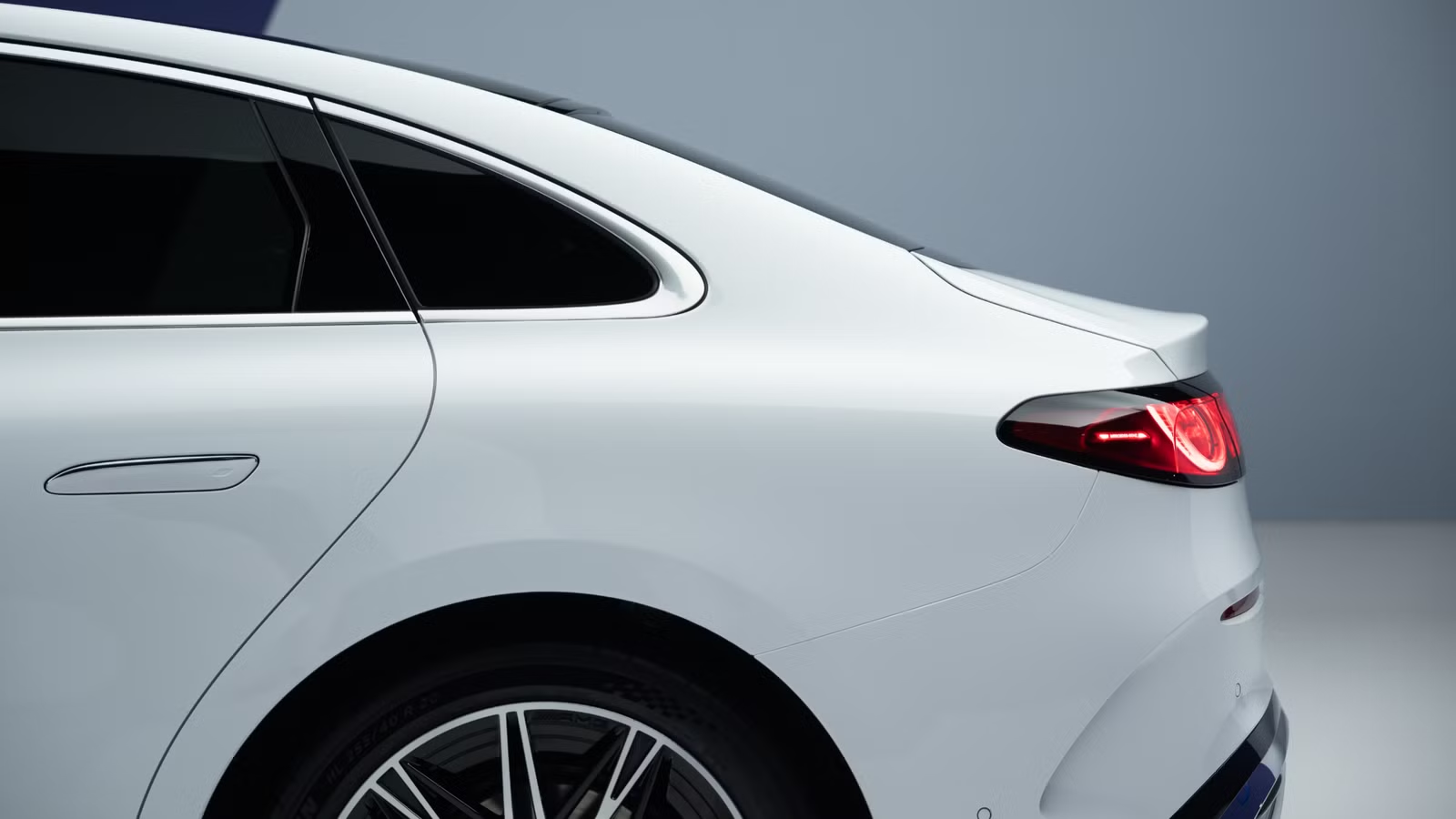
Remember the days when buying a luxury car equipped with a six-cylinder meant you were likely getting a mid-range model? Now, Mercedes-Benz is taking its six-cylinder engine and continuously moving it further up the food chain into performance-oriented models, leaving higher-spec C-Classes to make do with a turbocharged four-cylinder.
For those who don’t want to spend Mercedes-AMG money, this means that, in order to pick up a six-cylinder C-Class without the performance badge attached to it, their best bet is to dip into the used market. The outgoing C43, the BMW 340i, and the Audi S4 largely represent the final, accessible six-cylinder German compact executive sedans before the electrified four-cylinders fully take hold.
Mercedes-Benz Decided That Four-Cylinder Power Is The New Norm
2027 Mercedes-Benz C-Class revealed with combustion engine.Mercedes-Benz
Mercedes-Benz recently released the refreshed 2027 C-Class. At base level, the C300 enters the market with a 2.0-liter turbocharged four-cylinder engine hooked up to a 48-volt ISG mild-hybrid system. In total, the powertrain can pump out 255 horsepower and 295 pound-feet of torque, with the 48-volt setup itself injecting 23 horsepower. Prices have not yet been disclosed, but it’s expected the base model will sit somehwere between $50,000 and $55,000.
Instead of offering a more powerful six-cylinder for buyers who want additional power without a significant price increase, Mercedes is positioning the electrified four-cylinder setup to compensate for the power deficit at the bottom rung of the C-Class lineup. Not to mention, the turbocharged four-cylinder needs assistance to make the sort of power one would expect from a compact executive sedan. This same formula can be seen with Audi’s current A5 model, too. It uses a 2.0-liter turbocharged four-cylinder, much like the Mercedes, and produces 268 horsepower.
2027 Mercedes-Benz C-Class revealed with combustion engine.Mercedes-Benz
However, Mercedes does offer something of a consolation for new C-Class buyers who want more power without having to pay for a full AMG model. For an extra $10k (estimated) or so, buyers can opt for the C400, which uses a plug-in hybrid powertrain. With it, the model produces 395 horsepower and 479 pound-feet of torque when both its electric and internal combustion outputs are combined. In essence, Mercedes is providing modern six-cylinder power from a hybridized four-cylinder.
There is an obvious compromise here. Where the market lost its six-cylinder power, it gained electrified, hybridized four-cylinder output instead. Power outputs are power outputs, and one can make the argument that it doesn’t really matter where the power comes from, but many buyers simply aren’t interested in electrified powertrains, especially as the automotive industry moves further toward advanced, complex electrification. Six-cylinder mills are known entitites when it comes to smooth, reliable power in executive sedans, so naturally the transition toward more stressed and less balanced ‘fours’ is sure to alienate some buyers.
The Normal German Six-Cylinder Isn’t Totally Dead
BMW Neue Klasse M350 spy photosCarBuzz/Valnet
Pictured above are spy photos of the upcoming BMW M350, a model expected to feature a 3.0-liter turbocharged inline-six engine paired with a 48-volt mild-hybrid setup. However, the M350 is positioned to replace the current BMW M340i, which is marketed as a performance model slotted just below the full M3. The new model does, however, provide evidence that the German six-cylinder isn’t going away completely. At least, not yet.
The engine found under the M350’s hood is the BMW B58, which has been in continuous production since 2015. According to some preliminary reports, the M350’s iteration of the engine is slated to produce a combined output of around 417 horsepower. The M350’s use of the B58 signals a move by the engine upmarket, away from the standard BMW 3 Series.
BMW Neue Klasse M350 prototype spy photoCarBuzz/Valnet
BMW is actively showing what the future of the German six-cylinder will look like, at least for the next few years. Instead of powering a mid-range model, it needs to power a performance model in order to survive. Of course, a major driver behind the six-cylinder’s move upmarket is emissions regulations, and with Euro 7 standards approaching, European automakers need to accommodate the new restrictions in any way they can.
Mercedes-AMG may also introduce a new six-cylinder model, but details are scarce at present. Rumor has it that the brand is planning to unveil a new C53 at some point in the future. Should it arrive with a six-cylinder under its hood, the German six-cylinder will likely live on for some time. However, the C53 would fall under the AMG umbrella, meaning a substantial price increase over standard C-Class models.
Just a few years ago, German compact executive sedan buyers were spoiled for choice when it came to affordable six-cylinder options. A number of them were on the market, such as those mentioned above. Buyers didn’t have to spend a fortune to own one; they simply needed a modest budget to make it happen. Now, it seems buyers will have to step into AMG or M Power territory to get what they want from a German model. How’s that for a luxury tax?
That’s What Makes The Last C43, 340i, and S4 All The More Interesting
Front quarter shot of a 2016 BMW 340i xDrive sedanBMW
Let’s leave the new car market behind, because it can be a discouraging place for those interested in traditional German compact executive cars these days, and shift our focus to the used market. As it stands, if buyers want a six-cylinder engine without a performance badge – or price tag – they will have to look to the used market, whether it be an older Mercedes-Benz C43, BMW 340i, or Audi S4.
Now, it’s worth mentioning that none of these models are, in any way, collectibles. They’re only a few years old, and vast quantities of them were produced and sold across most of the world. However, they do occupy an intriguing middle ground these days. They all offer six-cylinder power, of course, along with the premium interiors expected of an upscale German nameplate. They also deliver strong performance beyond their engines and a great deal of everyday practicality. Rounding out the list of positives is a relatively low price, much lower than the 2027 Mercedes-Benz C400 will likely command.
2023 Mercedes-AMG C43 Front ViewMercedes-Benz
All three models have already gone through the depreciation wringer, which can be particularly tough for German luxury cars. For those who bought them new, that’s a tough pill to swallow. But for used buyers, the bulk of the depreciation has already occurred, which takes a major burden off the table from the outset. Of course, whichever model a buyer decides to purchase should be thoroughly inspected beforehand, but once a good example is found, it represents a sound financial decision – and ownership of one of the final German compact executive models with a six-cylinder engine and without a performance badge.
Take the C43 AMG, for example; the CarBuzz Marketplace shows nearly-new examples from the 2023 model year as trading just below $45,000 on average, and that’s for a car which is but a few years old, boasts low mileage, and therefore still has heaps left of life to give yet.
It’s a similar picture with the Audi S4 too, which houses a turbocharged V6, and indeed the story is much the same with BMW’s M340i also. All three can be secured at just a few years old with below 30,000 miles for roughly $5,000 to $10,000 less than what a base C 300 is expected to retail for in 2027, which opens up an exciting window of opportunity for used buyers.
Smart Money Buys One Of The Last Affordable German Sixes
2023 Mercedes-AMG C43 Rear ViewMercedes-Benz
The question posed has a fairly simple answer: Would a buyer rather pay a premium for a performance-badged new model with a six-cylinder, or simply purchase a few-year-old used model that comes with a six-cylinder and no performance badge? For those for whom cost is a priority, the likely choice would be the latter, as they’ll likely end up saving tens of thousands in the long run.
The affordable German six-cylinder can’t be called extinct just yet, as the market’s trajectory is far from certain. Nor can the engine type be called extinct as a whole, as BMW’s M350 and Mercedes’ supposed C53 AMG will prove that statement wrong. Hidden underneath all that, though, is the unfortunate fact that the six-cylinder’s market positioning has been fundamentally changed.
A parked 2025 Audi S4Audi
Six-cylinder engines offer quite a lot to the standard sedan buyer who is not particularly interested in outright power. For one thing, they’re smoother than their four-cylinder counterparts, and they also sound considerably better. The manner in which they make their power is also more refined, providing a more linear delivery rather than the raucous, buzzing output often found in turbocharged four-cylinders.
Mercedes-Benz C43, BMW 340i, and Audi S4 values likely won’t rise significantly because of these changes, simply due to the fact that there are many of them out there, and when they were made, they weren’t particularly exceptional. However, they may become more sought-after as the German automotive market has effectively decided that the six-cylinder is worthy of a performance badge, leaving the four-cylinder to fill the gap.
Sources: BMW, Mercedes-Benz, Audi, BMWBlog.com, Motor1.com, CarScoops.com.
