

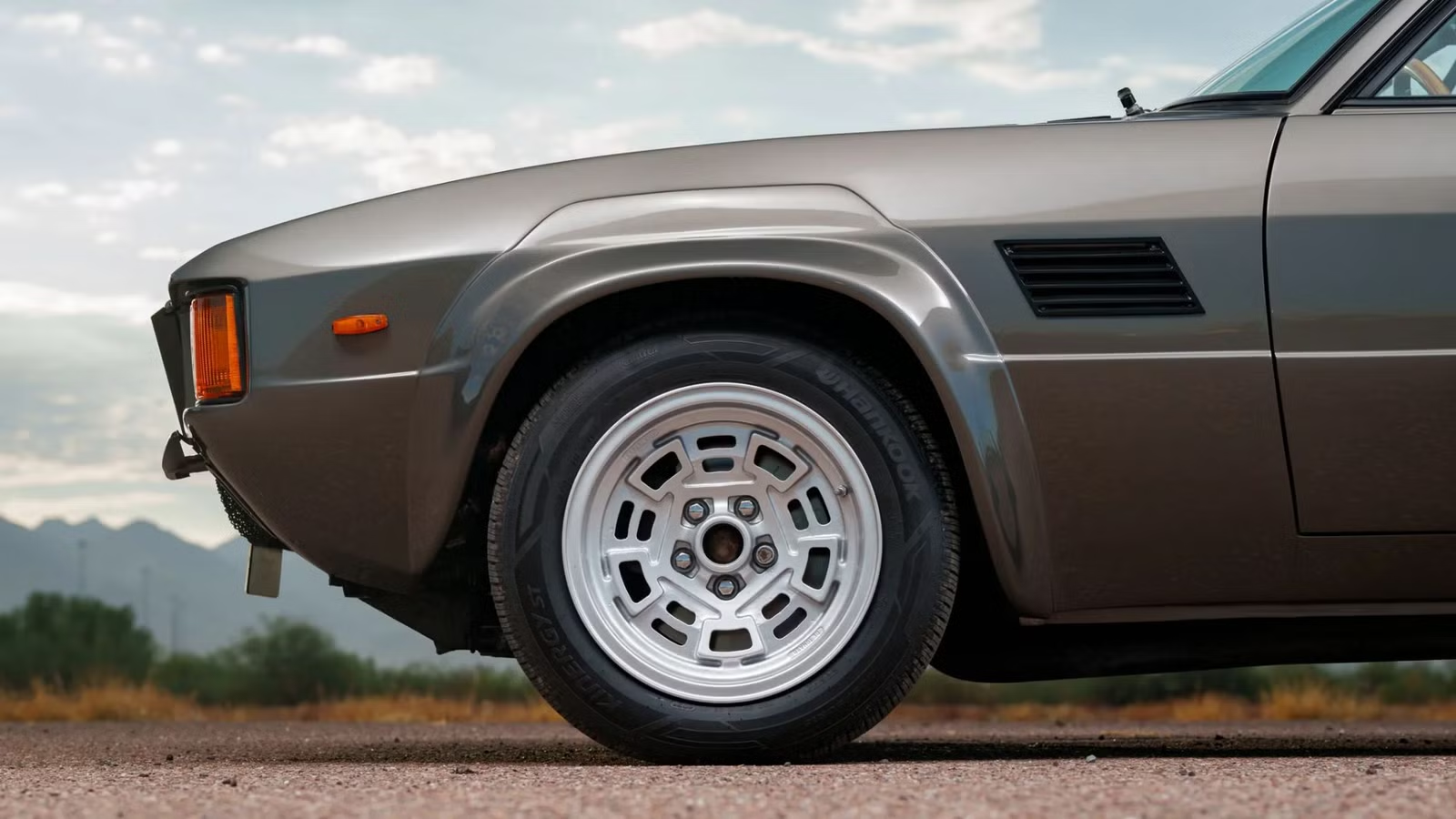
Sometimes, a car just gets a recipe absolutely right. The De Tomaso Longchamp was one such car, combining a surprisingly practical yet beautiful Ghia-designed body with a well-established performance V8 engine from Ford’s back catalog of brilliance. All the muscle of a Mustang, with the handsome lines of Europe’s best, the Longchamp deserves celebrating.
Luxurious Grand-Tourers Were All The Rage
1968 Lamborghini Islero And Espade Exterior Arranged Side By Side And Flanked By Stone WallsLamborghini
By 1972, every wealthy European wanted a grand tourer — but almost nobody wanted to pay the repair bills. That contradiction is exactly what gave De Tomaso its opening. It was the peak of muscle car madness, with small- and big-block creations ruling the roost, kicking out north of 400 horsepower and darting between every set of traffic lights with heaps of torque and even more tire smoke.
Over in Europe, things were a little different, but still just as intoxicating. While the US was busy producing muscle, automakers throughout the European continent were busy churning out sumptuous Grand Tourers, with ever-increasing performance. This route would eventually lead automakers down the path of supercar production, with the mid-engine Miura generally considered the first true car of its kind.
As exciting as the Miura is, it’s no reason to gloss over the uber-luxurious GT cars that proved oh-so desirable at the time. Cars like the Ferrari 365 GTB/4 “Daytona”, Lamborghini Espada, or Aston Martin DB4, 5, and 6. Long hoods, big engines, immaculately trimmed cabins, and enough trunk space for a week’s worth of luggage — simply idyllic for gallivanting across the Alps.
Dubious Reliability And High Maintenance Costs Spoiled The Appeal
These may seem like the perfect answer for cigar-smoking, whisky-drinking, mile-munching trips, but there was an inherent flaw with the GT concept that seemed to plague every model within the sector: cost. Not necessarily purchase cost. Buyers understood these cars came at a cost and they were getting a product that matched the price tag (or so they thought).
Instead, the issue of cost sat with repair and maintenance bills. Now, keeping on top of a supercar in the modern-day is no walk in the park financially, but at least modern machines are generally reliable. Back in the 60s, hand-built engines with complex carburetor setups frequently caused headaches, be it a poor tuning setup resulting in rough running, electrical woes, or overheating concerns – an issue that might not arise until belting along high-altitude mountain passes in the heat.
Someone had to solve this – and the answer came not from Maranello or Sant’Agata, but from an Argentine-born entrepreneur with a very American idea.
De Tomaso Found A Suitable Solution
1974 De Tomaso Longchamp front quarterBring a Trailer
While hand-built 12-cylinder engines built in tiny numbers added an air of exclusivity to many a Ferrari or Lamborghini, the aforementioned issues certainly did bring a dampener to the whole experience. In order to produce an altogether more reliable and therefore usable product, De Tomaso looked to the American muscle car scene, which was built around easy-to-maintain, durable engines that still delivered plenty of, well, muscle.
It seemed like the perfect solution, and in many ways, it absolutely was. A European-designed body with the motivation of a high-power yet proven reliable, and durable, all-American V8. Now, it should be noted that De Tomaso was not the first to the punch here. In fact, this was a recipe that had been sampled many times before, with cars like the Facel Vega HK500, the Jensen Interceptor, and the Iso Grifo.
Rather, it was De Tomaso’s execution which made the Longchamp really stand out as the perfect combination of European beauty and brutish American power. Its body was sleek yet purposeful, while practical too, thanks to a striking fastback design. Its interior was smothered in fine leather and rows of gauges, and it boasted everything one might need to cruise through hundreds of miles a day without stress, including 2+2 seating and even air conditioning.
Why The 351 Cleveland V8 Was The Perfect Answer
1974 De Tomaso Longchamp engine bayBring a Trailer
It was also of note that De Tomaso didn’t just use any American V8, as they sure weren’t all created equal, but that the automaker opted for the 351 Cleveland engine. It could have almost been tailor-made for the Longchamp, thanks to its strong torque delivery, which was ideal for high-speed cruising rather than track use, and its compact size, which allowed for a shorter hood and therefore a more accommodating cabin design.
The Cleveland had already proven itself as a high performer, too, with various Mustang and Torino products proving genuine 300+ horsepower outputs were possible. Chiefly though, it was cheap to service and maintain, and thanks to the wide range of models that sported Cleveland power at this point, parts were easily accessible, too.
In this specific guise, the 351 provided the Longchamp with 330 hp and 344 lb-ft of torque, a combination that proved capable of lasting the entire Longchamp production run, from 1972 through 1989. In comparison, premium competition such as the Aston Martin DBS V8 and Colombo V12-powered “Daytona” churned out surprisingly similar figures, while mainstream efforts like the Mercedes-Benz 450 SLC simply couldn’t get near it.
How a 17-Year Production Run Yielded Only 410 Cars – and Why That Matters Today
The Longchamp has become somewhat overshadowed by the striking Pantera sports car, but for grand touring, it remains one of the best classics anyone could buy today. That engine is, of course, a huge part of the appeal, with stellar performance, an intoxicating soundtrack, and a durability reputation that doesn’t scare the owner away from actually using it.
Couple that with the unusually understated styling of the Ghia-penned Longchamp, plus the practical 2+2 seating layout, and it becomes abundantly clear why this De Tomaso deserves every moment it gets in the spotlight. Furthermore, while it checks the reliability and practicality checkboxes, it also delivers on the obscurity and exclusivity front.
Despite enjoying a monstrous 17-year production run, only around 410 cars were ever built, making it every bit as scarce as other mechanically delicate European contemporaries, and miles more interesting than any more mainstream rivals, like Merc’s 450 SLC.
It really is a forgotten masterpiece, but for those who do take the time to discover it, the Longchamp delivers everything those often more celebrated GT cars of the 70s did, although with much more tolerable costs, fewer mechanical headaches, and greater capability.
Why the Longchamp Is One of the Last Affordable Classic GTs You Can Actually Drive
1974 De Tomaso Longchamp frontBring a Trailer
Now here comes the really good news: buying a De Tomaso Longchamp today is not like getting hold of a classic Ferrari or Aston Martin. It’s an altogether far more attainable prospect, and so for those looking to cover some miles in style this year, it’s seriously worth considering — should you be able to find one, that is.
Being a highly limited cruiser from the 1970s, it’s unlikely a Longchamp is going to crop up on the CarBuzz Marketplace, but we can review recent auction results from around the world to help build a complete picture of current values and availability.
- 1978 De Tomaso Longchamp — a rough example ripe for full restoration, sold last September in the UK for less than $10,000, representing the bottom-end of the market for these scarce cars.
- 1982 De Tomaso Longchamp — this later GTS model failed to sell with an estimate of €49,500 (around $56,400) in Germany, 2023.
- In the same year, a 1-of-17 Longchamp Cabriolet also remained unsold at the Retromobile Paris auction, with a guide of €150,000–€200,000, ($170,000 to $228,000).
- A sharp 1978 example sold for €49,500 ($57,000) at an RM Sotheby’s auction in 2020.
It’s a small market, that’s for sure. The fact that these most recent auctions date back over five years shows just how infrequently Longchamps appear for sale, and the fact that numerous examples remain unsold is also telling. Perhaps they were imperfect examples with troubled histories or dubious restorations, or perhaps the market has just not yet switched itself on to the brilliance of these elusive GT cars.
1974 De Tomaso Longchamp tailpipeBring a Trailer
What is apparent, though, is that the 351-horsepowered Longchamp represents a largely affordable entry-point into the world of classic European GT luxury, with excellent examples having traded hands for in the region of $50,000 to $60,000 in recent years.
Hagerty shows only the 1985 Longchamp GTS on its valuation tool, and for good-to-excellent-condition cars, it provides a window of $35,000 to $63,000. It is significantly cheaper than many contemporary rivals and, in many ways, arguably the far better product, too.
Sources: Hagerty.
