

Think of long-distance cruiser bikes and the mind immediately wanders into the world of American brands. But as we’ve seen countless times in the past, Japan is equally capable of producing capable products in a certain niche when it puts its mind to it. This is particularly true for the world’s largest motorcycle brand–Honda–courtesy of its endless financial and mechanical resources. So it doesn’t come as a surprise that the CBR-maker has a capable long-distance cruiser on offer that can hold its own in the America-dominated segment. Oh, and it costs thousands of dollars less, even though you get a segment-defining technology.
The Essentials Of A Long-Distance-Ready Cruiser Motorcycle In 2026
Front three-quarter view shot of 2025 BMW R 18 B parked indoors.BMW
More often than not, a cruiser motorcycle is built for rumbling through the streets in a laidback way and enjoying dollops of torque during your regular rides. But for a cruiser that wants to do long distances, there are a few additional prerequisites. First and foremost is an understressed engine. A capacity of over 1000cc is usually the way to go, with a minimum of 80 horsepower and 70 pound-feet.
2016 Honda CRF1000L Africa Twin 998 cc engineHonda
These numbers should make sitting at freeway speeds effortless. When you’re doing that, touring-centric equipment will come in handy. A tall windscreen is necessary, while a bagger-type fairing is a bonus. You also need some sort of luggage solution. These can be hard plastic or leather saddlebags for easy storage on your journeys.
BMW
An underrated essential is modern technology. This can make life way easier in a few ways. For instance, a clear TFT with turn-by-turn navigation means there’s no need for a secondary navigation device. Whereas, bits like traction control and ride modes can make life easier in varied conditions across states. Cruise control, meanwhile, should let you relax your right hand on arrow-straight highways. Compile all of the above, and there is only one Honda cruiser that gets you all these.
The Rebel 1100T Is Honda’s Most Well-Suited Cruiser For Long Distances
2026 Honda Rebel 1100T cornering cinematic shotHonda Powersports
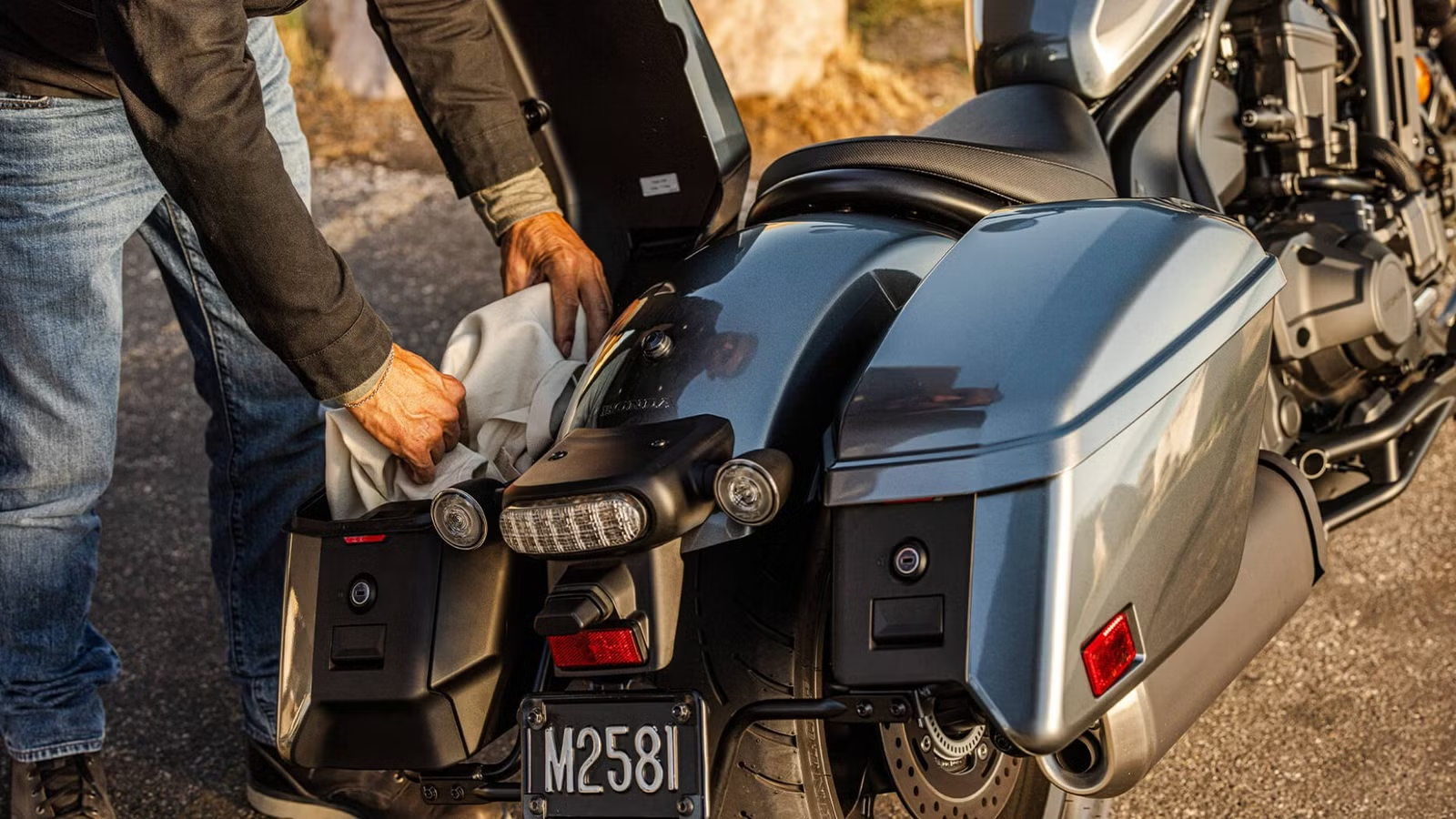
We’re talking about the Rebel 1100T. While the Rebel 1100 is already good at some of these things, the ‘T’ adds touring-specific parts such as a sizable batwing fairing with a windscreen up top and hard 35-liter saddlebags at the rear. This is topped with a feet-forward riding triangle and a proven mechanical package known to last decades with basic maintenance. What we’d recommend, however, is for you to purchase two accessories before your long tours: the tall windscreen and comfort seat. These cost less than $250 combined and are said to elevate touring comfort by existing owners on forums.
Honda
Even with these, the value proposition remains solid as ever. That is down to the lip-smacking base price of $10,899, which rises to $11,599 if you add the DCT. We’d surely recommend doing the latter, considering the automatic transmission will make life even easier and effortless on the tours. Particularly, you won’t have to worry about traffic when you enter a city area or downshifts during quick overtakes. The auto t’box will do all that for you.
A Deep Dive Into The 2026 Honda Rebel 1100T
Honda
So what do you get for the moolah on the Rebel 1100T? In short, a lot. But you’re not here for the short version, so here’s a lowdown.
Powered By An Extremely Tractable Parallel-Twin Engine
Honda Rebel 1100 DCT engine close-up detailHonda Powersports
Sitting on the freeway for hours is no easy feat for an engine. So it’s only fair Honda plonks one of its most potent parallel-twin engines on the Rebel 1100T. This is a counterbalanced 1,084cc powerhouse with a 270-degree crankshaft—also seen on the Africa Twin and NT1100. Here, it comes armed with a bespoke flywheel, camshaft, and specific valve timing to emphasize torque and mid-range punch for the cruiser experience. The numbers back that up, promising 87 horsepower (at 7,250 RPM) and 72 pound-feet (at 4,750 RPM).
Close-up of a 2026 Honda DCT automatic gearboxHonda Powersports
In standard trim, all the power reaches the wheel via a six-speed manual transmission with a single slipper clutch. But the dual-clutch automatic transmission is the real game-changer. This is a proven and sophisticated setup like no other bike in this space from the rest of the world. And if you have any doubts, just know that 57 percent of Rebel 1100 owners have picked the DCT over the manual since its introduction.
As a lowdown, the DCT does the shifting for you, while omitting the physical gear and clutch lever. There are four auto shift modes (Standard, Rain, Sport, and User), where all of these work with the TBW (Throttle-By-Wire) system to follow preset shift patterns. In addition, a manual setting lets you shift gears via the paddles on the left side switchgear.
The Chassis And Suspension Remain Simple
2025 Honda Rebel 1100T front wheel close-up detailHonda
Unlike the technologically advanced powerhouse setup, the chassis and suspension remain simple. The double-cradle steel frame ties up with Showa telescopic forks and piggyback rear shock absorbers, both offering preload adjustability. This works in tandem with 18/16-inch alloy wheels, each of which has a single disc brake to help shed speed. You’ll need the full might as well, considering the curb weight is 551 pounds for the DCT model.
Honda Powersports
What will help you tackle the weight are easy-going ergonomics. In the latest update last year, Honda has moved the handlebar rearward toward the rider, while the footpegs are higher and more forward than before. So sitting in the saddle for hours should be easier than ever now. Plus, the seat has a thicker padding, even though the seat height is still low at just 27.9 inches.
A Long List Of Features Sweetens The Pot
2025 Honda Rebel 1100T dashHonda
A flagship Honda rarely cuts corners in terms of features, and the Rebel 1100T doesn’t, either. Front and center is a five-inch full-color TFT, complete with phone connectivity, display modes (Bar, Circle, and Simple), and turn-by-turn navigation. You also get a USB port to keep your devices juiced up and a three-liter storage compartment under the seat.
As for electronics, you get all the essential safety aids. This comprises three traction control settings with integrated wheelie control, five ride modes (three preset, two user), cruise control, and dual-channel ABS. Honda claims all of these have been retuned in the latest update to suit the updated engine delivery. A breakdown of the three preset ride modes comprises:
- STANDARD: middle setting for engine power delivery (P), engine braking (EB), and HSTC, delivering a relaxed ride at low RPM and speeds
- RAIN: low P delivery and EB, matched to high HSTC, for relaxed riding and extra reassurance
- SPORT: aggressive P and standard EB, with low HSTC intervention to allow maximum performance
Source: Honda Powersports
