

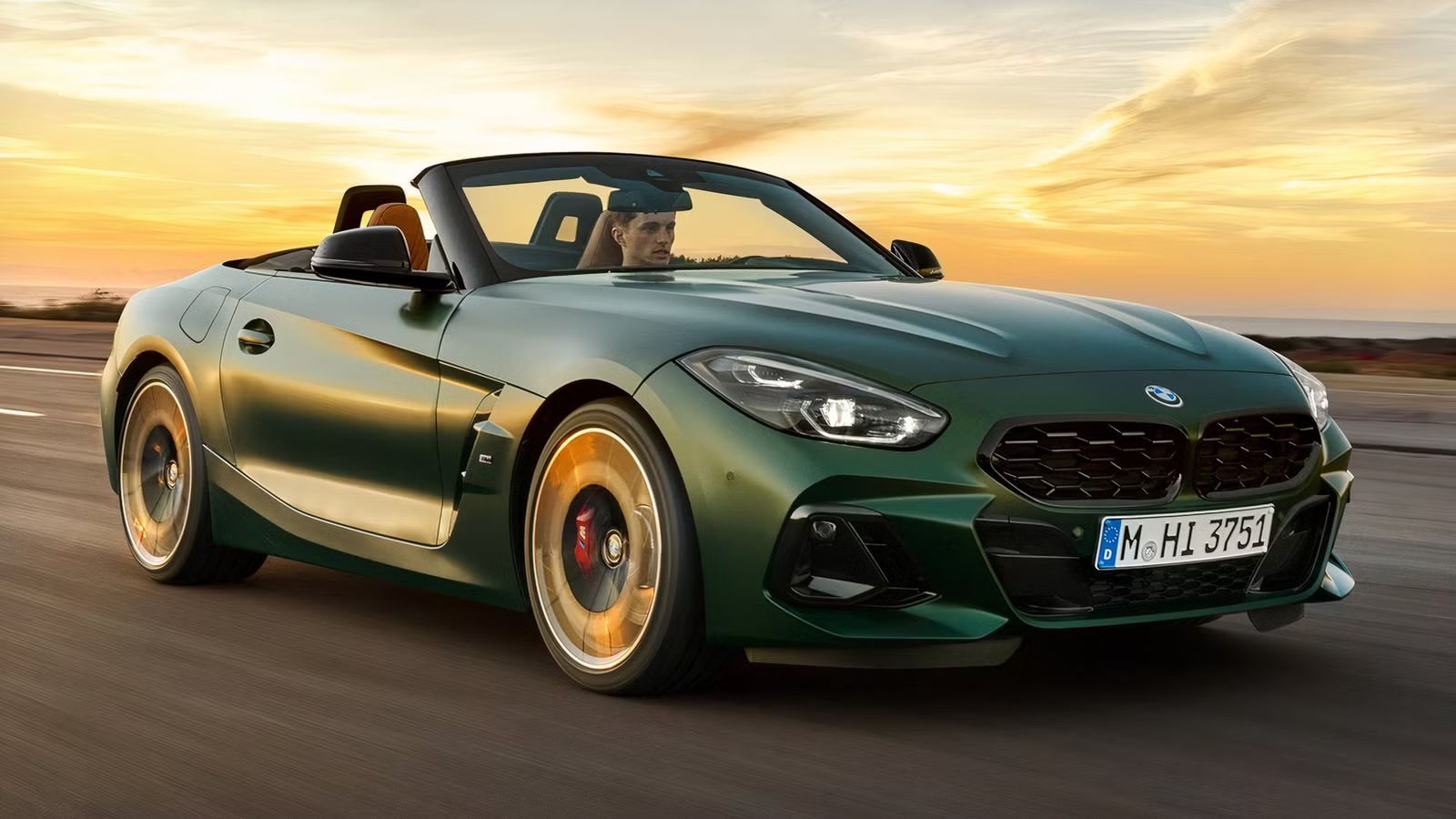
If you compare BMW and Toyota when it comes to traditional and old-school sports cars, you’d usually give the German company the upper hand. After all, BMW has spent decades building its core identity around rear-wheel-drive machines with strong engines that aim to provide maximum driving pleasure to their owners.
Of course, Toyota sits on a global pedestal in the broader automotive hierarchy, but it’s surely best known to most Americans for providing everyday vehicles like Camrys, RAV4s, Corollas, or hybrids. Nevertheless, the Japanese company still has plenty to say in any old-school sports car argument, and here, recent sales figures concur.
After all, Toyota was able to sell more than three of these traditional sports cars to just one from BMW during the second quarter of 2026. And while Toyota certainly has more vehicles in this particular mix, the bigger takeaway is that BMW allowed its presence in this part of the market to narrow so much.
BMW Should Be Winning This Fight
2025 BMW Z4 RoadsterJared Rosenholtz/CarBuzz/Valnet
Specifications
2026 Toyota GR Supra 3.0
2026 BMW Z4 M40i
Engine
3.0-liter turbo inline-six
3.0-liter turbo inline-six
Transmission
Six-speed manual or eight-speed automatic
Six-speed manual or eight-speed automatic
Drivetrain
Rear-wheel drive
Rear-wheel drive
Power
382 hp
382 hp
Torque
368 lb-ft
369 lb-ft
Q2 2026 U.S. sales
1,197
1,099
MSRP
$58,300
$68,400
The headline figures in this argument point to Toyota and Lexus selling a combined 3,523 examples of the GR86, GR Supra, and Lexus LC in the US. Meanwhile, BMW sold 1,099 examples of the Z4, which was its only equivalent traditional sports car. And all that points to Toyota having the deeper “old-school” sports car lineup today.
Ordinarily, you might expect this to be BMW’s wheelhouse, and it still sells some of the world’s most desirable performance cars elsewhere, like the M2, M3, and M4. However, they’re not deliberately old-school sports cars. When you look at just low-slung, rear-wheel-drive, two-door cars that their manufacturers build primarily for driving enjoyment, BMW’s entire US presence comes down only to the disappearing Z4.
!!!MODEL TAG!!! Listing Carousel 2026 BMW Z4 M40i Roadster
Some would argue that Toyota’s broader lineup, including the GR86, GR Supra, and the LC over at Lexus, gives it more opportunities to find buyers, which is true. But it’s still intriguing to see where BMW finds itself. After all, this is a brand very closely associated with sporty-type cars, and it only has one model left in this particular category.
Over at Toyota, there’s the GR86 at the affordable end of the market, producing 1,961 sales in Q2, as well as the Supra in the six-cylinder performance space with 1,197 for the same quarter. And at Lexus, the LC sits right at the top, as a V8-powered luxury flagship, generating 365 to round out the total. Combined, this means that the Japanese group effectively covers three distinct positions in the marketplace.
The Supra And Z4 Were Almost Neck And Neck
2026 Toyota GR Supra from the frontToyota
It’s interesting to see what happens when you separate the two closest relatives from the rest of the lineup. Here, the GR Supra still comes out on top compared to the Z4, but only just, with the Supra recording 1,197 sales and the Z4 1,099. Of course, both are more closely related than casual buyers might realize. The current generation Supra and the Z4 come out of a collaboration between Toyota and BMW, so they both use similar underpinnings and rear-wheel drive. Each has featured BMW-sourced turbo power, including versions of the BMW 3.0-liter inline-six.
The GR Supra and Z4 are still two very different cars, as the former is a fixed-roof coupe while the latter is a two-seat soft-top roadster. The Supra comes with a 382 hp turbocharged 3.0-liter inline-six in the US, with the choice of a six-speed manual or an eight-speed automatic. Meanwhile, the Z4 M40i also produces 382 hp, but the less expensive sDrive30i has a 255 hp turbocharged inline-four. It’s also important to point out that both cars are approaching the end of their production runs. And this means that Q2 sales could reflect a mixture of remaining dealer inventory and vehicles passing through the delivery process.
The GR86 Did Most Of The Heavy Lifting
2026 Toyota GR86 Yuzu Edition from the front three-quarter angleJoel Stocksdale / CarBuzz / Valnet
The strongest-selling car in this whole group was the more middle-of-the-road GR86. It uses a naturally aspirated 2.4-liter flat-four generating 228 hp and 184 lb-ft of torque and, on paper, it looks quite modest alongside the Supra or the Z4. The GR86 comes to the market as a compact, rear-wheel-drive, attainable solution in a segment where BMW has no direct equivalent. Toyota offers standard, Premium, and limited Yuzu Edition versions as part of its 2026 GR86 range and will bring in further updates in 2027.
But perhaps the biggest part of the GR86 success story is that Toyota entered another collaboration arrangement, this time with Subaru, to justify the project. Here, the GR86 is closely related to the Subaru BRZ and has a Subaru-developed boxer engine, and this may well be helping to make this lower-volume enthusiast car viable.
The Lexus LC Completes The Ladder
2026 Lexus LC Front 3/4 ViewLexus
The Lexus LC only sold 365 cars during Q2, which is very modest compared with the GR86 and Supra, but it plays an entirely different role. This is more of a grand tourer than a lightweight sports car, and it’s certainly more luxurious than either Toyota GR model. However, it still belongs in the comparison lineup because it’s a low-slung, rear-wheel-drive machine where design, performance, and driver appeal all count. This naturally aspirated V8 flagship features a 5.0-liter V8 generating 471 hp and 398 lb-ft of torque and also comes in a convertible form.
Related
How Toyota Lost It’s Sporty Mojo And Got It Back Again
Toyota may be the best performance brand on the market today. This is how it got there.
You could argue that BMW’s wider range has cars capable of attracting buyers who may be looking at the LC. But if you include models like the M2 or M4 in this conversation, it would significantly widen the definition and also bring other Toyota and Lexus performance cars into the chat.
The Real Victory Is Having Cars Left To Sell
2027 Toyota GR86 badge in Trueno BlueToyota
Purists will mourn the disappearance of the Z4, a name that first appeared in 2002 as the successor to the Z3. The current G29 is the third-generation offering, which arrived for the 2019 model year, and is due to bow out with the Z4 Final Edition. And when the Z4 production line does go silent, BMW won’t have any vehicles at all in terms of traditional “old-school” sports car presence. Certainly, Toyota is changing as well, and the fifth-generation Supra has also come to the end of its run. But when the last Supras leave dealer inventory, Toyota will still have skin in the game, and it’ll fall to the GR86 to carry most of the company’s dedicated affordable sports car presence.
Related
Toyota Supra Fans Won’t Have To Wait Another 20 Years For The Mk6
Toyota is hard at work figuring out the next steps for its iconic sports car.
That Toyota will still have skin in the game may well come down to its broader manufacturing approach. It knows that traditional sports cars are very difficult products to sustain because they sell in far smaller numbers and rely on a fluctuating market. And this may have led Toyota to reach out to BMW itself to make its Supra viable and, separately, to Subaru, to make the GR86 numbers work.
The Z4 also benefited from that kind of cross-manufacturer approach, allowing BMW to sell its own version of the same underlying sports car idea. But that was the extent of BMW’s cross-company collaboration, and it still ended up with the narrower traditional sports car lineup. In essence, Toyota built itself more than one path to selling old-school sports cars, but ultimately, BMW did not.
Sources: BMW, Toyota.
