

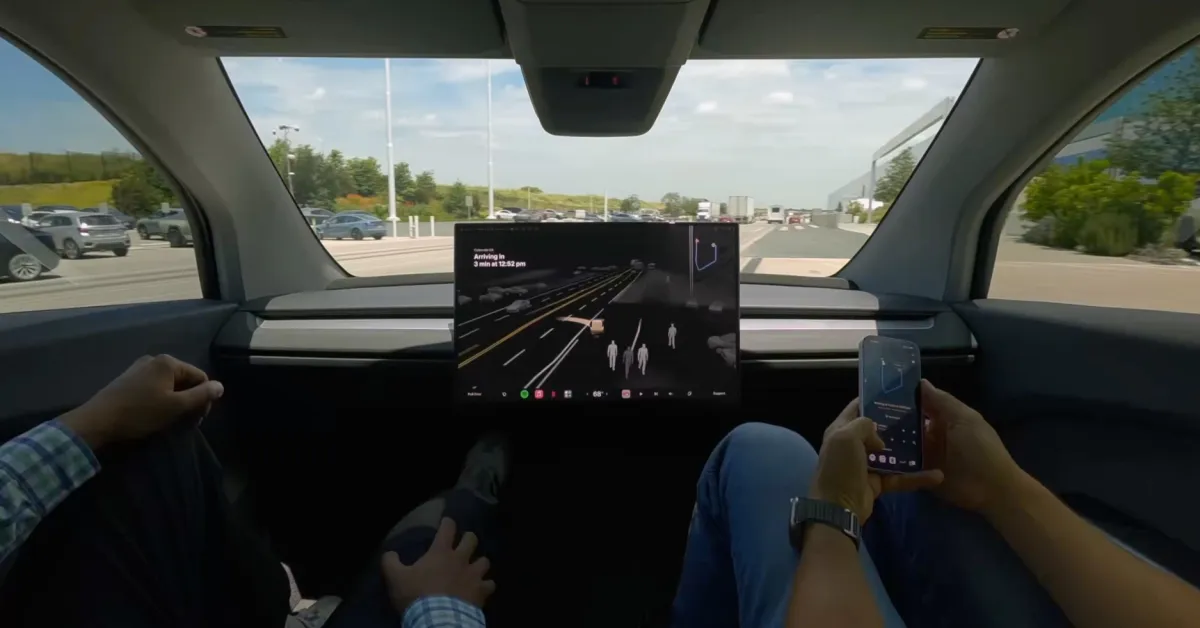
Tesla says “Cybercab employee rides at Giga Texas” are “starting soon” — its first stated step toward putting people inside the wheel-less, pedal-less robotaxi.
But the announcement, spread across two Tesla accounts and roughly 2.9 million combined views, is thinner than it sounds. It’s not clear whether Tesla means Cybercabs running a real ride service in Austin or simply driving employees around a factory parking lot.
What Tesla actually posted
On July 10, Tesla’s official Robotaxi account posted a short clip of a gold Cybercab — butterfly doors up, no steering wheel, no pedals — driving itself across the outbound lot at Gigafactory Texas, captioned only “Cool news from Giga Texas.”
The main @Tesla account quote-tweeted it with the actual claim: “Cybercab employee rides at Giga Texas starting soon.”
That’s the entire announcement. Tesla confirmed employees will get Cybercab rides, but placed them squarely at Giga Texas — not on the public robotaxi network in Austin. And Tesla gave no detail on what “employee rides at Giga Texas” actually involves: no route, no fleet size, and no word on whether the rides run on public roads or purely on private property.
Many Tesla fans believe that it is the 7/7 announcement that some Tesla executives teased last week, but never came on 7/7, and now evidently slipped to July 10th.
Two very different possibilities
The vague framing leaves two readings, and they’re miles apart in significance.
The best case for Cybercab fans would be Tesla folding the vehicle into a functioning ride service — a real, hailed employee shuttle operating across the Giga Texas campus, which is a genuinely massive site with internal roads. That would at least resemble the kind of deployment the vehicle was built for.
The other reading is that “employee rides” means little more than the parking-lot loop in the video — a Cybercab ferrying workers a few hundred feet across an admittedly enormous lot. For any other automaker, “our car drove an employee across the parking lot” would not be a news event.
Crucially, neither version is what Cybercab fans are actually waiting for: the vehicle joining Tesla’s paying Austin robotaxi fleet, which for now remains the best-case near-term outcome for the entire program. That fleet still runs on Model Y vehicles with safety monitors, and city officials put it at roughly 50 vehicles a year after launch.
The problem the video doesn’t solve
We laid this out last week: Tesla is mass-producing a Cybercab it can’t sell or drive itself. The bottleneck was never the hardware — Tesla has already stacked well over 100 finished Cybercabs in the Giga Texas outbound lot. The bottleneck is the software.
The Cybercab has no steering wheel and no pedals, which means there is no fallback. If the self-driving system doesn’t work, the vehicle literally cannot be driven. That’s fine for a slow loop around a factory lot. It’s a much bigger problem on a public street.
And Tesla’s public autonomy record is still troubled. Its current supervised robotaxi fleet in Austin crashes at roughly four times the rate of human drivers — about one crash per 57,000 miles, versus the human benchmark near one per 229,000 miles. Tesla has admitted its FSD stack needs a ground-up rewrite before it can scale to an unsupervised, driverless vehicle.
Where this fits
Tesla can build these vehicles quickly — the unboxed process is working, and the Cybercab is genuinely the most efficient EV Tesla has ever made. What Tesla can’t yet do is make the car earn money, because that requires unsupervised self-driving at scale, which Tesla would have been able to do with the Model Y in Austin.
Meanwhile, Waymo is running fully driverless, paid rides across multiple US cities at scale. Tesla is teasing employee rides in a parking lot.
Electrek’s Take
This is news, but not really — and we can’t even tell which unimpressive version of it we’re looking at.
Tesla says “Cybercab employee rides at Giga Texas” are starting soon, but it won’t say what that means. Either the company is putting Cybercabs into some kind of real ride service on the Giga Texas campus, or it’s just driving employees around the factory parking lot. It’s a massive parking lot, sure — but a car driving itself around private property is something autonomous vehicles have done for a decade, and for any other automaker it wouldn’t be a press event at all.
What it explicitly is not is the thing Cybercab fans are actually hoping for: the vehicle joining the paying robotaxi fleet in Austin. That’s the best near-term outcome anyone can realistically hope for from this program right now.
The bottleneck holding the whole program back is unsupervised Full Self-Driving at scale. We’ll take it seriously when a Cybercab completes unsupervised, paying rides on public streets, which I assume is going to happen in Tesla’s geo-fenced Austin service area right before the earnings this month.
If you’re a Tesla owner, powering your EV with home solar is one of the smartest ways to lock in low fuel costs for years. With electricity rates climbing nearly 10% last year, home solar protects you against future rate increases. And with lease and PPA options, you can go solar with zero upfront cost and start saving immediately. If you want to find the best deal, check out EnergySage. It’s a free service with hundreds of pre-vetted installers competing for your business, so you save 20 to 30% compared to going it alone. No sales calls until you pick an installer. Get your free quotes here.
FTC: We use income earning auto affiliate links. More.
