

In 2013, hybrids represented a growing part of the US automotive industry. Manufacturers were turning to these powertrains to provide solutions for those who may have had environmentalism and frugality in mind. Usually, OEMs would provide hybrid options for vehicles in their mainstream segments, but they were still relatively rare for vehicles at the expensive end of the market. But Lexus had a different idea when it came up with its LS 600h L, an all-wheel-drive flagship sedan that was the epitome of luxury.
This was a car that cost more than many Porsche 911s, weighed as much as a large SUV, and carried a V8 under its hood. And it was about as far away from the definition of a normal fuel-saving hybrid as you could get. Today, however, used buyers may find a 2013 version for the same kind of money as a new Toyota Camry, making it one of the strangest used luxury bargains of the modern era.
Lexus Built This Car For The Same World As The S-Class
2013 Lexus LS 600h L painted in brown from the sideLexus
2013 Lexus LS 600h L
Engine
5.0-liter 2UR-FSE V8 with Lexus Hybrid Drive
Transmission
Electronically controlled CVT
Drivetrain
Full-time AWD
Power
438 hp (total)
Torque
385 lb-ft from the engine
While the focus of this cost comparison may be the 2013 Lexus LS 600h L, the Japanese company first introduced the vehicle to the US market in 2008. These were the days before the SUV really flexed its muscles, and a time when cars like the BMW 7 Series, Audi A8, and Mercedes-Benz S-Class sold silence, engineering restraint, and rear-seat comfort.
Lexus was into this game as well with its LS and for its flagship project, it decided to use a 5.0-liter V8 hybrid system rather than a typical V12, as well as full-time all-wheel drive. For the LS 600h L, it would also stretch the idea into a long-wheelbase body to come up with something that was heavier, more complex, and more deliberately theatrical than the stablemate LS 460.
Lexus wanted to show that hybrid drive could be a viable proposition for executives, and in doing so, it brought the LS 600h L into the same conversation as the most expensive European luxury sedans of the day. The car went on sale for around $120,000, with properly optioned examples near $135,000, but as might have been expected with a project like this, depreciation has been vicious. In 2026, it’s now sitting in the same monetary band as mainstream family sedans, and this changes the car’s entire story.
What $135,000 Got You In 2013
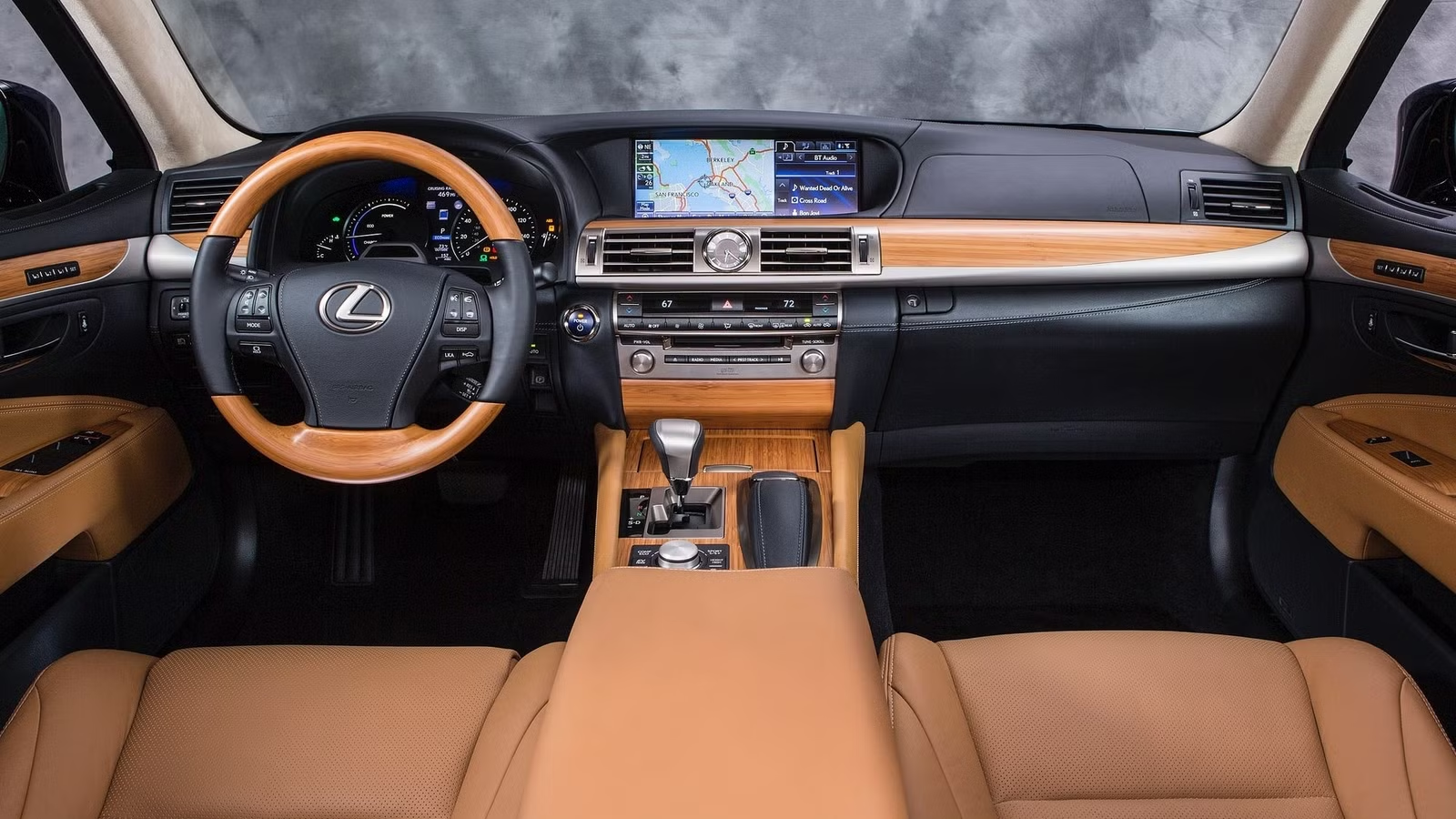
2013 Lexus LS 600h L interior frontLexus
While the powertrain represented the headline in 2013, Lexus really justified this vehicle’s price with its optional Executive-Class Seating package. Here, the rear right passenger sat diagonally opposite the driver and there were four luxury seats in total, rather than the usual five-passenger configuration. The rear seats could recline, provide a multi-function massage, and one seat could even deploy an ottoman.
Buyers could also expect a wood-trimmed rear table, wireless headphones, and rear-seat entertainment. There was even a climate control system with an infrared sensor in the headliner that would measure temperatures around the occupants and adjust the airflow accordingly.
With all its design and configuration efforts, Lexus was clearly trying to remove as much friction from the act of travel as possible. Its aim was to provide silence and precision, with plenty of soft surfaces and small systems that would work invisibly in the background. Meanwhile, noise isolation was clearly one of the big targets for Lexus and the company had already built a formidable reputation for making its large sedans feel incredibly calm at speed.
Lexus added another layer of quietness in stop-and-go traffic situations with its hybrid system approach. Here, the car was able to move under electric power in some conditions, eliminating the noise of the V8, even if that engine was ultimately a part of the experience.
The L110F Hybrid System Makes This Lexus Special
2013 Lexus LS 600h L engine bayLexus
It’s worth unpicking the makeup of the LS 600h L to see what made it so special. Here, Lexus started with the 2UR-FSE gas engine, a 5.0-liter aluminum V8 using the company’s D4-S direct and port injection system. This engine produced 389 horsepower at 6,400 rpm and 385 pound-feet of torque at 4,000 rpm, before Lexus added two motor generators, known as MG1 and MG2. MG1 was the primary generator and started the engine rather than directly driving the wheels. The MG2 was the main drive motor rated at 221 hp, and it managed the regenerative braking duties. On-board was a sealed nickel-metal hydride battery pack rated at 288 V that sat behind the rear seat. It also had a boost converter, raising system voltage all the way up to 650 V.
The transmission was an electronically controlled continuously variable transmission with a two-stage planetary gear reduction system. However, this L110F system was never a belt-type CVT of the kind that you’d find in an economy car. Instead, it featured a power-split hybrid transmission that could blend gasoline and electric torque smoothly throughout the full-time all-wheel drive system. The AWD setup also had a Torsen limited-slip center differential with a rear-biased 40:60 torque split. In certain conditions, the system could vary that torque split to help the car feel more secure.
The Numbers Never Quite Matched The Promise
2013 Lexus LS 600h L dashLexus
One of the car’s biggest problems was its mass. Period testers found that the car weighed as much as 5,470 lbs, putting it far closer to large SUV territory than you’d normally expect from a sedan. This didn’t help with expectations for the LS 600h L, especially when it came to acceleration and fuel economy.
The company claimed a 60-mph time of 5.5 seconds, but some testers found that a heavily optioned example would need more like 6.3 seconds to reach that target. EPA figures showed 19 MPG city, 23 MPG highway, and 20 MPG combined, and while those figures might not be too bad for a powerful all-wheel-drive luxury flagship, they didn’t exactly state a strong case for hybrid propulsion.
Related
Lexus’ Stealthy Sporty-Ish Sedan Is A Steal In 2025
This slept-on Lexus is a great blend of sporty and luxury, making for a great overall sleeper sedan.
In the end, the LS 600h L depreciated hard. It may just have been too expensive to appeal to normal hybrid buyers and too compromised to make a strong environmental argument. It may also have seemed overly complex for those who just wanted some traditional luxury sedan transportation that usually came with a smooth V8. Some buyers may have opted to get the cheaper LS 460, as that already delivered much of the same proposition but with far less mechanical complication.
The Bargain Only Works If You Respect The Repair Math
2013 Lexus LS 600h L frontLexus
Depreciation has now pushed the LS 600h L into the same broad price zone as a new Toyota Camry. A recent market snapshot suggests an average of around $24,000, while stronger examples could still creep into the $30,000 range. That’s extraordinary for a car that once sat at the very top of the Lexus range and its pricing today may make it generally tempting.
Related
The World’s First Hybrid V8 Production Car
Vehicles equipped with hybrid V8s have become popular over the last several years, but this car got the ball rolling nearly two decades ago.
However, the purchase price is only the start, as the car still has all of that expensive hardware to consider. The hybrid battery is a lot more complex and costly than something you’d find on a Prius, and you might have to pay almost $7,000 before taxes and local variables to replace that high-voltage element. There’s also the air suspension, which in this case is electronically controlled with adaptive damping. Replacement costs can be significant if issues arise with struts, sensors, or related hardware. One estimate suggests that shock or strut replacement for the LS 600h L could be in the low- to mid-$5,000 range, depending on model year and location.
Buyers looking for a good example should focus on documented battery health, functioning suspension, a clean warning light history, and, ideally, evidence of specialist maintenance. Overall, they should always remember that this is now a depreciated top-end flagship and was never a cheap sedan to begin with.
Lexus may never have hit a bullseye with its LS 600h L because it was too heavy to be really quick, too thirsty to be a proper economy player, and way too costly to be a volume luxury sedan success. Having said that, it was certainly an ambitious project, with that V8 hybrid powertrain, full-time AWD planetary hybrid transaxle, and executive cabin. And it had enough engineering density to put ordinary used luxury sedans to shame as well.
There’s no doubt that this former flagship sedan looks like a steal if it comes in for Camry money today, but with those possible repair bills it clearly demands respect. Buyers should carefully conduct their pre-purchase checks, but if they do find “the right one”, they may be able to enjoy one of the great forgotten Lexus flagships at some really sensible money.
Sources: Lexus, RepairPal, Kelley Blue Book, Edmunds.
