

UPDATE: 2026/07/09 06:15 EST BY BELINDA ANDERSON
Differences Between The Toyota bZ And Subaru Solterra
We’ve given more insight into what actually sets the Toyota and Subaru siblings apart, and which is the better buy between the two.
Functioning as a profit-making auto manufacturer is as hard now as it has ever been, thanks to various world events making it more expensive than ever to produce vehicles. Tightening emissions regulations are forcing brands to spend billions developing new technology for road use, which ultimately forces them to retail their creations for more money than they used to. The result is that consumers can’t afford to buy new cars as they used to, which ultimately reduces sales and, in turn, profit for the manufacturer.
To get around this somewhat, many manufacturers now work with one another to develop new technology, which reduces overheads and helps increase profits. Subaru has built a solid relationship with Toyota to this end, with the two Japanese marques having collaborated on several projects over the last decade or so. In fact, the latter owns 21% of Subaru, automatically making their relationship closer than other brand collaborations. This isn’t all great news for Subaru, though.
Subaru Is Being Dragged Into Toyota’s Mess
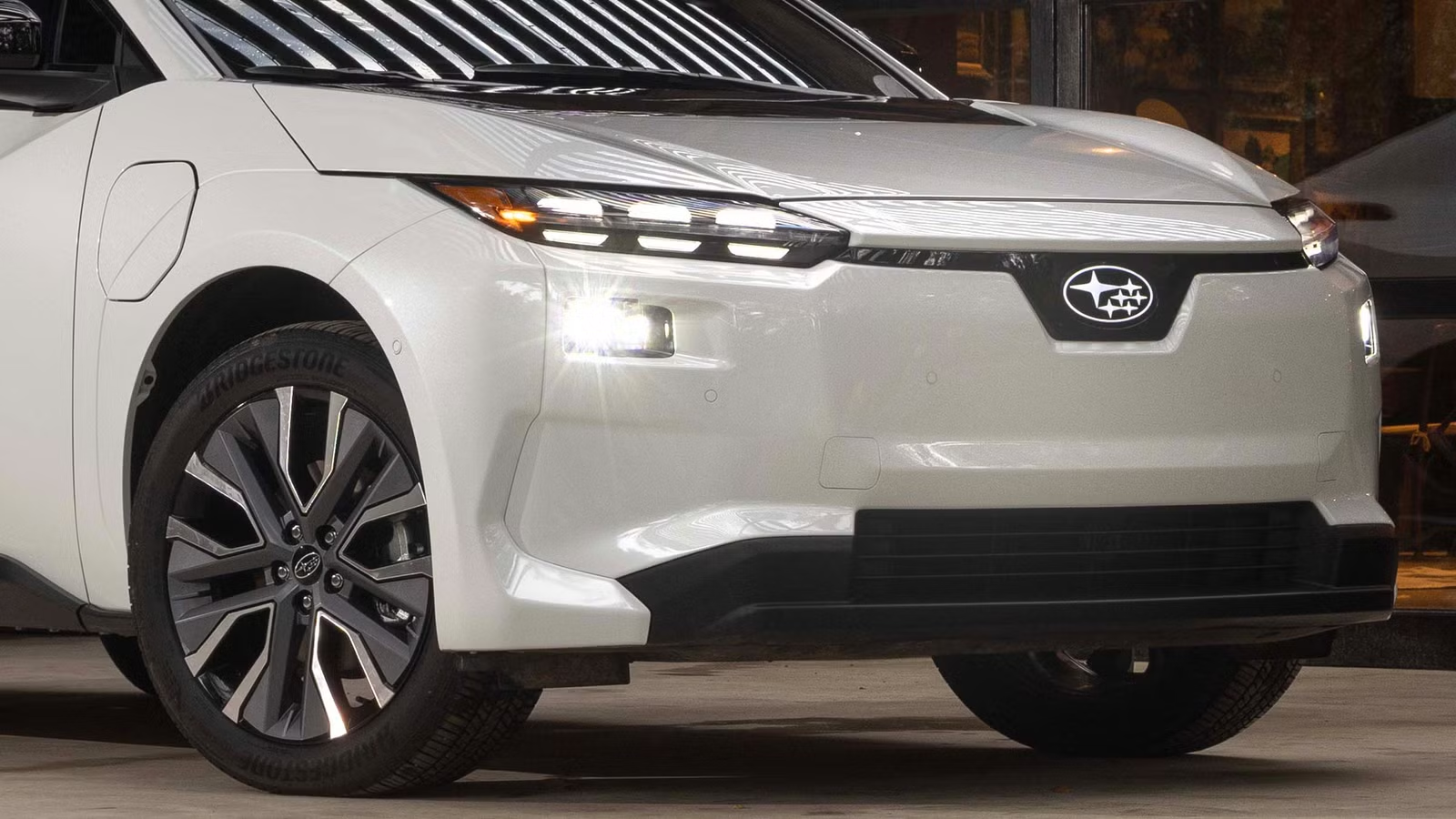
2026 Subaru Solterra XT from the front three-quarter angleSubaru
2026 Subaru Solterra
Powertrain
Single/dual electric motors
Transmission
1-Speed Auto
Power
233-338 hp
Torque
249-323 lb-ft
0-60 mph
4.3-4.9 seconds
Despite Toyota being Subaru’s biggest shareholder, the latter acts independently for the most part. Subaru develops its own range of vehicles and engines, as well as transmissions, and doesn’t rely on borrowing Toyota’s tech in most of its offerings. There are a couple of key exceptions, including the Subaru BRZ and Solterra models. While the former was developed in conjunction with Toyota, the Solterra used a platform largely developed by Toyota.
Subaru had a hand in co-developing the all-electric e-TNGA platform used for the Solterra and its bZ4X cousin, mainly by working on the vehicle’s all-wheel drive setup, though most of the work was carried out by Toyota. The agreement was for Subaru to offer a rebadged version of the bZ4X, which got a considerably revised cabin and body to reflect Subaru’s own design language.
The issue is that e-TNGA-based models have been subject to numerous recalls since the cars entered production in 2022. Soon after the cars began reaching customers, around 6,000 units from both manufacturers were recalled due to concerns that the wheels could become loose and detach while driving. Having initially only covered Toyota’s cars, Subaru issued its own recall in February 2023.
The issue, caused by improperly tightened hub bolts, was eventually rectified, though further recalls covering issues with the HVAC and panoramic camera systems led to further frustration.
Subaru Has Been Forced To Deal With Yet More Issues
2025 Subaru Solterra – charging portSubaru
Now, in 2026, the machines have faced yet more scrutiny. Toyota has recalled a total of 20,991 2026 bZ4X, Subaru Solterra, and Lexus RZ units due to the risk of the cars suffering from total power loss. A problem has been identified with the battery ECU software, which could lead to the car losing all drive power at random moments. Of the total recall number, 4,757 are Solterras. The issue is easily resolved with a dealer-installed software update, but it’s yet another embarrassing situation for Subaru, especially given that the problems aren’t even the company’s fault.
Problems For Subaru
2027 Subaru Solterra Exterior Rear QuarterSubaru
With four separate major recalls having gripped the e-TNGA-based crossover so far, it’s undoubtedly a frustrating situation for Subaru to be gripped in. After all, its customers have to return their cars to dealers for repairs or risk their lives by driving an inherently unsafe machine because of issues it had no hand in developing. The areas Subaru developed appear to have held up well thus far, but it’s now being tarred with the same brush as Toyota after the Solterra was diagnosed with the same problems.
Subaru Solterra Recall History
- February 2023: Improperly tightened hub bolts may loosen and cause wheels to detach from the vehicle (1,182 units affected)
- October 2025: HVAC system failure will result in the defogger and defroster system becoming inactive (94,320 units affected)
- December 2025: Software issue may cause Panoramic View Monitor to show a black screen, restricting rear visibility (1,024,407 units affected)
- July 2026: Battery ECU software problem can randomly cause a loss of drive power (4,757 units affected)
As a result, Subaru faces the risk of its reputation being harmed through no fault of its own, and the automaker can’t publicly distance itself from the issues because of its close relationship with Toyota. Ultimately, the brand is stuck between a rock and a hard place, as going out on its own to develop a bespoke EV platform is simply impossible with its current financial standing. For better or worse, Subaru has to take the flak, and simply focus on making sure its own creations are as dependable as possible.
The e-TNGA Problem Illustrates The Risks Of Badge Engineering
Press image of 2024 Toyota bZ4XToyota
This story clearly illustrates the risk of badge engineering, as the secondary manufacturer in the relationship risks its reputation on technology it only had a small hand in developing. Of course, the amount of money and hassle saved by taking this route tends to make the risk more than worth taking, and it’s ultimately the other manufacturers’ decision to enter into such a deal. Having a key hand in the development of said platform can help mitigate the risk of such a situation occurring, as two different development teams are on hand to address any problems found during the incubation period.
In Subaru’s case, it held up its end of the bargain by developing technology within the e-TNGA foundations that has proven reliable thus far.
Related
Why Toyota’s New Twin-Turbo V6 Is Constantly Being Recalled
Toyota finds itself in an uncomfortable and quite unusual position. Issues with its newer twin-turbo V6 could be shaking confidence in the marketplace
Differences Between The Toyota bZ And Subaru Solterra
2026 Toyota bZ WoodlandToyota2026 Subaru Solterra XT from the frontSubaru
The 2026 Solterra lineup consists of five trims spanning an MSRP range from $38,495 to $45,855. Toyota’s bZ lineup is limited to just three models, one of which is the rugged bZ Woodland, which Subaru doesn’t offer at all. From Toyota, the starting price is lower, with the entry-spec trim costing $34,900 and the most expensive non-Woodland being the Limited at $43,300 – the Woodland version costs $45,300 in base trim, or $47,400 as the Premium AWD version.
Subaru’s base offerings have 233 horsepower, upgrading to 338 hp from the mid-point in the range. Toyota brings 221 hp in cheaper models, although 338 hp is unlocked by adding another motor (and $2,000). The most range you can get from the bZ lineup is 314 miles, while the Solterra’s max is 288 miles.
The Rest Of Subaru’s Range Illustrates Its Quality Prowess
2024 Subaru Crosstrek Sport. Motion.Off-roadSubaru
Being involved in Toyota’s issues is more annoying for Subaru because it has proven to be comfortably on top of any reliability concerns with its own creations. Take the Crosstrek compact crossover as a good example: it earns a solid 9.8/10 in the iSeeCars recall score. In contrast, the Solterra can only muster an 8.6/10 performance due to various issues it has experienced. Furthermore, Subaru’s own SUV range has vastly outscored the rebadged bZ4X in recent times.
It ended up at the back of the queue in this regard, with the Solterra securing a JD Power Quality and Reliability rating of just 67/100, a full 13 points adrift of the Outback midsize crossover. Every other Subaru SUV model comfortably cleared the 80-point barrier, offering a clear glimpse into just how well-engineered its recent in-house vehicles are, compared with the primarily Toyota-underpinned Solterra.
The data from CarEdge doesn’t help the Solterra’s case, either. Whereas the similarly sized Crosstrek is estimated to cost around $1,835 to keep well-maintained over a five-year run, the Solterra is estimated to cost $2,647, a deficit of over $800. Still, unless Subaru decides to go its own way in the future, it’ll just have to suck up the issues that crop up with the e-TNGA platform for the foreseeable future.
Related
2026 Subaru Solterra First Drive: What The Solterra Should’ve Been From The Start
Here’s why Subaru (and Toyota) finally have a winner on their hands.
The e-TNGA Saga Is More Evidence That Toyota’s Standards Are Slipping
2025 Toyota bZ4X Nightshade White Rear Angled View DrivingToyota
Toyota’s woes with its e-TNGA platform have only added to the narrative that the brand is starting to lose its sparkle when it comes to dependability, with the marque struggling to secure its usual high-end results in JD Power’s Vehicle Dependability Study. The brand has slipped further down the rankings in recent times, having ended the 2025 edition of the survey in a strong fourth place. The trouble is, the problems-per-100-vehicle score worsened from 162 to 185 in just a year, leaving it a rather disappointing eighth overall. By contrast, Lexus secured the top spot in both studies.
Its backward step shows that Toyota’s vehicles are becoming less dependable, though they’re at least leaving the factory in better shape than they once were. Having recorded a score of 200 PP100V in the 2025 JD Power Initial Quality Study, which measures how many quality-related issues are present in the early days of vehicle ownership, it improved to 181 for 2026. While heading in the right direction, even this was still comfortably below the study average, which is surprisingly subpar for a company that has prided itself on selling cars of sound quality and reliability for decades.
Judging by its improvement in the 2026 IQS, Toyota is clearly aware of its current shortcomings compared to its rivals and its Lexus sibling, and is working hard to fix them. Further swift improvement is crucial for the manufacturer, as if it continues, what initially seems to be a blip could well become known as the rule.
Sources: CarEdge, iSeeCars, J.D Power, Subaru.
