

In the oak-paneled boardrooms of global OEMs, executives sat and scratched their heads. They couldn’t understand what Toyota was doing and wondered why it was hedging its bets about an all-electric future. After all, this was the company that tried to force-feed the Prius as some kind of global shorthand for green motoring. In doing so, Toyota was one of the earliest adopters of the electrification concept, but now it had decided to slam on the brakes.
Instead, it was now talking about a multi-pathway approach which seemed inconceivable to some of those other decision makers, but that with hindsight, now looks increasingly inspired. Electric vehicles were not going away, and Toyota wasn’t about to abandon them. But the EV-only narrative that some OEMs adopted has been badly dented by slower demand, cost pressures, charging frictions, and huge financial write-downs. And far from taking the wrong approach, Toyota appears to have read the market far more carefully than its rivals.
Toyota Was Never Really Arguing Against EVs
2026 Toyota RAV4 Hybrid close-up rearToyota
2026 Toyota RAV4 Hybrid Specifications
Engine
2.5-liter inline-four hybrid system with electric motors
Transmission
Electronically controlled CVT hybrid transaxle
Drivetrain
Front-wheel drive or all-wheel drive
Power
226 hp
Torque
163 lb-ft gasoline engine and 153 lb-ft front electric motor.
Some rival boardroom executives thought that Toyota had somehow missed the real EV moment by just sitting on the fence. Those skeptics thought that the company had then tried to dress up its caution as wisdom, but in truth, Toyota had simply been more pragmatic during those formative years. The Japanese company was sure that the better solution would depend on how electricity is generated, where the vehicle would be used, what charging access was around, and how scarce materials might factor into the picture.
Toyota was certainly not anti-EV at any point, and its thinking goes back well before the current EV cooldown. After all, Toyota had built its modern green car reputation on hybrid electrification and, in many respects, its work had helped to make electrification feel normal. The Prius developed into a solid and respected solution, a logical choice for commuters and a staple of taxi fleets worldwide. Eventually, the Prius would be the foundation for hybrid versions of some of Toyota’s other hits, like the Camry, Corolla, Highlander, and RAV4.
As Toyota slowed down its battery EV development, other OEMs decided that they would set hard BEV deadlines. Toyota’s then-chairman, Akio Toyoda, warned them that the idea of carbon reduction was fine but that they should never reduce the argument to one powertrain. Governments may have been leaning hard into their zero-emission targets and putting pressure on OEMs and many companies may have seen gold at the end of the BEV rainbow. But words like customer demand, flexibility, and regional conditions would soon factor into the equation instead.
Today, Toyota’s messaging has crystallized to an extent. It’s no longer positioning the hybrid as a bridge to tomorrow’s EV but considering it to be the default mainstream answer instead. Battery EVs can still work and be the correct tool for the right use case, but not as something inevitable across the board.
The 30% Prediction No Longer Sounds So Outlandish
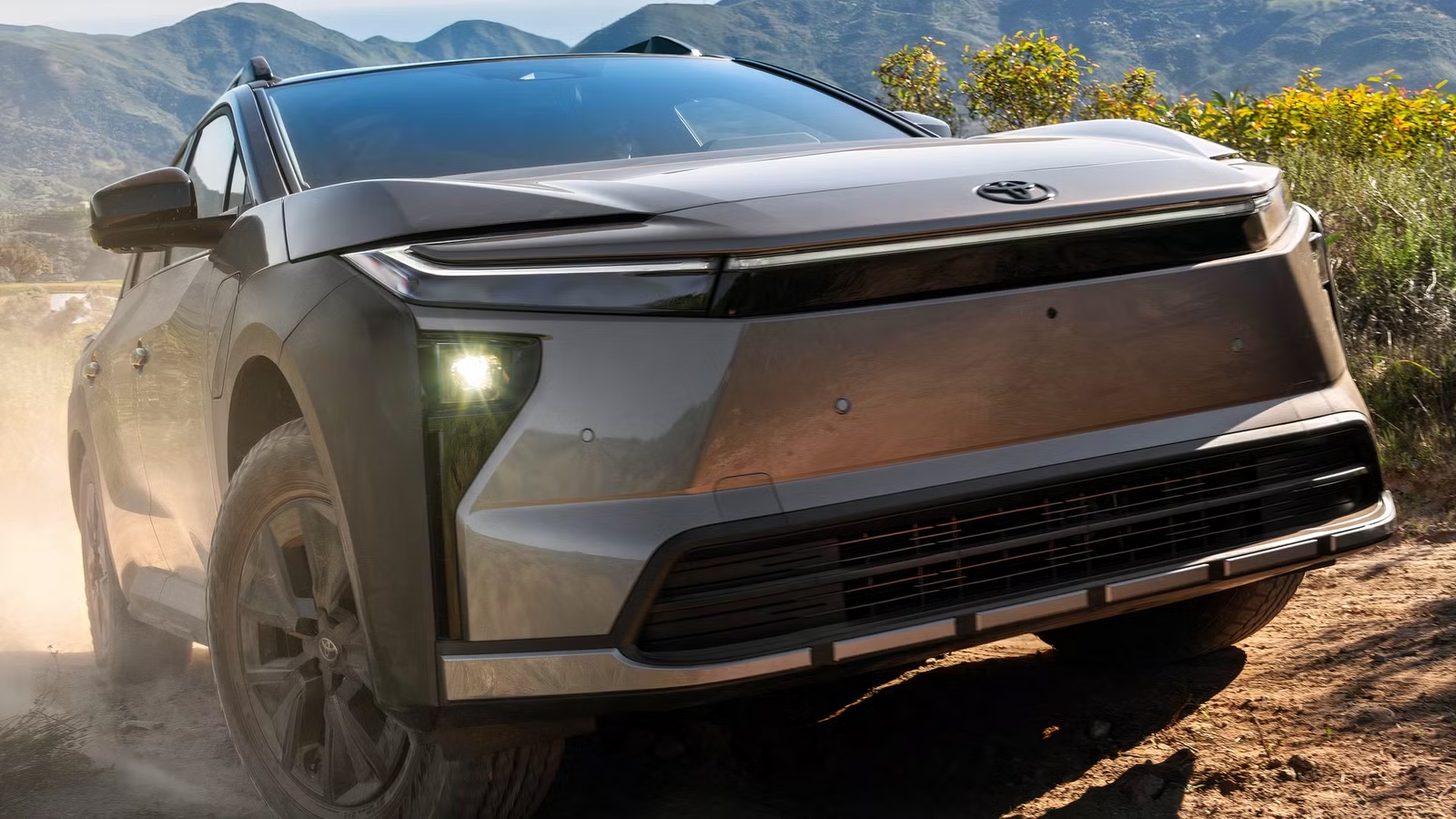
2026 Toyota bZ Woodland from the frontToyota
Akio Toyoda believes that battery EVs will top out at no more than 30% of market share, no matter how quickly they progress in terms of technology, batteries, and charging. Toyoda believes that the remaining 70% will comprise hybrids, fuel cell vehicles, hydrogen combustion vehicles, and other options.
While some may construe that as quite an anti-EV statement, that’s not the case. After all, Toyota has committed enormous sums of money to electrification and has announced a global plan to commit about $70 billion to electrified vehicles through 2030. More than that, it will also earmark around $35 billion towards battery EVs and that’s not the type of behavior you’d associate with a company that’s trying to pretend EVs don’t matter.
The 2026 Toyota bZ, which is the renamed version of the bZ4X in the US, is a credible EV candidate. It has an updated available 74.7 kWh battery, a North American charging standard compatibility, plug-and-charge capability, and an available dual-motor AWD setup. It can produce up to 338 hp, cover a manufacturer-estimated 314 miles, and the quickest AWD version can get to 60 mph in 4.9 seconds. The bZ is now a clear example of what Toyota can do when it puts its mind to full EVs. It’s showing how these EVs can be a factor and an attractive proposition for those who want to charge easily, value smooth electric performance, and may have a driving pattern to suit the technology.
Toyota’s 71.4 kWh Battery Argument Is Its Sharpest Weapon
2007-2009 Toyota Camry Hybrid Battery PackToyota
Toyota is keen to draw attention to limited battery resources and to do this it uses a mathematical equation. Here, it says that the 71.4 kWh battery capacity that it uses for one bZ4X could instead be allocated across five Prius Plug-In Hybrids, 55 Corolla Cross Hybrids or 92 Yaris Cross Hybrids.
Toyota believes that while a single EV could be an excellent answer for one household, the picture is far more nuanced when it comes to fleet-level figures. In cases where batteries, rare earth supply, cost, and manufacturing capacities are necessarily limited, it may make more sense to spread smaller battery packs across a larger number of vehicles. This would then help produce a larger near-term reduction in consumption across the market.
Of course, there are practical consumer arguments to make as well. A vehicle like Toyota’s RAV4 Hybrid never requires a charger and simply uses a smaller battery to cut fuel consumption. Buyers already turn to the RAV4 in substantial numbers anyway, and Toyota can turn these vehicles out in significant numbers compared to far fewer BEVs when material constraints come into the picture.
The Bill For Betting Against Hybrids Has Become Impossible To Ignore
Side shot of a 2022 Ford F-150 Lightning’s charging port coverFord
Some top industry analysts have tried to calculate what OEMs may have lost by putting all their money on BEVs. One suggests that write-offs linked to revised EV strategies come close to €60 billion, while another reports global carmaker EV roll-back write-downs at about $70 billion. Most of the big companies, like Ford, GM, Stellantis, Porsche, and Honda, have been affected in different ways by reassessed battery plants, delayed programs, and weaker-than-expected demand. GM has taken major charges linked to its EV pullback while Volvo reversed course. Its original plan was to sell only BEVs by 2030 but now, the Swedish company expects plug-in hybrids to remain a big part of its product mix.
Related
Toyota’s Heaviest Plug-In Hybrid Has Way More Range Than Its Own Prius Flagship
Toyota’s most impressive plug-in hybrid isn’t the one you’re expecting.
Meanwhile, Toyota said all along that customers and infrastructure would effectively determine the pace and, crucially, it didn’t lose significant amounts of money by trying to prove otherwise. Toyota’s hesitation could have backfired and left the company exposed if battery costs had fallen faster than some people expected. It could also have been on the back foot if governments decided to tighten regulations more aggressively or if charging infrastructure suddenly became prolific. But none of that happened and those that were early and bought into the BEV hype showed that this was not automatically the same as being right.
For Buyers, The Spreadsheet Now Points Back To The Driveway
2018 Toyota RAV4 Hybrid Limited AWD rear viewToyota
Toyota now feels fully ready to offer the market solutions based on individual fit. Hybrid buyers can choose the redesigned 2026 RAV4, which now comes in hybrid and plug-in hybrid versions only and fully replaces the old gas-centric solution with regular hybrid form. The new RAV4 produces 226 hp with front-wheel drive or 236 hp with all-wheel drive. Its manufacturer estimates 44 mpg combined for the FWD version and consumers can buy it starting at $31,900 before dealer processing and handling fees.
Related
How Toyota’s Chairman Saved Billions By Stalling Mass EV Production
Toyota is hitting the sales numbers with specific types of EV. And with that approach, Toyota’s chairman may have saved the company a lot of cash.
At the same time, Toyota is also offering a full EV in the shape of the bZ. This features strong AWD acceleration, quiet operation, and a much-improved charging interface thanks to its NACS compatibility. It goes on sale from $34,900 before delivery charges, with a potential range of around 314 miles.
So, the ultimate lesson is not that EVs failed, but that the all-EV inevitability story fell on its face. Toyota bided its time until better EVs made sense while still making millions of hybrids for those who wanted lower emissions but weren’t willing to change their lifestyle. The company also wanted answers to some honest questions about which powertrain would cut the most carbon for most people and at the right price. In doing so, Toyota wanted to produce products for people to use in the real world that they actually live in, and as it turned out, the right answer looked more like a hybrid crossover.
Sources: Toyota, Reuters, Toyota Asia, EY.com,
