

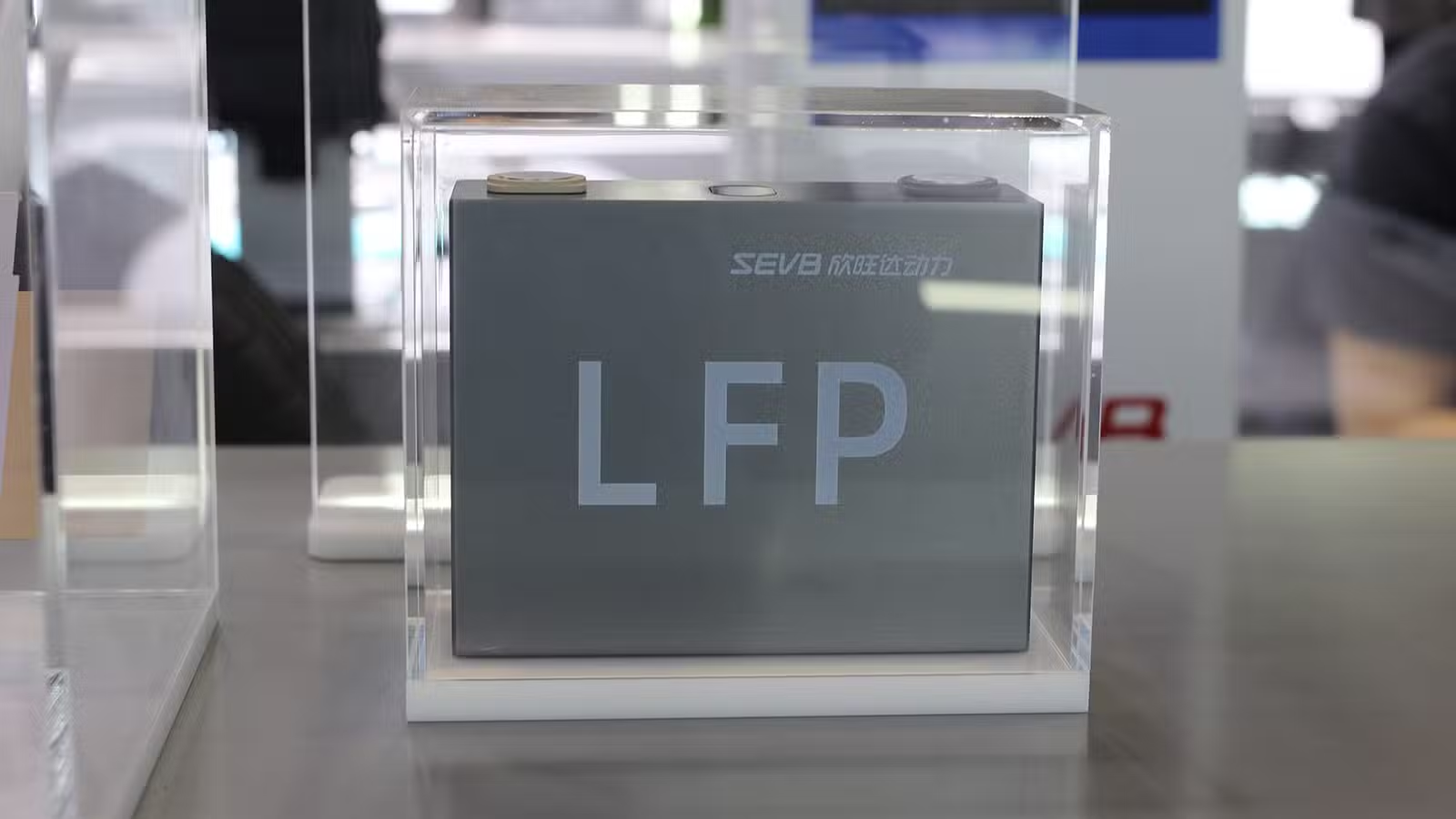
A file photo shows a Sunwoda LFP battery cell. Credit: CnEVPost
- Two mandatory national safety standards take effect on July 1, establishing the world’s first “no fire, no explosion” requirement for EV batteries.
- The new rules will raise technical and capital thresholds, accelerate the exit of low-end capacity, and likely benefit leading battery makers and the LFP route.
China’s electric vehicle (EV) industry is approaching a pivotal safety compliance milestone, as two mandatory national standards take effect on July 1.
The two standards are the Electric vehicles traction battery safety requirements (GB 38031-2025) and the Electric vehicles safety requirements (GB 18384-2025). The former focuses on traction batteries, while the latter targets vehicle-level safety.
This marks the first time China has rolled out its two core mandatory safety standards, covering both batteries and vehicles, on the same day. The industry views them as the “strictest battery safety rules ever.”
The most fundamental change in the new rules lies in a thorough reconstruction of the safety governance philosophy, reversing the industry’s previous approach to risk prevention.
The old standards allowed traction batteries to catch fire or explode after thermal runaway, but required occupants to be warned at least five minutes in advance.
The new version mandates system-level intrinsic safety, requiring batteries to achieve “no fire, no explosion” after thermal runaway in a single cell.
“This is a shift from after-the-fact handling to upfront prevention,” China Automotive News quoted Liu Kai, executive secretary general of the new energy vehicle (NEV) battery branch of the China Association of Automobile Manufacturers, as saying in a report on Tuesday.
This imposes stricter requirements on system-level thermal safety management, aiming to eliminate at the source the potential safety threats to occupants posed by fire or explosion caused by battery thermal runaway, Liu said.
To better reflect real-world accident causes, the new standards also add two mandatory tests: bottom impact and long-term fast-charging cycling. These cover two high-frequency scenarios, namely vehicle underbody strikes and high-frequency ultra-fast charging.
The vehicle-level standard rolled out at the same time also delivers a disruptive upgrade. Its core change is to abolish software-based power cut-off and mandate an independent physical “one-touch power cut” device.
China’s new national standard for EV batteries requires, for the first time, that the vehicle’s entire high-voltage circuit can be physically disconnected with a single action. Illustration by the Chinese Ministry of Industry and Information Technology.
Previously, high-voltage cut-off relied on software signals from the onboard controller. In the event of a severe collision that damages the main control system, the cut-off function could fail.
The new rules require that a driver be able to cut off the vehicle’s high-voltage circuit within one second through a single tap or long press. The hardware operates independently of the onboard main control software.
The two standards have clearly divided roles, forming a dual-layer protection architecture and breaking away from the fragmented design of the past that relied on a single warning.
Leading battery makers have moved early. China Auto News cited an executive at CATL (HKEX: 3750) as saying the company mass-produced its first generation of no-thermal-propagation battery technology back in 2020, meeting the new requirements six years ahead of time.
Huang Xiaobin, deputy general manager of the commercial vehicle battery product application department at Eve Energy (SZSE: 300014), said the company’s ternary and lithium iron phosphate (LFP) battery systems already achieved “no fire, no explosion” in 2022.
That said, cost pressures are diverging sharply within the supply chain. Meeting the new rules will raise battery system costs by 15% to 20%, China Auto News said, citing estimates from a market research firm.
This translates into additional costs of about 3,000 yuan ($440) to 5,000 yuan per battery pack per vehicle.
The impact on products from large companies that planned ahead is minimal, but small and medium-sized enterprises and low-end models face greater cost pressure, widening the gap in resilience between leading firms and smaller players, the China Auto News report noted.
Liu expects the new rules to push companies to systematically rebuild everything from cell materials to battery management system (BMS) algorithms, squeezing the survival space of those relying solely on assembly or low-quality cells.
In addition, thanks to its high intrinsic thermal stability, LFP faces a smaller cost increase in meeting the new rules, and its market share is likely to consolidate further. This could intensify the divergence between different chemistry routes.
The new rules arrive as industry growth is slowing. Ma Xiaoli, deputy director of China’s National Power Battery Innovation Center, said earlier today that the industry is shifting from rapid growth to a phase of structural upgrading.
Ma expects domestic traction battery installation demand to reach 888.7 GWh for full-year 2026, up 15.8% year-on-year. That growth rate is sharply lower than the 40.35% recorded in 2025.
Structural divergence is becoming increasingly evident. Commercial NEVs are becoming the core growth engine, with installation demand expected to rise 34.7% in 2026, far outpacing the 10.8% growth for passenger vehicles.
CATL’s chairman said solid-state batteries must still clear three main hurdles before mass production.
($1 = 6.7942 yuan)
