

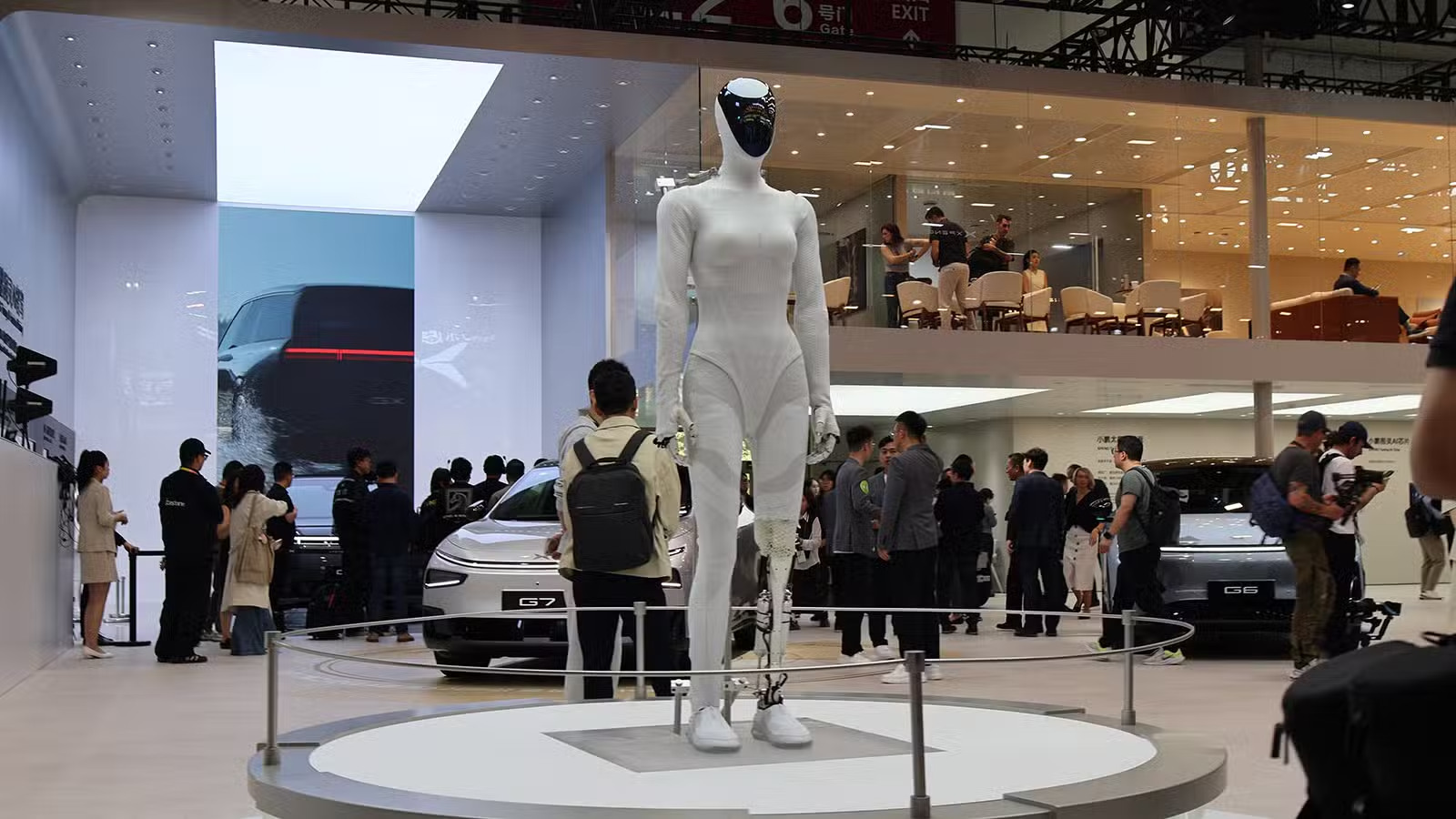
An Xpeng Iron humanoid robot on display at the Beijing Auto Show in April 2026. Credit: CnEVPost
- Mi Liangchuan, head of Xpeng’s robotics business, has departed recently, becoming the second key executive to leave its robotics team within a month.
- Xpeng chairman and CEO He Xiaopeng is now personally serving as head of the company’s robotics center and its product division.
Xpeng (NYSE: XPEV) has lost another senior executive from its robotics business, adding uncertainty to its push for mass production by year-end.
The head of the company’s robotics business, Mi Liangchuan, has departed recently, according to a report by 21jingji on Tuesday.
Xpeng chairman and CEO He Xiaopeng is now personally serving as head of the company’s robotics center and its product division, the report noted.
This is the second key figure Xpeng’s robotics team has lost within a month. Earlier this month, lead product chief Shi Xiaoxin also departed.
Mi had previously been regarded as one of the four core figures steering Xpeng’s robotics team, alongside Chen Jie, Ge Yixiao and Liu Xianming, 21jingji noted.
Before joining Xpeng, Mi worked at Nvidia (NASDAQ: NVDA) for nearly 15 years, with extensive experience in autonomous driving.
He joined Xpeng in 2021 as senior director of autonomous driving. In September 2023, he was promoted to head of the robotics business.
During Mi’s tenure, Xpeng’s humanoid robot Iron achieved a highly anthropomorphic walking gait, drawing attention at the company’s tech day last November.
In an interview in November 2025, Mi recalled that before Iron achieved natural walking, he and his team had once been “deeply despairing” for as long as half a year.
The turning point came on March 26, 2025, when he saw on a monitor that Iron could “walk backward,” marking an important inflection point in motion control, according to 21jingji.
Mi described that moment as the “ChatGPT Moment” for Xpeng Iron’s motion control, attributing it to the team’s breakthrough in “spine” technology.
He has also explained the logic behind Xpeng’s commitment to the humanoid path. He argued that human environments and tools have been designed as humanoid centric for thousands of years.
The second reason is that designing specially designed hardware for specific needs means any functional change would drive up costs. A humanoid robot, by contrast, can be continuously upgraded via software OTA.
This personnel turbulence comes as Xpeng undertakes a major restructuring of its robotics business. Mr. He announced in a June 10 internal letter that he would personally serve as “CEO” of the robotics business.
He called the move an important step in Xpeng’s strategic transformation from a smart car company into a “physical AI company.”
Xpeng subsequently created nine second-tier departments, integrating core modules including hardware, AI large models, supply chain, precision manufacturing and marketing.
He said the robotics business now stands “on the eve of mass production and commercialization,” with high complexity that requires coordinated resources across the entire group.
According to the company’s plans, Xpeng will achieve scaled mass production and initial deliveries of its advanced humanoid robots in the fourth quarter of 2026.
To support this goal, Xpeng’s humanoid robot mass-production base broke ground earlier this year in Guangzhou’s Tianhe district, the industry’s first such base.
In early June, the first phase of the mass-production base project completed concrete pouring for the first section of the plant, moving into construction of the upper main structure, 21jingji noted.
Chinese automakers including Li Auto (NASDAQ: LI), Seres (HKEX: 9927), Chery (HKEX: 9973) and BYD (HKEX: 1211) have all bet on a robotics transformation.
“Other companies in the West are weak,” Musk said.
($1 = 6.7942 yuan)
