

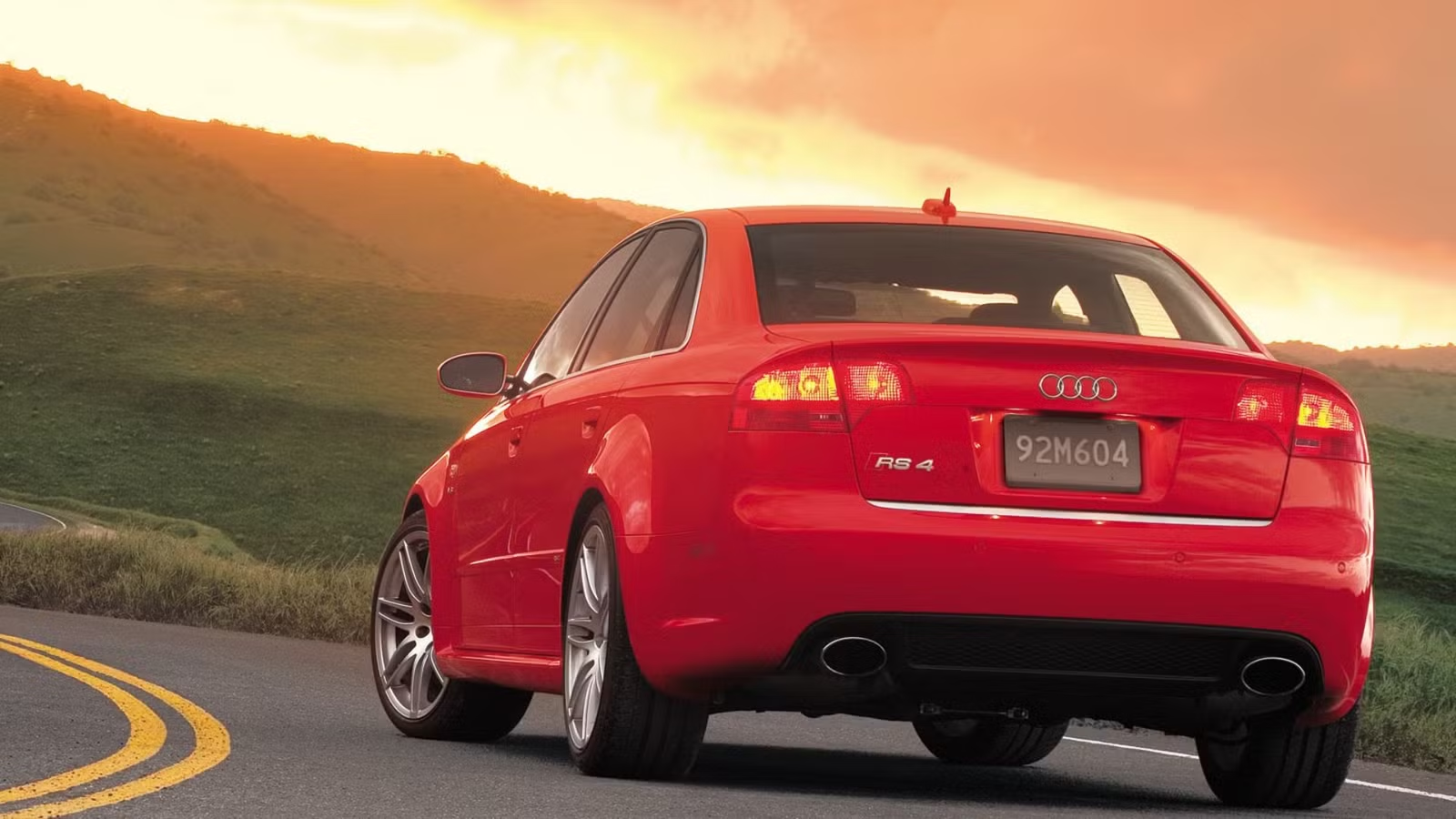
The spiritual home of the V8 engine may be the USA, but Germany has certainly given it a run for its money. Whenever German engineers need to inject some character into a car, be it a sports car like the Mercedes-Benz SL, or an SUV like the Audi RSQ8, the first choice is usually an engine with eight cylinders rumbling ahead. These German cars aren’t only fast in a straight line, though; they’re also pretty fast to drop in value.
This sub-$25,000 used category has put European finesse and V8 performance in reach of more people. If you’re faced with the decision of either getting a hybridToyota Corollaor a sports car from a decade ago, we know which one your heart wants. With this budget, here are our five favorite choices for German V8 thrills.
5
2010 Mercedes-AMG E 63
A Handcrafted 6.2-Liter V8 That Sounds Like Nothing Else
Mercedes-AMG has a habit of making brilliant V8 engines, but its swan song has to be the thunderous 6.2-liter V8 from the noughties. For under $25k, you can pick up a pretty tidy W212-generation E 63, which puts out an impressive 518 horsepower and 465 lb-ft of torque. Sure, the facelifted models might get you slightly more torque, but it’s the experience that is key here. The engine note is a thing of legend, deep and instantly recognizable.
That handcrafted engine is accompanied by a seven-speed transmission, some aero elements like a lip spoiler, and a four-second 0-60 mph time. Top speed is limited to 186 miles per hour with the driver’s pack, but we can imagine it’ll go even faster. For $25k, we found a few examples with 67k miles, or even a one-owner example with 70k miles on the clock. Daily driving is easy thanks to heated/ventilated seats and a properly good Harman Kardon sound system.
What To Look For
The 6.2L engine was replaced by the 5.5L unit in 2011, so make sure to get a 2010 model for the final run of big-displacement engines. Overall, it’s a decently reliable car, but check for rusted headbolts making repairs tricky. These bolts could also allow water into the engine, which can cause a serious misfire. Some owners have reported failing camshafts, too. Look out for a car with the optional limited-slip differential equipped to get more of that power down onto the road.
4
2017 Audi S6
Beware Failing Turbos
Audi’s love of the V8 is a long-standing one, with two of its models on this list. The 4.0L twin-turbo V8 unit is still used today in Audi’s executive RS6 wagon, but if you’re a fan of low-key performance, the S6 might be for you. The engine makes a healthy 450 hp and 406 lb-ft of torque, and with Audi’s legendary quattro all-wheel-drive technology, it feels like a point-and-shoot sedan that won’t slip under load. Power is routed through a seven-speed transmission.
Exterior design is pretty understated for the engine that hides inside, with the only aggressive elements being the quad exhausts and badge. Inside, you get a comfortable daily cruiser that has heated and ventilated seats (heated even in the rear), and a Bose sound system. And all this is enjoyed during a blast from a stop to 60 miles per hour in just 4.4 seconds.
2013 Audi S6 Exterior Engine Close-UpAudi
What To Look For
Being the most modern on this list, you’ll be checking out higher mileage examples, around the 90k mark. The biggest issues surrounding these cars are to do with the turbos failing, so check if they’ve ever been inspected for compressor wheels cracking. PCV failure can be frustrating, as it is signified by a loud whistle; while the part itself is inexpensive, labor is intensive. These are easily tunable engines, and they are reliable under strain, but make sure any modifications are done by an approved mechanic.
3
2013 BMW 550i
The 550i Trim Level Is Your Best Bet
Close
The F10-generation BMW 5 Series, produced from 2010-2017, is a competent daily driver that can be picked up for not much less than a new Toyota Camry. If you want a BMW V8, though, the 550i trim level is your best bet, with a 4.4L turbocharged unit that makes a great 400 hp and 450 lb-ft of torque. This all comes in a package that is handsome, minimalist, and unlikely to make a passerby look twice. They might look again when you get to 60 miles per hour in just 4.7 seconds.
BMW calls this engine an “iron fist in a velvet glove,” which is a perfect way of describing how understated it looks inside and out. Lots of creature comforts can be yours, such as a Bang & Olufsen sound system, a rearview camera, and lovely light tan upholstery. You can even have this car with a six-speed manual that BMW says has a shorter throw to make it more satisfying to use.
What To Look For
2011-2013 BMW 5 SeriesBMW
While the pre-technical-upgrade, or pre-TU, engines are said to be something to avoid, there are ways to mitigate the risks. First off, the valve stem seals are the worst offenders in this engine, as they weren’t as resistant to the engine’s heat as they should’ve been. This can cause oil to burn off.
Some owners have found their turbochargers have failed, so make sure you keep the engine running for a few moments so the oil can circulate.
2
2012 Porsche Panamera S
You’ll Feel Like A Fighter Pilot
The flat-six engine might be the usual Porsche power plant, but the company is just as invested in its V8s, even going so far as to try to replace the six-cylinder with a V8 in the 928. The Panamera is an overly hated design, this writer thinks, but you won’t care about others’ opinions when you put your foot down. A 4.8L naturally aspirated V8 engine gives you 400 hp and 369 lb-ft of torque, pushing you from 0–60 mph in five seconds.
Top speed sits at 175 mph. It’s not only the engine that’s Porsche-coded, though, with Porsche active suspension as standard. Air suspension is a nice-to-have feature, but pushes the price up significantly. Inside, you’ll feel like a fighter pilot given the number of buttons, and two sporty bolstered seats offer generous rear space thanks to the fastback design.
A front angle shot of a 2010-2013 Porsche Panamera Turbo driving Porsche
What To Look For
The 970-generation Porsche Panamera is a sensible used buy, especially as the “S” models do not have the added complexity of turbochargers. This model has a few issues with the air suspension, which was only optional with this variant, so you’re avoiding a lot of trouble by going for old-fashioned steel. Some oil leaks could be present, so a pre-purchase inspection is advisable. Given how inexpensive some examples are, be sure to verify a history of routine maintenance from specialized service centers.
1
2007 Audi RS4
A Rare Sight On The Road Today
The B7-generation RS4 looks tiny compared to many modern sports sedans, and that makes it even more usable on the road. A slick six-speed manual transmission lets you feel more connected to a highlight of Audi’s engine history, the 4.2L all-aluminum V8 that sings to over 8,000 rpm. It makes 414 hp and 317 lb-ft of torque, meaning that even though it has RS on the back, you’ll be able to enjoy it without breaking the law.
This engine eventually made its way over to the brilliant Audi R8 supercar. Audi was obsessed with performance, which meant modified pistons, crankshaft, and cylinder heads compared to the S4. Quattro AWD makes the power even more usable in wet conditions, and with fewer than 2,000 units coming to the US, it’s a rare sight on the road today. 90% of its peak torque figure comes from just 2,250 revs, which means you don’t have to strain when cruising.
2007 – 2008 Audi RS4 Sedan DashboardAudi
What To Look For
Expect to look at the upper end of mileage (100,000) to slip in under $25k, but that shouldn’t put you off an RS4. Oil consumption is common, but that’s not a sign of problems, and you’ll be happy to know that higher-mileage examples won’t have a carbon deposit build-up problem. Dynamic Ride Control suspension helps stabilize the car in corners, but the shock absorbers are extremely expensive and require specialist tools to install, so check whether these are worn or have been replaced.
Sources: Audi, BMW, Mercedes, Porsche, Pistonheads, BimmerPost
