

The battery, weighing 630kg, is designed and built in Maranello and integrated into the car’s floorpan. Designed with Korean battery company SK On, it consists of 210 cells connected in series, arranged 14 per module, with 15 modules in the pack – one centrally at the front behind the front axle, then mounted two by two to the rear, where the last four are stacked two-high, beneath the rear seats.
They have a peak discharge rate of 830kW and a total capacity of 122kWh at 800V, with a usable capacity of around 11kWh. The Luce’s peak charge speed is claimed to be 350kW, although Ferrari says it will take 70kWh in 20 minutes, meaning a sustained rate over that time of 210kW.
The battery pack is designed and built in Maranello so that Ferrari – which says 90% of all of its cars are still on the road – can place new battery tech into its own pack design should it need to, even decades down the road – in a similar way to how it’s offering F80-derived packs for LaFerrari batteries now.
Dynamics
While the Luce weighs 2260kg, it has a centre of gravity that’s 95mm lower than a Purosangue’s and a yaw moment of inertia that’s 15% smaller. Weight distribution is 47:53 front to rear.
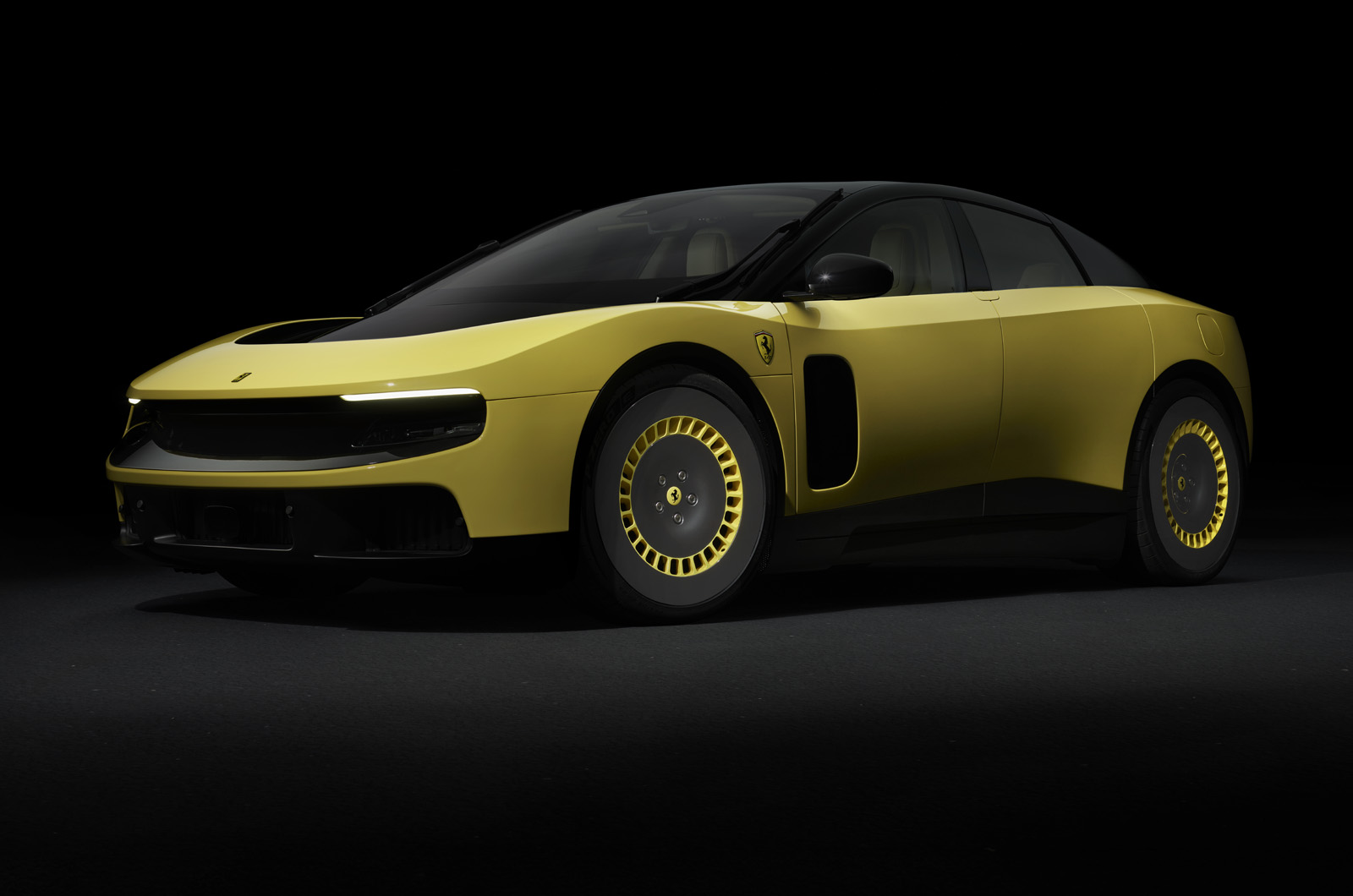
It has the largest wheels yet fitted to a Ferrari, with 23in, 9.5J front and 24in, 11J rear wheels, in two different styles – lighter five-spoke alloys or a more aerodynamically efficient turbine design, which gives maximum range.
Between them, suppliers Pirelli, Michelin and Bridgestone offer two normal tyres, two winter tyres and a run-flat option.
Ferrari’s chief product development officer, Gianmaria Fulgenzi, said the Luce will be “the most comfortable Ferrari ever produced”. The suspension is by double wishbones at the front and rear and employs an evolution of the 48V Multimatic TrueActive spool-valve dampers first used on the Purosangue, which negate the need for conventional anti-roll bars. Here, though, their internal ball screw pitch is increased by 20%, which better absorbs vertical impacts, and they’re 0.5kg lighter at each corner.
