

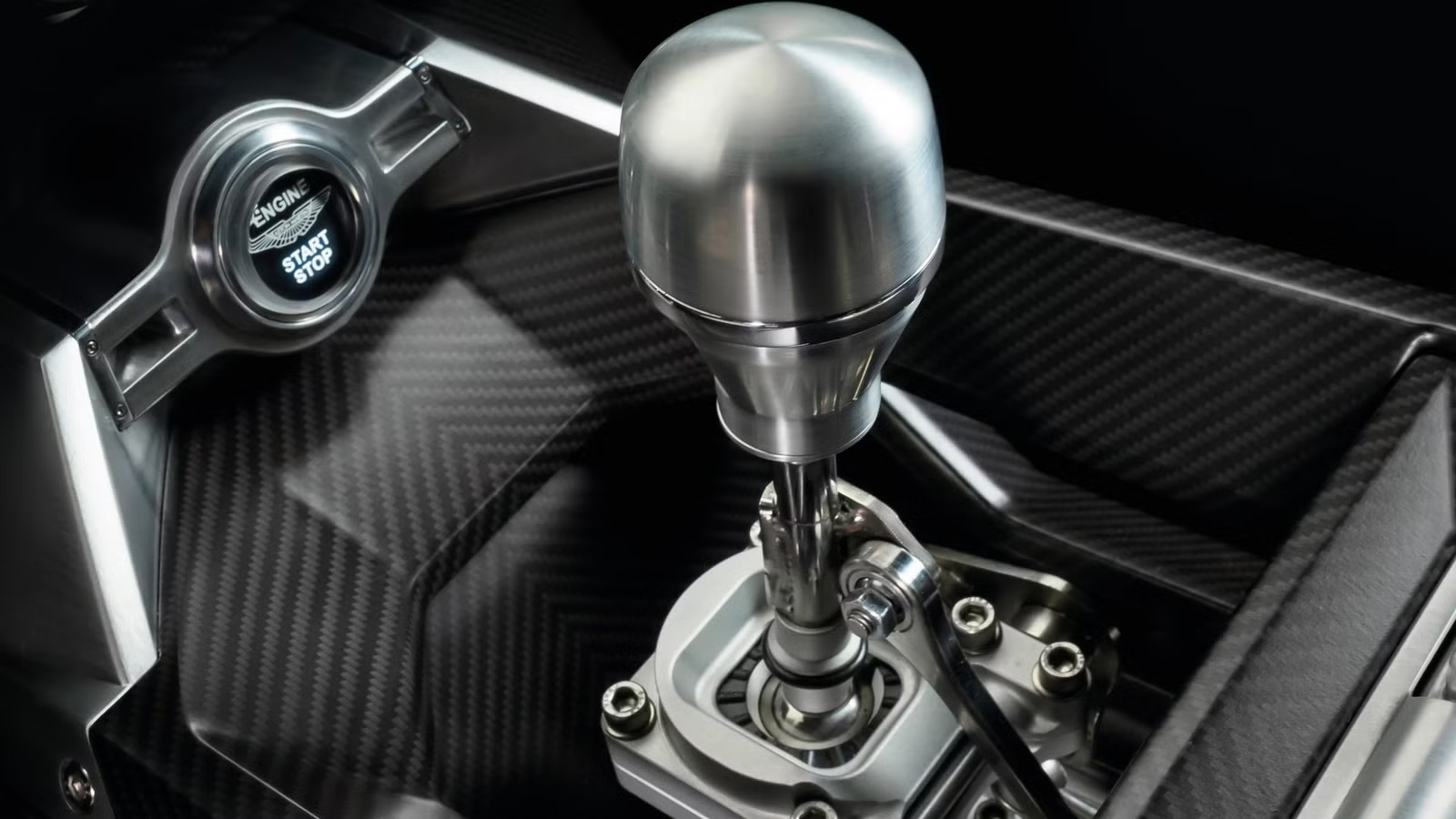
Manual or Automatic? Which is better? That topic has been debated ad nauseam in the automotive world. Both have their benefits and drawbacks. Automatic transmissions are more abundant in modern vehicles, typically more efficient, and easier to use. In contrast, defenders of manual transmissions remind us that their main selling point is that they are more engaging. Still, some advantages aren’t performance-related.
While a variety of cars still rely on manual transmissions, the number of performance cars equipped with them has declined over the last decade. Today, automatic transmissions are favored and often required in high-performance vehicles. Whether you care or not that the manual transmission is dying, that’s up to you, but at least we have the memory of the few icons over the last half-century that were only available with a manual transmission.
For this article, we selected 10 vehicles that we consider iconic, based on their significance to the respective brands, public notoriety, influence on the automotive zeitgeist, and the general lasting legacy. The cars are arranged alphabetically by manufacturer names.
Bugatti EB110
Transmission: Six-Speed Manual
Engine
3.5-liter quad-turbocharged V12
Horsepower
603 hp @ 8,250 rpm
Torque
479 lb-ft @ 4,200 rpm
0-60
3.14 seconds
The Bugatti EB110 was among the new generation of supercars that emerged in the 1990s, marking a much-needed return to the main stage for the brand. The quad-turbocharged 3.5-liter V12 engine was a notable achievement for the time and set a top speed record. The vehicle was the sum of all its parts, and one of the more significant components was the bespoke short-throw six-speed manual transmission. After the Bugatti EB110’s production ended, the French automotive manufacturer followed it with the Veyron. In contrast to the predecessors, the Bugatti Veyron 16.4 employed the world’s first seven-speed twin-clutch transmission.
Dodge Viper
Transmission: Six-Speed
Engine
8.0-liter – 8.4-liter naturally aspirated V10
Horsepower
400 hp – 645 hp
Torque
450 lb-ft – 600 lb-ft
0-60
4.4–3.3 seconds
Did you know, left untreated, the bite of a Viper could kill the average person within one or two hours. However, Dodge’s Viper is more potent. Hyperbole aside, in its earliest incarnation, the Dodge Viper was a sleek, muscular coupe that lacked basic amenities such as air conditioning, airbags, traction control, and anti-lock brakes. Paired with its hulking V10 engine was a six-speed BorgWarner T56 manual transmission, a focal point of the Viper’s design.
The second and third-generation Dodge Vipers used the same transmission. However, the T56 transmission was succeeded by the Tremec TR-6060 manual, which improved the Viper’s torque capacity while increasing its transmission durability. This design would also be used in other American icons, such as the Chevrolet C6 Corvette and, more recently, the Cadillac CT5-V Blackwing.
1st-Generation Ford GT
Transmission: Six-Speed
Engine
5.4-liter supercharged V8
Horsepower
500 hp @ 6,500 rpm
Torque
500 lb-ft @ 3,250 rpm
0-60
3.5 seconds
During the resurgence of American-made supercars, we were introduced to the spiritual successor to Ford’s iconic Ford GT40. At its core was a 5.4-liter supercharged V8 engine. It was a mighty engine housed in a sleek aluminum body and an aluminum spaceframe skeleton, which, in full trim, weighed 3,350 pounds and was one of the most powerful engines used in any factory- or road-going Ford model at the time.
Paired with this engine was a six-speed manual transaxle developed by engineering firm Ricardo UK, which has also been the manufacturer of Porsche’s 991 GT3 Cup car transmissions, including the sonorous Porsche 911 RSR. Between the supercharged eight-cylinder power plant and Ricardo-built transmission was a single-plate AP Racing clutch. When the second-generation Ford GT debuted, it not only lost two cylinders but also its manual transmission, replaced by a seven-speed Getrag dual-clutch transmission.
Honda Civic Type R (EK9 – FL5)
Transmissions: Five- And Six-Speed
Engine
1.6-liter – 2.0-liter inline-four
Horsepower
182 hp – 325 hp
Torque
118 lb-ft – 310 lb-ft
0-60
4.9–6.7 seconds
The Honda Civic Type R is nearly royalty in the world of front-wheel-drive automobiles. For decades, the Civic Type R has been a symbol of the Japanese market’s finest, and from its inception to its current form, it has consistently been a force to be reckoned with. The Type R badge debuted on the rear of Honda’s Civic in its sixth generation.
In that form, it employed a naturally aspirated 1.6-liter inline-four-cylinder engine paired with a close-ratio five-speed transmission. When the Honda Civic EP3 Type R debuted, it featured a new six-speed close-ratio transmission. When the FD2 debuted, it paired the same six-speed close-ratio transmission with a helical limited-slip differential. Even in the latest incarnation of Honda’s Civic Type R, the FL5 employs a six-speed manual transmission.
Honda S2000
Transmission: Six-Speed
Engine
2.0-liter – 2.2-liter naturally aspirated inline-four
Horsepower
240 hp @ 8,300 rpm
Torque
153 lb-ft – 162 lb-ft
0-60
5.5 – 6.0 seconds
The Honda S2000 features one of Honda’s most unique engines, the F20C. It bucked tradition by employing a longitudinally mounted four-cylinder power unit rather than a transversely mounted inline-four used in the majority of the Japanese automaker’s vehicles. Mated to the F20C four-cylinder engine was a close-ratio manual transmission with shift linkages mounted to the top of the transmission case to improve the shifter feel, which was effective. This six-speed transmission also featured a short-throw shift system, and the entire transmission was designed to be extremely rigid while remaining compact and lightweight.
Lamborghini Diablo
Transmission: Five-Speed
Engine
5.7-liter – 6.0-liter naturally aspirated V12
Horsepower
485 hp – 587 hp
Torque
461 lb-ft – 471 lb-ft
0-60
3.5 – 4.5 seconds
The last V12 engine in any Lamborghini that you could get with a manual transmission was found in the last renditions of the Diablo. Lamborghini kept its naturally aspirated V12 engine alive for decades, with it receiving a slew of changes and revisions over the years. Lamborghini’s iconic V12 engine began its life in the 350 GT. Evolutions of the powerplant later appeared in icons such as the Miura P400 SV, Espada, and Countach, before making its way into the Diablo.
Displacement changed over the years, and so too did its power and performance capability, with the V12 being a mainstay in the Diablo’s production run. Its greatest iteration was in the VT 6.0 SE version, where the 6.0-liter naturally aspirated V12 engine was paired with the same five-speed dogleg transmission that was used in every other incarnation of the Diablo.
Lotus Elise
Transmission: Five – And Six-Speed
Engine
1.6L – 1.8L inline-four
Horsepower
118 hp – 245 hp
Torque
122 lb-ft – 188 lb-ft
0-60
3.8 – 5.1 seconds
Simplify, then add lightness. The mantra guided the Lotus brand to create some of its most renowned models, including the Lotus Elise, named after the granddaughter of Lotus’s chairman at the time, Romano Artioli. When the model debuted, the Elise was immediately defined by its petite frame that weighed a mere 1,698 lbs in its heaviest iteration of the Series 1 batch and would ultimately reach its heaviest in later iterations, tipping the scales at 2,052 pounds, which is still a noteworthy attribute today, with few coming close to the lightweight composition.
Beyond its featherweight body, the Elise was designed to be an engaging sports car, and as many who vehemently defend the manual transmission will harp on about, a manual transmission is the way to go for maximum driver engagement. In every iteration of the Elise, a manual transaxle was employed, with the Series 1 and Series 2 versions using either a five-or six-speed transaxle, while the Series 3 exclusively employed a six-speed transaxle.
McLaren F1
Transmission: Six-Speed
Engine
6.0-liter naturally aspirated V12
Horsepower
618 hp @ 7,400 rpm
Torque
479 lb-ft @ 4,000 rpm
0-60
3.2 seconds
In the 1990s, McLaren introduced what would become one of, if not the greatest, performance cars of the modern era, the F1. Decades after the debut, it’s still the fastest naturally aspirated road car ever, and its value on the modern used market speaks to its legacy. While the naturally aspirated V12 engine, which shares its engine bay with swathes of gold heat shielding, is the centerpiece of the F1, the six-speed manual transmission is also worth mentioning.
Unsurprisingly, like many of the greats, the McLaren F1 relied on Formula One knowledge and technology, including an aluminum flywheel and a carbon clutch. As for the transmission, it was a six-speed transverse unit housed in a magnesium casing that also served as a load-bearing member. Interestingly, the first five gears were close-ratio units, designed for speeds between 0 and 160 mph, while the sixth gear enabled the F1 to reach a top speed of over 200 mph.
Porsche 959
Transmission: Six-Speed
Engine
2.8-liter twin-turbocharged flat-six
Horsepower
444 hp @ 6,500 rpm
Torque
369 lb-ft @ 5,500 rpm
0-60
3.7 seconds
At one point, the Porsche 959 was the world’s fastest production car. Not only that, but it was also an early production car to employ all-wheel drive. If the model had debuted a few months earlier, it would’ve been the first street-legal all-wheel-drive production car with a twin-turbocharged engine. The vehicle was an innovator and trend-setter, as cliché as it sounds.
The Porsche 959’s hardware and many of its defining features would be inherited by later Porsche models. Mated to its twin-turbocharged flat-six was a six-speed manual transmission made from magnesium that only had five gears imprinted onto its rounded shift knob, although there really were six gears to row through.
Porsche Carrera GT
Transmission: Six-Speed
Engine
5.8-liter naturally aspirated V10
Horsepower
605 hp @ 8,000 rpm
Torque
435 lb-ft @ 5,750 rpm
0-60
3.5 seconds
A handful of cars over the years have been earmarked as widow-makers, most notably the Porsche 930 Turbo, notorious for its metric ton of turbo lag and tail-happy demeanor that could kill you if you weren’t careful. The same applies to Porsche’s legendary Carrera GT. Arguably, the model might be more deserving of the “Widow Maker” title than the 911 Turbo, due to its powerful mid-mounted V10 engine, which exclusively powers the rear axle in a sleek supercar weighing a mere 3,042 pounds.
To say it was a handful when pushed would be an understatement. In truth, it was dangerous all the time, and between trying to throttle a vocal V10 engine and keeping the nose pointed straight, a driver would need to take one hand off the wheel to shift through all six gears of its transversely mounted manual transmission, which was directly inspired by Porsche’s motorsports technology. Even the clutch that it was paired with was mighty, being as small and lightweight as possible to allow for better ground clearance and less interference with the engine’s position.
Sources: Porsche, McLaren, Lamborghini, Lotus, Honda, Ford, Dodge, Bugatti
