

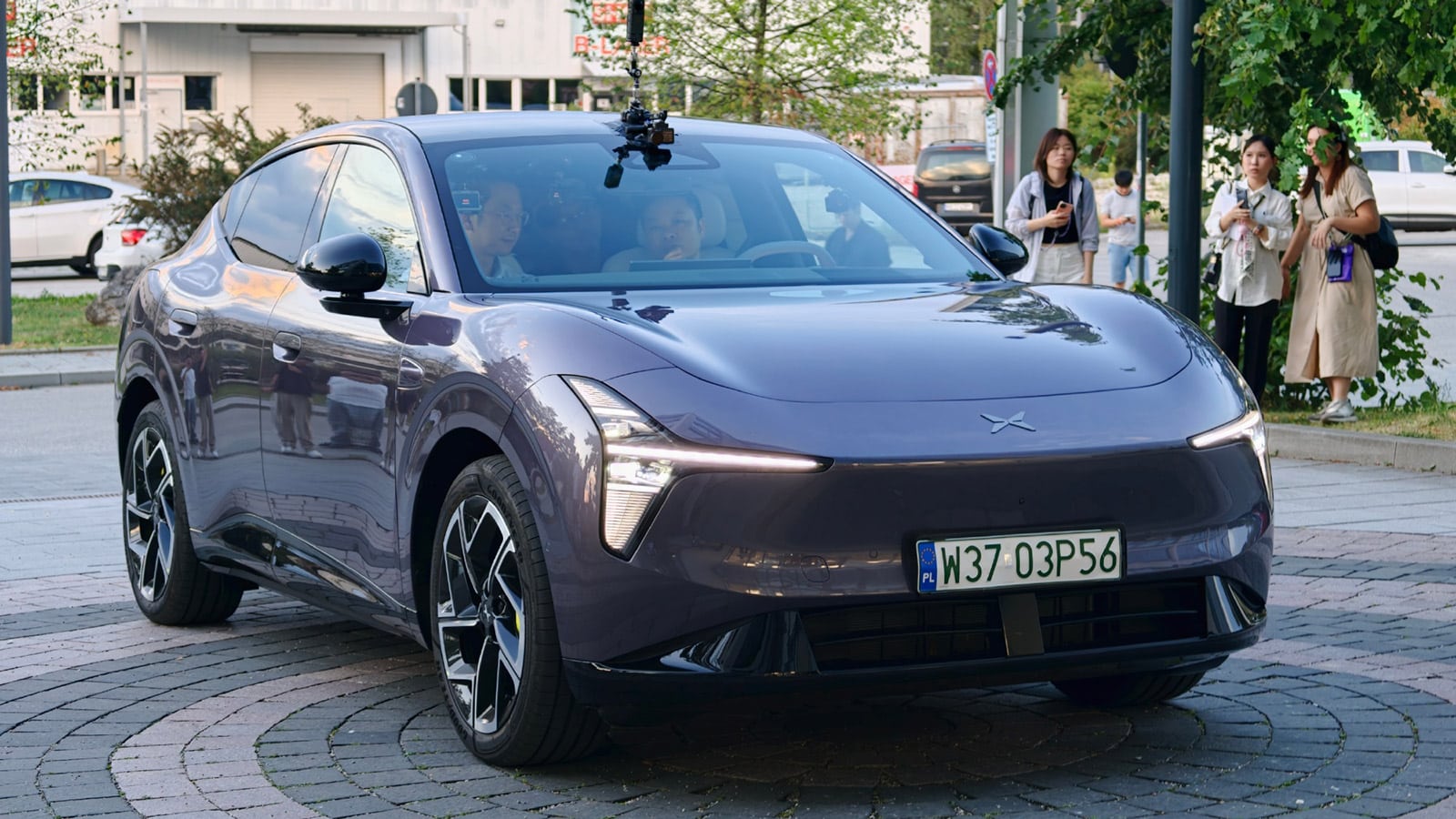
An Xpeng Mona L03 undergoing autonomous driving tests in Germany. Credit: Xpeng
- Xpeng completed local testing of VLA 2.0 in Germany, paving the way to bring its smart-driving capabilities from China to global markets in 2027.
- VLA 2.0 has been live in China for nearly half a year, with smart driving surpassing human driving at scale.
Xpeng (NYSE: XPEV) has completed European localization testing of its second-generation Vision-Language-Action (VLA) model in Germany, paving the way to bring its smart-driving capabilities from China to global markets in 2027.
Xpeng vice president Yu Tao said on Weibo on Wednesday that the company’s chairman and CEO He Xiaopeng completed the local acceptance test for the second-generation VLA model of Xpeng’s Turing AI smart driving system, or NGP, in Germany on July 14.
The test marks a key step for Xpeng in bringing advanced driver assistance to Europe. Mr. He said that globalizing intelligent assisted driving must first make safety the top priority, and that he hopes Xpeng will become the first Chinese company to bring advanced intelligent assisted driving to Europe.
The system, trained on Chinese road conditions, has already shown a high level of adaptability and stability in Europe, and can handle a variety of complex local urban driving scenarios with almost no additional data training, according to Yu.
The system can handle urban arterial roads, narrow alleys and high-curvature turns, while also autonomously navigating around obstacles and smoothly yielding to pedestrians.
Yu also said the second-generation VLA can already recognize complex European road signs, understand local traffic rules and right-of-way systems, and adapt to European users’ driving habits.
Xpeng chairman and CEO He Xiaopeng (center) poses for a photo with his team next to an autonomous driving test vehicle. Credit: Xpeng
The acceptance test also provides a technical backdrop for Xpeng’s upcoming global launch event for the Mona L03 in Munich.
The company previously said the Mona L03 will be launched globally on July 16, and that it will unveil the latest developments in its physical AI strategy and technology at the same event.
Xpeng’s decision to hold the launch event in Germany is part of the company’s globalization strategy. Mr. He previously said that the auto industry was born in Germany, and that Xpeng hopes to bring mature smart mobility experiences to global users.
The Mona L03 will be Xpeng’s first global model to launch simultaneously in China and Europe. The company said the SUV (sport utility vehicle) was developed to global standards and is planned for markets in 64 countries and regions.
The model began pre-sales in China on July 2, with a pre-sales price range of 143,800 yuan ($21,300) to 165,800 yuan. Xpeng positions it as “the first smart and stylish SUV for young people,” targeting young consumers and families.
The Mona L03 offers both battery electric vehicle (BEV) and extended-range electric vehicle (EREV) powertrains, continuing Xpeng’s “dual-powertrain” strategy to cover consumers with different range preferences.
Smart driving is the core selling point Xpeng hopes will set the model apart. All Mona L03 variants are equipped with the company’s in-house developed Turing AI chip, with computing power of up to 1500 TOPS, and support the second-generation VLA system.
The Max variant uses a single chip with computing power of 750 TOPS and is equipped with the distilled version of the second-generation VLA. The Ultra SE variant uses dual chips and supports the full version of the second-generation VLA, further bringing advanced driver-assistance hardware into the mass-market price range.
Liu Xianming, head of Xpeng’s smart driving business, said Wednesday on X that VLA 2.0 has been live in China for nearly half a year, with assisted-driving mileage share reaching 50.44 percent.
He said this is the first time Xpeng has seen smart driving surpass human driving at scale.
He also acknowledged that the same model does not yet get every scenario right in Europe, but said it can already handle most urban scenarios with surprising stability.
He compared the adaptation process to an experienced driver entering a new country and quickly learning local road rules.
“The same model, from China to Europe” is the core message Xpeng is trying to convey. If the capability can be commercialized in Europe, it would help the company turn its smart-driving edge in China into a differentiated selling point overseas.
The progress is also tied to Xpeng’s broader technology narrative. The company defines its overall autonomous driving strategy as physical AI, with the core being the development of proprietary multimodal foundation models from scratch and the extension of the same technology base to robotaxis, humanoid robots and other embodied AI scenarios.
Liu said Xpeng has deployed the same model to its L4 robotaxi fleet in China and has started internal testing this month.
That means VLA 2.0 is not only an assisted driving system for passenger vehicles, but is also seen by the company as a foundation for higher-level autonomous driving capabilities.
Wall Street has previously viewed VLA 2.0 as an important variable in the revaluation of Xpeng’s technology. Morgan Stanley once called the system “a bold leap forward,” and said it would help convince investors that Xpeng is more than just a car company.
Xpeng has set the global launch event for the Mona L03 SUV at 7:00 pm Beijing Time on July 16, or 1:00 pm local time in Munich.
