

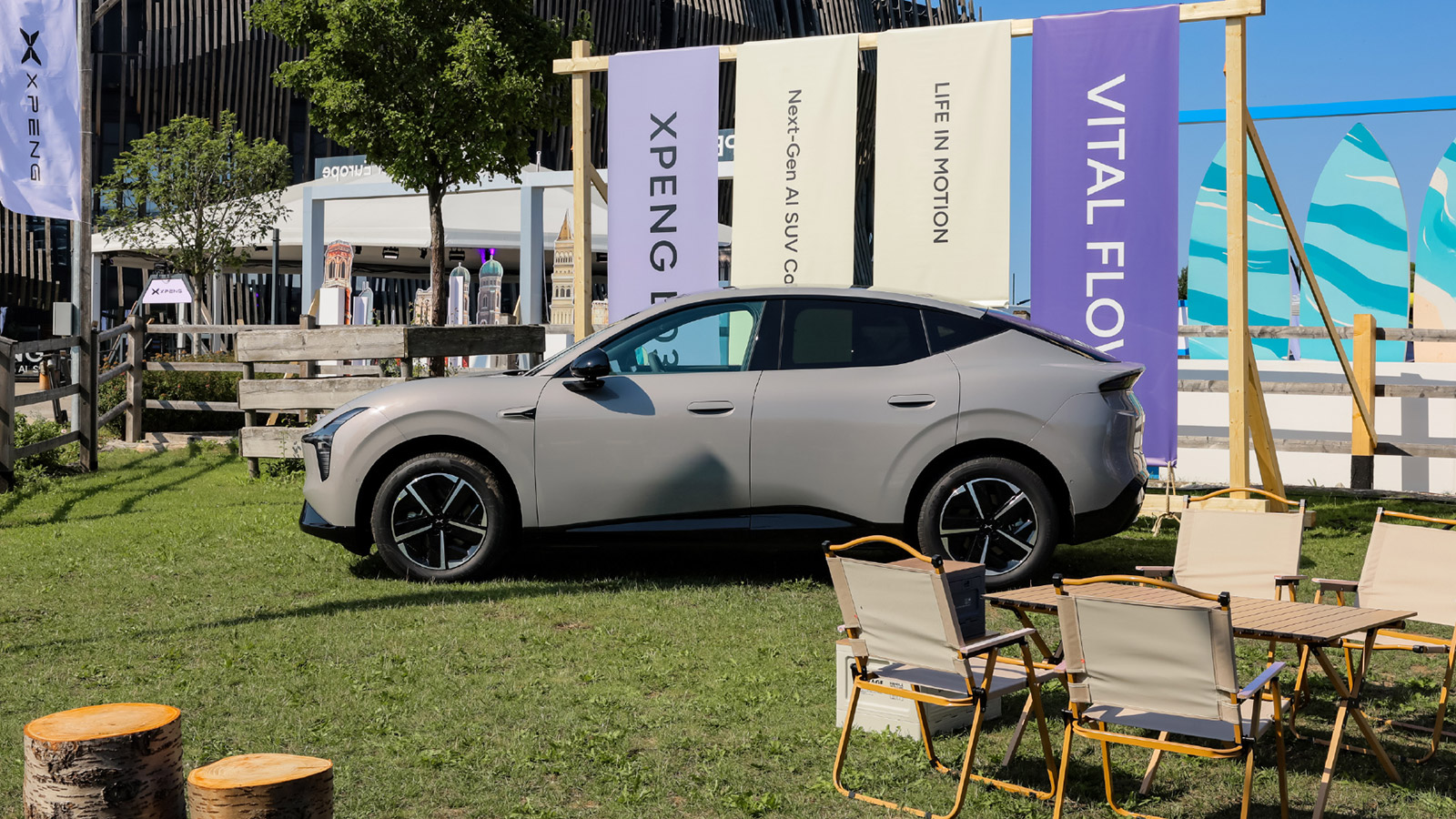
Xpeng Mona L03. Credit: Xpeng
- The Xpeng Mona L03 starts at 123,800 yuan ($18,300) in China and is offered in both BEV and EREV versions.
- The SUV will be sold in 64 overseas markets as Xpeng more closely integrates its low-cost products, intelligent-driving technology and European localization strategy.
Xpeng (NYSE: XPEV) has officially launched the Mona L03 SUV (sport utility vehicle), seeking to build a new global sales pillar through more aggressive pricing, dual powertrain options and high-computing-power driver-assistance features.
The Chinese electric vehicle (EV) maker held the Mona L03’s global launch event in Munich, Germany, on Thursday. The model is available in 9 variants in China, priced from 123,800 yuan ($18,300) to 156,800 yuan.
In Europe, the L03 BEV starts at €35,600 ($40,770).
The Mona L03 is offered in both battery electric vehicle (BEV) and extended-range electric vehicle (EREV) versions, extending Xpeng’s dual-powertrain strategy.
Both powertrain versions start at 123,800 yuan in China, with deliveries of the EREV version scheduled to begin in late August.
The official starting price is 20,000 yuan below the pre-sales price of 143,800 yuan announced on July 2. The price reduction suggests Xpeng is seeking to accumulate orders quickly and establish scale in the fiercely competitive mainstream SUV market.
In China, the Mona L03 will compete with the BYD (HKEX: 1211) Yuan Plus, the Leapmotor (HKEX: 9863) C10 and other similarly priced compact SUVs.
Xpeng is seeking to differentiate the model from rivals that emphasize range or value for money through its design, powertrain options and driver-assistance computing power.
The BEV version offers CLTC ranges of 525 kilometers and 625 kilometers, with energy consumption of 11.9 kWh per 100 kilometers. It can accelerate from 0 to 100 kilometers per hour in as little as 6.6 seconds.
The version supports 3C fast charging, with some variants taking 19.1 minutes to charge from 10% to 80%.
The EREV version is equipped with a 37.2-kWh battery, offering a CLTC battery-only range of 315 kilometers and a combined range of as much as 1,330 kilometers. It has WLTC combined fuel consumption of 5.16 liters per 100 kilometers and can accelerate from 0 to 100 kilometers per hour in 6.8 seconds.
The dual-powertrain strategy will help Xpeng address differences in energy infrastructure and driving habits across markets. The BEV version is primarily aimed at urban users with convenient access to charging, while the EREV version targets consumers who remain concerned about charging availability and long-distance travel.
That arrangement is particularly important in Europe. Charging networks, electricity prices and long-distance travel requirements vary significantly across European countries, meaning a BEV-only offering could limit the model’s appeal in some markets.
Xpeng said the Mona L03 is its first global model to be launched simultaneously in China and Europe and will eventually be sold in 64 overseas markets.
The model uses a single-motor rear-wheel-drive layout and has been adapted to the regulations and driving environments of different markets.
Intelligent driving is another area in which Xpeng aims to establish an advantage. All Mona L03 variants are equipped with the company’s in-house-developed Turing AI chips. The Max version uses a single chip with 750 TOPS of computing power and features a distilled version of the second-generation Vision-Language-Action (VLA) system.
The Ultra SE version uses 2 Turing AI chips with combined computing power of 1,500 TOPS and supports a more fully featured version of the second-generation VLA system.
This means Xpeng is bringing driver-assistance hardware previously found mainly in more expensive vehicles to the mass market at around 150,000 yuan.
Xpeng also announced that its overseas vehicles will integrate the Google Maps Auto SDK, with the Mona L03 becoming the first model to feature it.
Users will be able to access Google-provided maps, real-time traffic information, place searches and route planning directly through an in-car interface designed by Xpeng.
Google Maps’ data services will also support Xpeng’s NGP (Next Generation Pilot) and Xpilot Assist driver-assistance systems.
For Xpeng, which is preparing to bring its second-generation VLA system to Europe, mapping and navigation data are important foundations for localization.
The company previously completed European localization testing of its second-generation VLA system in Germany. Xpeng said the same model can already recognize European traffic signs, understand some right-of-way rules and handle narrow roads and complex parking environments.
Still, deploying a driver-assistance system trained in China in Europe will require Xpeng to address different national regulatory requirements, liability frameworks and levels of consumer acceptance.
The Mona L03 is also part of Xpeng’s broader European expansion. The company has established a European research and development center in Munich and begun localized production in Austria, while working with suppliers including Bosch and BASF.
Xpeng said it is working with more than 150 dealers to expand its presence in Europe and plans to build more than 1,000 self-operated supercharging stations across 13 European countries. Its X-Energy megawatt charging and energy-storage stations are also set to enter Europe.
A broader overseas presence could help Xpeng reduce its reliance on China, but it will also require greater investment in sales networks, after-sales services and brand building.
Compared with established European automakers, Xpeng remains at an early stage in terms of local brand awareness and service coverage.
The Mona L03 arrives as Xpeng’s sales begin to recover. The company delivered 40,126 vehicles in June, up 15.9% year-on-year and marking its highest monthly total so far in 2026.
Xpeng’s cumulative global deliveries have also surpassed 1,200,000 vehicles. However, its deliveries in the first half of the year still declined from a year earlier, making the sustained ramp-up of new models important to the pace of its sales recovery in the second half.
The Mona lineup has already demonstrated that lower-priced products can significantly expand Xpeng’s customer base. Its first model, the Mona M03 sedan, delivered 175,689 units in 2025, accounting for about 41% of the company’s annual deliveries and making it Xpeng’s most important sales contributor.
Xpeng Mona M03 Monthly Deliveries 2024-2026
Month
2024
2025
2026
January
15,225
6,722
February
15,312
4,375
March
16,593
9,335
April
14,210
13,699
May
10,900
14,160
June
14,111
14,197
July
15,758
August
517
15,334
September
10,023
14,546
October
10,203
16,424
November
11,962
14,886
December
15,904
12,390
Xpeng Mona M03 monthly deliveries
2024
2025
2026
However, the Mona M03’s growth momentum has slowed this year. Xpeng needs the L03 to attract consumers who prefer SUVs while avoiding excessive overlap in pricing and positioning with its existing G-series models.
Deutsche Bank analysts previously estimated that the Mona L03 could achieve average monthly sales of about 12,500 units and replicate the Mona M03’s early success.
An official price below the pre-sales level may further increase the likelihood of that forecast being achieved.
Xpeng completed local testing of VLA 2.0 in Germany, paving the way to bring its smart-driving capabilities from China to global markets in 2027.
($1 = 6.7688 yuan, $1 = 0.8733 euros)
